

Agri-PDB Platform at COP17: The Role of National Public Development Banks in Land Restoration
Agri-PDB Platform at COP17: The role of national public development banks in land restoration
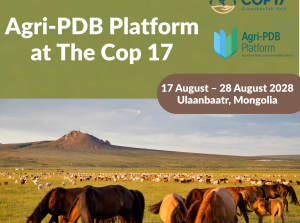
August 17–28, 2026 | Ulaanbaatar, Mongolia
Introduction
Climate and biodiversity COPs, together with other international fora, are structured primarily around multilateral development banks (MDBs), UN agencies and global climate funds. National public development banks (PDBs) are rarely represented in these discussions, despite financing an estimated two-thirds of formal agricultural credit worldwide (approximately up to $1.4 trillion, per INSE/AFD research). PDBs sit at the point where national policy — including countries’ Nationally Determined Contributions (NDCs) — is translated into domestic lending, credit lines and guarantees. The Agri-PDB Platform was present at COP17 to address this gap, bringing the operational experience of national Agri-PDBs into a forum where their role in financing agricultural and land-restoration commitments is otherwise largely absent from the discussion.
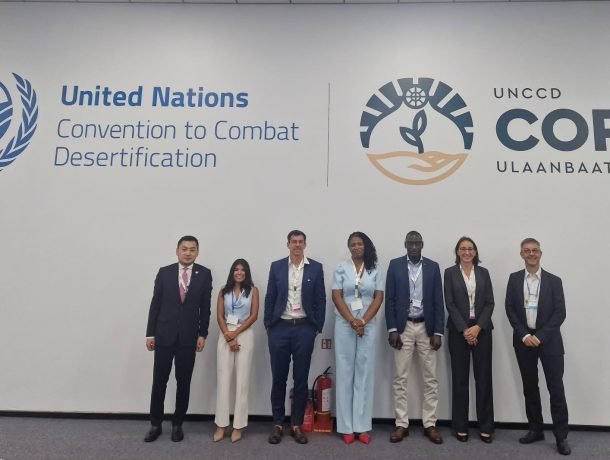
On the margins of the UNCCD COP17 in Ulaanbaatar, the Agri-PDB Platform convened a side event on the role of national Public Development Banks (PDBs) in restoring agricultural lands and preventing degradation. The session brought together farmers’ organisations, regional banking networks, national development banks and international partners to examine how restoration and resilient agriculture can be financed at scale.
The discussion opened from a shared premise: land degradation and desertification are driven as much by unsustainable land use and agricultural practices as by drought, and closing the financing gap for agroecology, sustainable livestock, agroforestry and soil regeneration requires institutions positioned close to farmers, herders and local water users. As state-owned institutions mandated to serve national policy objectives rather than to maximise profit, PDBs are able to sustain credit during crises, de-risk rural lending to mobilise private capital, and combine finance with technical assistance — positioning them as central, rather than peripheral, actors in restoration financing.
The event was organised by the Agri-PDB Platform, launched in 2021 by IFAD and the French Development Agency (AFD) and hosted by IFAD, with the mandate of supporting public development banks in financing green and inclusive food systems through knowledge sharing, peer exchange and technical support.
Land Restoration as an Investable Proposition
A recurring message was that financing decisions, more than political declarations, will determine whether land restoration happens at scale. This requires shifting how restoration is financed: blending concessional and commercial capital so that soil health becomes bankable, lending against future yields rather than land title, and aggregating smallholder producers into portfolios that are visible to capital markets. National and regional public development banks, with their local-currency lending, rural risk pricing and long investment horizons, were identified as the institutions best placed to convert national land and drought-resilience targets into investable pipelines.
This framing extended to the banking sector’s own incentives: healthy soils drive farm output, and farm output drives loan repayment capacity, meaning restoration finance is as much a matter of portfolio quality as of environmental policy. Climate-smart agriculture, agroforestry, sustainable land and water management, and resilient value-chain infrastructure were highlighted as priority areas where finance can convert restoration from an environmental objective into a productive rural investment.
Barriers to Restoration Finance
Across regions, participants converged on a similar set of structural barriers limiting the flow of finance to land restoration:
- Insecure land tenure, which discourages long-term investment in soil health and disproportionately affects women farmers and pastoral communities. In some countries, a significant share of farmers remain landless or lack formal stewardship rights.
- Reliance on land-based collateral, which excludes producers who cannot prove formal title and limits access to finance for smallholders, cooperatives and women-led enterprises.
- A mismatch between loan tenors and restoration timelines: agricultural lending in several regions is typically structured around 1 to 18-month cycles, while restoration and agroforestry investments require payback periods of 10 to 15 years.
- Limited concessional or blended capital to absorb large-scale climate finance instruments, combined with the technical complexity of direct accreditation to funds such as the Green Climate Fund.
- Fragmented, localised climate-risk data, which constrains financial institutions’ ability to underwrite climate-smart agricultural lending with confidence.
- Insufficient technical knowledge, on the part of producers, of the agroecological practices and transition processes needed to restore degraded land.
- The absence of investable project structures: capital availability was repeatedly described as less of a constraint than the lack of standardised, bankable project pipelines.
Instruments and Approaches – Potential Solutions
A range of concrete instruments and approaches were shared as ways to address these barriers:
- Guarantee mechanisms and credit guarantees that de-risk lending to smallholders and agribusinesses, unlocking domestic and international capital that would otherwise remain on the sidelines.
- Blended-finance vehicles combining concessional and commercial capital, offering longer tenors, lower interest rates and repayment schedules aligned with agricultural production cycles.
- Alternatives to land-based collateral, such as warehouse receipts, and joint land titling for spouses to improve women’s access to credit.
- Non-repayable, concessional support at the point of delivery to producers, where the public benefits of restoration — water access, soil health, adaptation — do not generate sufficient cash flow for the investment to be repayable by the farmer directly.
- Separation of environmental compliance from formal land ownership, through dedicated environmental registries, allowing credit to be conditioned on environmental regularisation independent of unresolved tenure disputes.
Standardisation of contracts, technical criteria and risk allocation by type of intervention, applying an infrastructure-finance logic to restoration so that projects do not need to be structured from scratch each time.
Digital platforms and data tools that help financial institutions assess the environmental implications of a project — its adaptation, biodiversity and carbon impacts, and trade-offs between them — to strengthen investment decisions and reduce environmental risk.
Regulatory and central bank measures, including mandated lending quotas for agriculture and micro, small and medium enterprises, and the integration of climate risk into prudential frameworks.
Country and Regional Examples of National Development Banks (NDBs)
Participants illustrated these approaches with a range of national programmes: dedicated funds channelling blended finance to herders, cooperatives and rural SMEs to support rangeland restoration; national development bank programmes combining grants, credit lines and equity to finance native forest protection and climate-resilient production systems, delivering water-access infrastructure and productive systems at territorial scale; and national agricultural bank programmes supporting irrigation modernisation, soil conservation, reforestation and payment-for-ecosystem-services partnerships. Across these examples, restoration was consistently described not as a standalone environmental initiative, but as one already embedded — often without a single unifying label — within existing water, irrigation, soil conservation and climate-resilience financing lines.
A shared dataset covering 69 public development banks, developed to map the correlation between countries’ national climate commitments and what their PDBs are actually financing, was presented as a resource for identifying these existing efforts and supporting their replication and scale-up across regions.
Land Tenure and Equitable Benefit-Sharing
Discussion returned repeatedly to the question of how PDBs can integrate secure land rights and equitable benefit-sharing into their financing criteria, so that scaling up restoration investment does not create new pressure on smallholders, women and pastoral communities. National approaches vary widely — from dual systems combining a one-time land allocation to citizens with separate use-based licensing for agricultural or rangeland management, to the separation of land ownership from environmental compliance through dedicated registries that allow credit to proceed independently of unresolved ownership status. There was broad agreement that solutions in this area are necessarily country-specific, and that government policy — not PDBs alone — has a central role to play in resolving tenure insecurity.
Conclusion
The session confirmed a shared view across regions and institutions: financing land restoration at scale requires public development banks — as the institutions closest to farmers, herders and local financial systems — to be equipped with risk-sharing tools, standardised project structures, blended capital and peer knowledge to convert national restoration priorities into bankable pipelines. The Agri-PDB Platform reaffirmed its role in supporting this process and in continuing engagement with national and regional partners, including civil society, ahead of COP18.
Similar articles