

The Agri PDB Platform at COP17
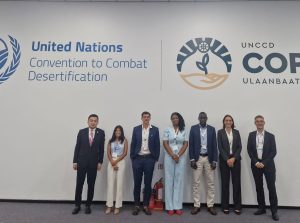
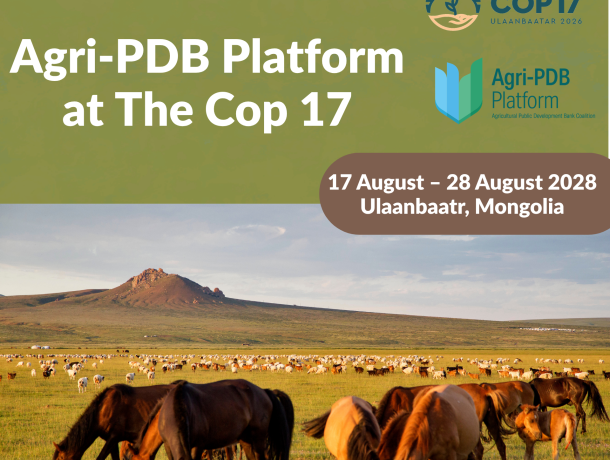
The 17th Session of the Conference of the Parties (COP17) to the United Nations Convention to Combat Desertification (UNCCD) will take place in Ulaanbaatar, Mongolia, from 17–28 August 2026, under the theme “Restoring Land, Restoring Hope.” The COP will bring together States Parties, international organizations, public development banks, scientific actors, civil society, youth, Indigenous peoples, pastoral communities, and the private sector around a central goal: restoring land to strengthen the resilience of territories and populations. COP17 brings global attention to the realities facing dryland communities, while sharing its practical experience in sustainable rangeland management, ecosystem restoration, and community-led resilience.
The Agri PDB Platform is committed to highlighting the role of a key actor in land restoration efforts: national public development banks, particularly those working in agriculture.
How do PDBs and the Agri PDB Platform contribute to Land Restoration ?
PDBs: game changers for the COP17 goal
Worldwide, PDBs lead initiatives on land restoration and agricultural transformation, strengthening communities’ and ecosystems’ resilience[i].
For instance, in 2024 the Uganda Development Bank directed 18% of its agricultural financing toward water management and irrigation infrastructure, alongside climate-smart practices such as mulching, organic manure, and afforestation1. Similarly, NABARD in India supports land restoration through large-scale watershed development programmes and soil rehabilitation initiatives, with 3,747 watershed projects financed and cumulative disbursements exceeding ₹2,245 crore (approximately USD 256 million).²
Agri PDB Platform: A Central initiative for food systems transformation
Restoring land and transforming agricultural systems requires coordinated action across public actors, the private sector, producer organizations, and civil society.
The Agri PDB Platform, as a global network of PDBs, strengthens the banks’ ability to finance the transition of food systems, particularly where access to finance remains limited, through peer-to-peer knowledge exchange, training, and capacity building.
Agroecology Transition and ILSA Programme
The Agri PDB Platform supports the agroecology transition through the EU ILSA programme. Through ILSA, the Platform delivers trainings, and equips PDB staff with practical tools — such as the Business Agroecology Criteria Tool (B-ACT) — to operationalize agroecology. It also facilitates peer-to-peer exchanges between member banks, to advance agroecological and climate-resilient rural finance.
Sustainable Livestock and FSIP
PDBs have real potential to finance and promote investments in value chains that can otherwise drive land degradation, livestock being a prime example, through approaches like forest management integrated with livestock production. Within the Global Environment Facility (GEF)-funded Food Systems Integrated Program (FSIP), the Agri PDB Platform supports country-level livestock projects by connecting national PDBs to the programme, and offering them capacity-building, practical tools, and peer-to-peer learning opportunities. This positions PDBs as strategic actors in embedding long-term institutional support for sustainable livestock transformation within the 32 FSIP countries.
Farmland Restoration and RAIZ Initiative
As a partner of the FAST Partnership, the Agri PDB Platform explores the Resilient Agriculture Investment for Net-Zero land degradation (RAIZ) initiative, which aims to help governments and financial partners co-design financing mechanisms which unlock blended investments for farmland restoration. The RAIZ initiative places national PDBs at the centre of NDC implementation and recognizes them as key actors in translating climate commitments into action.
Tools and Methodologies
The Platform supports sustainable food systems transformation by putting practical tools in the hands of PDBs. One example is the ABC-Map, a tool developed to assess the climate, biodiversity, and carbon impact of agricultural investments, helping banks make more informed decisions that support investments in land preservation. Examples of this are already underway with MAIIC in Malawi and FINAGRO in Colombia.
Discovering PDBs’ potential through Strategic Research
The Agri PDB Platform is investing in research to close the knowledge gap on Agri-PDBs contributions for agriculture and food systems transformation, providing evidence on PDBs’ central role within the international development finance architecture.
What value is the Agri PDB Platform bringing to the COP17?
Side Event “Restoring Agricultural Lands and Preventing Degradation: Financing Solutions through Public Development Banks”
The Event will explore PDBs role in financing sustainable agricultural practices for soil health, biodiversity, and land restoration, to showcase how banks implement them at a country level. The exchange will highlight what makes restoration projects bankable for private investors, and strengthen partnerships among governments, PDBs, local communities.
Advocacy and Awareness Raising
The Agri PDB Platform will enrich COP17 discussions, by showcasing PDBs’ perspectives and successful initiatives on land restoration and agricultural transformation.
The Agri PDB Platform will advocate for PDBs’ approaches to be scaled up and replicated — with partners playing a key role in this effort.
Side Event
Restoring Agricultural Lands and Preventing Degradation: Financing Solutions through Public Development Banks
Co-organized by the Agri PDB Platform, UNCCD, AFD, APRACA, and AFRACA
When: 27 August, 9:30–11:00 AM
Find out more about the Programme
1 Uganda Development Bank Limited. (2024). Powering Uganda’s economy: Creating a sustainable future for all—Annual report 2024.
2 National Bank for Agriculture and Rural Development. (2025). Annual report 2024–25. NABARD.
Similar articles