

Stabilizing Food Systems During El Niño: The Countercyclical Role of Multilateral and Public Development Banks
As a strong El Niño event continues to affect agricultural systems worldwide and forecasts point to significant impacts extending into 2027, the Agri-PDB Platform, in collaboration with IFAD, convened a webinar bringing together experts from the World Meteorological Organization, the Inter-American Development Bank, and the Colombian Fund for Financing the Agricultural and Livestock Sector (FINAGRO), to discuss the implications for food security, rural livelihoods, and agricultural finance. With the participation of over attendees, among which 59 PDBs representatives from 19 countries, the session showcased practical approaches to climate risk management, contingent financing, and resilience-building, reaffirming the important role of PDBs and MDBs in supporting farmers and agrifood systems before, during, and after climate shocks.
Stabilizing Food Systems During El Niño: The Countercyclical Role of Multilateral and Public Development Banks
13 October 2026 | Online
Introduction
With a strong El Niño event already affecting agricultural systems across multiple regions and forecasts pointing to continued impacts in 2027, concerns are growing over risks to food security, rural livelihoods, and agricultural production worldwide. , the Agri-PDB Platform, in collaboration with IFAD, convened a webinar bringing together experts from the World Meteorological Organization (WMO), the Inter-American Development Bank (IDB), FINAGRO, to examine the scale and implications of the ongoing El Niño, and the role that Multilateral Development Banks (MDBs) and Public Development Banks (PDBs) can play in strengthening food systems preparedness, response, and resilience to climate shocks.
Opening the session, Nigel Brett, Director of IFAD’s Production, Markets and Infrastructure Division, highlighted that climate shocks such as El Niño can have far-reaching consequences across food systems, affecting agricultural production, rural livelihoods, and financial stability. He also stressed the importance of strengthening preparedness and ensuring that financial institutions are equipped to support vulnerable farmers and agrifood systems.
In this context, he underscored the critical role of MDBs and PDBs in helping countries anticipate, absorb, and recover from climate-related shocks through:
- emergency financing;
- risk-sharing instruments;
- long-term investments that enhance resilience and reduce future vulnerability.
El Niño outlook and its implications for rural livelihoods, agri-food systems, and agricultural finance
Presenting the latest climate outlook, Dr. Arun Kumar and Sebastian Grey from the World Meteorological Organization (WMO) highlighted that the current El Niño is already among the strongest on record and is expected to remain active into 2027. Evidence reveals that El Niño impacts:
- are already being observed across regions, including shifts in rainfall patterns, prolonged droughts in some areas, increased flood risks in others, and disruptions to agricultural production and food systems.
- vary significantly across countries and seasons, underscoring the importance of relying on regional and national climate forecasts rather than global averages.
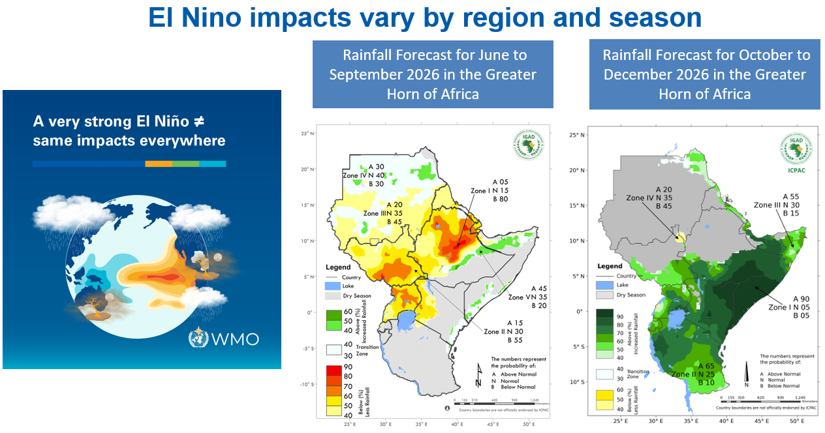
A key message from WMO was that El Niño is unfolding against the backdrop of record global temperatures. Combined with extreme heat climate shocks can act as a risk multiplier, increasing water stress, reducing crop yields, affecting livestock production, and putting additional pressure on vulnerable populations.
Finally, drawing on lessons from previous El Niño cycles, the presenters emphasized the value of early warning systems and anticipatory action in reducing losses and supporting more effective responses.
Building on this outlook, Olivier Pierard, Consultant to the Agri-PDB Platform and Expert in Climate Finance, examined what a prolonged El Niño could mean for Public Development Banks and agricultural finance institutions. While climate forecasts cannot predict the precise local impacts, he emphasized that agricultural lenders should already be preparing for the potential financial consequences of climate-related disruptions.
His presentation highlighted how climate shocks can affect development banks through multiple channels. Beyond direct damage to crops, livestock, irrigation systems, and other agricultural assets, El Niño can weaken borrowers’ repayment capacity, increase non-performing loans, generate liquidity pressures, affect insurance and reinsurance markets, disrupt financial operations, and even create broader fiscal pressures that ultimately affect financial institutions.
Against this backdrop, Pierard stressed the importance of acting before impacts materialize. He outlined six immediate priorities for agricultural development banks, as presented in the slide below:
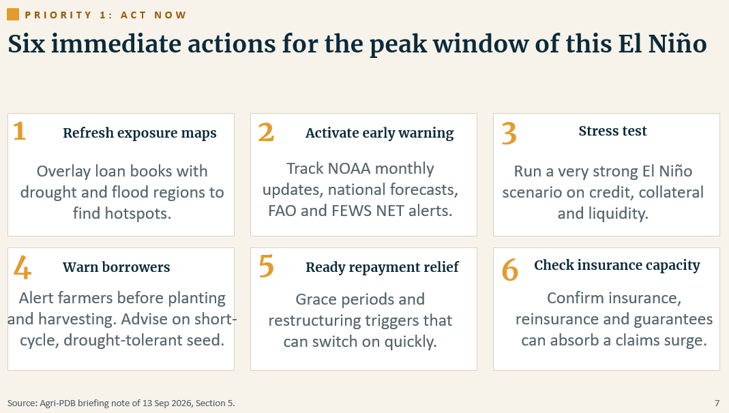
He underscored that anticipating risks and preparing response mechanisms in advance can significantly improve institutions’ ability to support farmers during periods of climate stress.
Finally, he encouraged institutions to stress-test not only their credit portfolios, but also collateral values and liquidity positions simultaneously. Such forward-looking assessments, he argued, can help identify vulnerabilities early and enable financial institutions to remain operational and continue supporting agrifood systems even under severe climate scenarios.
Perspectives from Development Finance Institutions: From Preparedness to Action
Inter-American Development Bank (IDB): Preparing Liquidity Before Disasters Strike
Fernando De Olloqui, Lead Financial Markets Specialist at IDB, argued that climate shocks increasingly expose a critical gap between the speed at which disasters generate impacts and the speed at which financial resources reach affected communities.
To address this challenge, the IDB is advancing an integrated disaster risk financing approach that combines prevention and resilience investments with risk retention and risk transfer instruments. Within this framework, particular attention was given to the Bank’s innovative Global Credit Program (GCR) model, which combines ex-ante contingent financing with financial intermediation through Public Development Banks and other financial institutions.
The model establishes pre-arranged contingent credit lines that can be rapidly activated once predefined trigger conditions are met, allowing liquidity to be channelled quickly to affected beneficiaries through existing financial institutions. This approach not only improves the speed of recovery, but also expands the reach of emergency financing through national development finance systems.
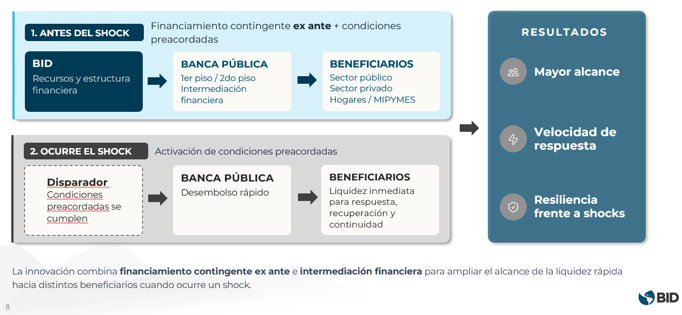
Experience from Ecuador pilot highlighted how pre-arranged contingent financing can strengthen local response capacity and could provide a blueprint for future applications in the agricultural sector, allowing PDBs to deliver rapid liquidity to farmers, agribusinesses, and SMEs following climate shocks.
FINAGRO: Managing Climate Risk Across the Entire Agricultural Finance Cycle
Presenting the experience of FINAGRO, Risk Director Adriana Pachón Ruiz emphasized that effective countercyclical action requires an integrated risk-management architecture capable of supporting producers, financial institutions, and public policy objectives throughout the entire risk cycle.
In response to recurrent El Niño and La Niña events, FINAGRO has developed a risk-management framework structured around five complementary functions: understanding risk, reducing risk, transferring risk, absorbing shocks, and supporting recovery. This architecture combines agroclimatic information systems and portfolio monitoring with development finance, climate adaptation investments, agricultural insurance, guarantee mechanisms, liquidity support, loan restructuring, and recovery finance.
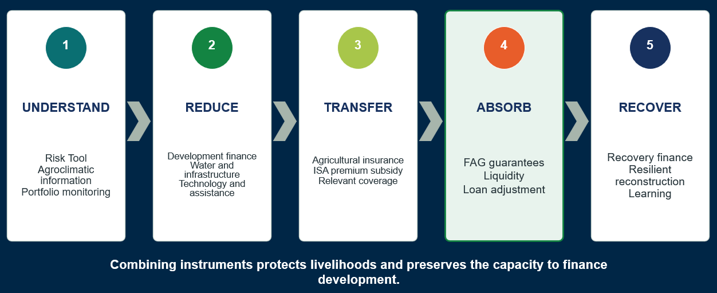
A recurring theme throughout the presentation was that the response begins before the shock and continues well afterwards.
- Prior to climate events, efforts focus on monitoring exposure, financing adaptation measures, and expanding insurance coverage.
- During a crisis, priority shifts to maintaining liquidity, sustaining credit flows, activating guarantees, and adjusting loan conditions where cash flows are affected.
- Following a shock, financing is directed toward productive recovery and resilient reconstruction, ensuring that recovery investments reduce future vulnerability rather than simply rebuilding existing risks.
As on one hand IDB’s contingent financing model ensures rapid availability of liquidity through development finance institutions when shocks occur, FINAGRO’s integrated risk-management architecture demonstrates climate risk management is embedded across their entire portfolio and operational cycle. Ultimately, both examples highlight the importance of moving from reactive disaster response to proactive financial preparedness.
Interactive Dialogue and Discussion
The Q&A discussion highlighted that the financial instruments needed to translate preparedness into action remain insufficiently developed. In particular, limited insurance coverage and the lack of scalable risk-transfer mechanisms continue to constrain the ability of financial institutions and farmers to anticipate and absorb climate shocks.
Panellists emphasized that strengthening resilience will require a shift from reactive crisis response to proactive financial preparedness.
This includes:
- expanding contingent financing mechanisms;
- integrating climate information into financial decision-making;
- ensuring that Public Development Banks have the tools and liquidity needed to respond rapidly when shocks occur.
The discussion also underscored that many of the approaches presented during the webinar could be adapted beyond agriculture to support resilience across other climate-sensitive sectors.
Conclusion
The webinar underscored that climate shocks are increasingly recurrent risks that require proactive financial preparedness. Speakers showcased practical approaches that can help MDBs and PDBs anticipate shocks, maintain financial flows, and support recovery.
A key point which emerged is that as climate uncertainty continues to grow, financial instruments need to act on that climate information before crises occur.
Similar articles