

2nd Working Group on Impact key performance indicators trends and emerging challenges
The working group on impact indicators held its second sessions exploring current trends and emerging challenges related to the development of key performance indicators. Through the experience of Mali’s National Agricultural Development Bank (BNDA) and Mexico’s Trust Funds for Rural Development (FIRA), participants gained a deeper understanding of how impact indicators (economic, social, and environmental) are collected, centralized, and used by both PDBs in the context of governance and decision-making, thanks to a structured system of controls and monitoring.
2nd Working Group on Impact key performance indicators trends and emerging challenges
31 March-29 April 2026 | Online
Introduction
The working group on key performance indicators continued with two additional sessions, in French and English, dedicated to current trends and new challenges. Organised by the Agri-PDB Platform, in collaboration with the German development bank KfW, Findev Advisory, and DJOSSOUR Formation & Conseil, the sessions highlighted that impact KPIs are no longer used only for reporting purposes; they are increasingly becoming strategic management tools for decision-making, climate risk anticipation, and access to sustainable finance. It combined expert presentations, bank testimonies, live poll, and an interactive Q&A.
Setting the scene for impact measurement in agri-finance
Nejib Ajili, Monitoring & Evaluation and Sustainable Agriculture Expert and CEO of DJOSSOUR Training & Consulting, and Nabil Kesraoui, Sustainable Finance Expert and CEO of Findev Advisory set the scene providing insights into: (i) the emerging trends in impact across economic, social and environmental dimensions; (ii) how impact KPIs relate to major transitions affecting agricultural finance, including financial inclusion, agroecology, biodiversity, climate adaptation, and climate-smart agriculture; and (iii) ways to connect KPIs with financial innovation, especially green, social, blue, sustainability, and resilience finance instruments.
Their key messages included:
| Theme | Key message |
| Strategic role of KPIs | Impact KPIs should move from donor-driven compliance tools to operational tools used in committees, dashboards, and portfolio management. |
| Structural drivers | Four major forces are accelerating the use of impact KPIs: budget pressure, climate and environmental risk, access to finance, and internal coherence across bank departments. |
| Economic dimension | Banks should measure who is reached, how many jobs are created or maintained, whether agricultural incomes improve, and whether financing transforms productivity and value chains. |
| Social dimension | Disaggregated data is essential to assess women, youth, rural and underserved populations, new borrowers, access to services, and food security outcomes. |
| Environmental dimension | Environmental KPIs such as avoided emissions, hectares under sustainable practices, water efficiency, renewable energy, and biodiversity proxies can serve both as impact indicators and early-warning risk signals. |
| Emerging trends | Three impact trends were stressed: agroecology and biodiversity, climate-smart agriculture focused on water, and carbon mitigation through renewable and low-carbon investments. |
| Climate finance | Credible, measurable, and externally verifiable KPIs are increasingly required to unlock green finance, blended finance, climate funds, and thematic bonds. |
| Practical approach | Banks were encouraged to start with a limited number of materials on KPIs, document methodologies in a KPI dictionary, and progressively strengthen data systems and digitalization. |
Experience of the Mali’s National Agricultural Development Bank (BNDA) and Mexico’s Trust Funds for Rural Development (FIRA)
Representing BNDA, Assana Coulibaly, Head of Corporate Social Responsibility Department, demonstrated that even when a bank is still at an early stage of formal impact measurement, it can already build a useful monitoring culture through simple, actionable indicators. He explained that BNDA has adopted climate and CSR-related strategies and has begun integrating performance indicators into internal governance processes, including the climate strategy steering committee, audit reporting, and board-level discussions. The bank currently tracks economic, environmental, and social indicators such as agricultural yields, financing directed to agro-industry, climate-related financing volumes, hectares under climate-smart practices, renewable energy investments, and financing for women and youth.
The testimony also illustrated the operational side of KPI integration: data collection forms at loan appraisal stage, codification in the banking system, controls before and after disbursement, and verification of whether funded clients actually implement the financed solutions.
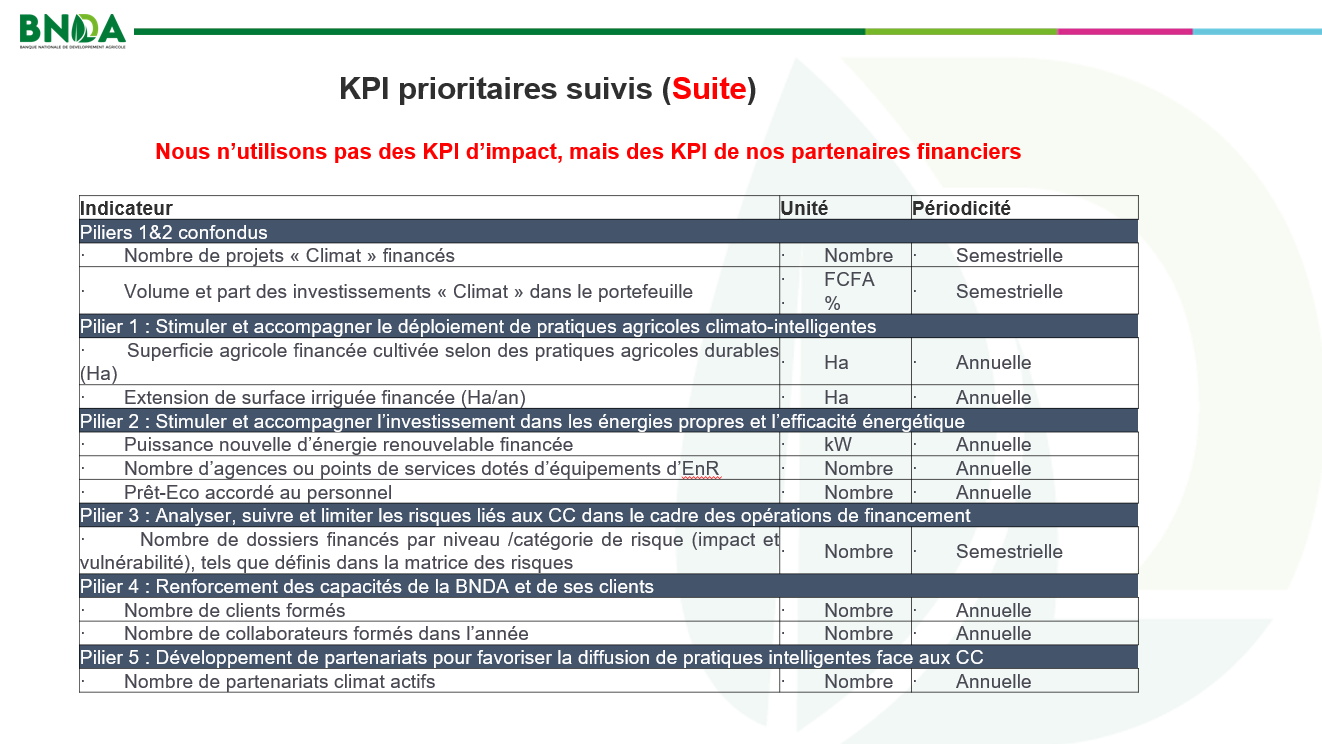
A key message from this testimony was that banks do not need to begin with highly sophisticated impact systems. They can start with simple indicators aligned with their strategy and progressively evolve toward more robust impact KPIs.
As per FIRA, Erick Rodriguez Maldonado, Deputy Director of the Environment, explained that FIRA has been integrating sustainability into its financing activities by creating products and programs that encourage more sustainable agricultural practices. In this context, the Fund has developed sustainable, adaptation, and Blue Finance taxonomies to classify sustainable investments. Under these frameworks, FIRA has issued multiple thematics including green bonds, blue bonds, gender bonds, and financial inclusion bonds, which enabled the allocation of financial resources into projects that have more social, environmental, and economic benefits. Through the issuance of, firstly green bonds, and then social bonds, the Fund noted an over-demand from investors market, proving that KPIs represent a key factor for PDBs to unlock access to capital.
Going further, FIRA presented six impact indicators used for the whole portfolio of the Funds demonstrating the impact of its funding. These indicators are displayed in this slide:
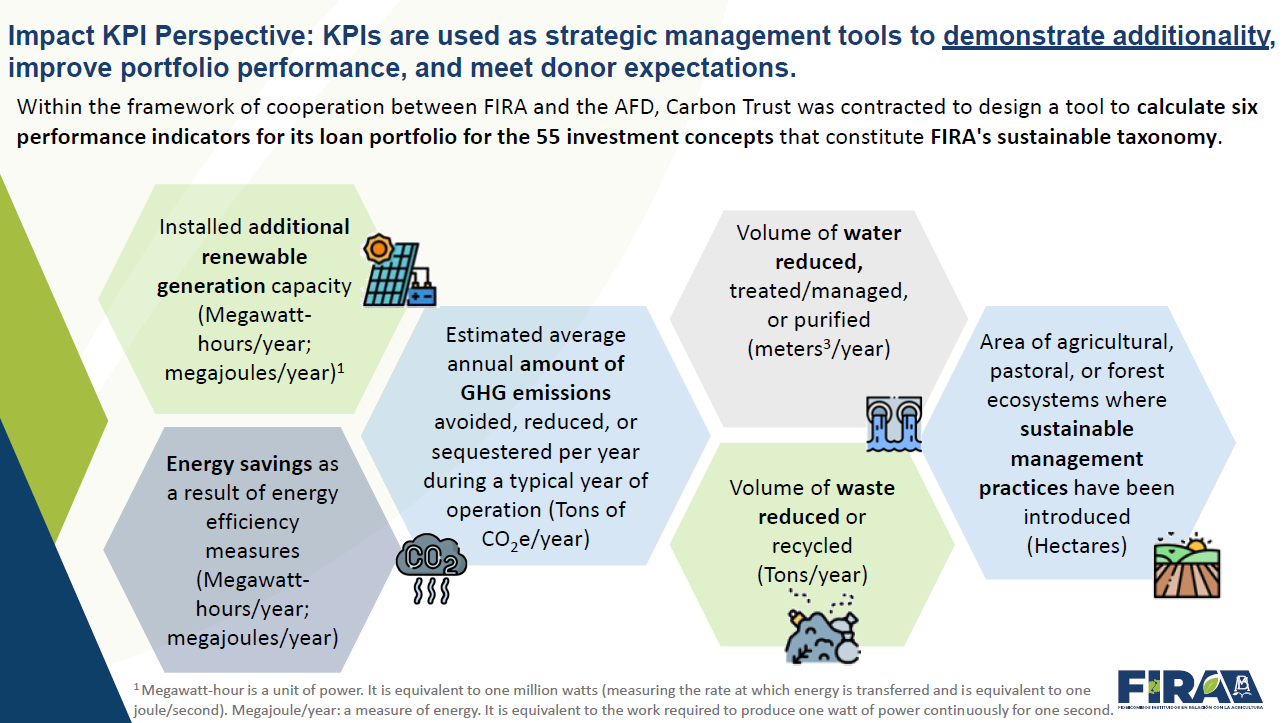
This “standard package” of impact indicators enables to highlight the concrete impact of activities. Noting the relevance and precision of tools, such as satellite imagery, FIRA has started to use such technology to have geographical coordinates information at the level of each piece of hectare it finances to cross it to a layer in which it can determine whether if its credit is within the agricultural frontier or not, being this a direct indicator to see whether that activity is contributing to ecosystem degradation or not. This is part of FIRA’s objective to enrich the six presented indicators to a more sophisticated level of tracking.
Main issues raised during the Q&A
With BNDA Mali
- How wood and forestry products can be linked to impact frameworks. The response clarified that such products are primarily related to environmental KPIs, while also having economic and social dimensions through jobs and rural community benefits.
- How banks can distinguish between traditional reporting and ESG/RSE-oriented assessment in credit processes. Speakers noted that sustainability scoring and qualitative/quantitative criteria can increasingly be integrated into lending decisions.
- Which carbon assessment tools and emission factors institutions should use. The recommendation was to adopt proportionate tools based on institutional maturity and to rely on recognized methodological references such as GHG Protocol, PCAF, IPCC, CDM, and relevant local factors when available.
- Whether environmental KPIs should be aligned with national strategies, the Paris Agreement, and sustainable finance frameworks. The answer was yes: public development banks should align both with national priorities and international reference frameworks.
- Which financing mechanisms are most sensitive to robust impact KPIs. The discussion pointed to green, social, and sustainability bonds, blended finance mechanisms, climate funds, concessional lines from development finance institutions, and impact investors.
With FIRA Mexico
- How FIRA attributes KPI outcomes to sustainable bond financing. The answer specified that the bank’s sustainability taxonomy focuses mainly on new long-term investments and technologies, not routine working capital. This helps isolate impact attributable to financing. Most investments involve new environmentally beneficial technologies (e.g., solar photovoltaic systems).
- ILO representant questioned why quality jobs were still limited. The gap was acknowledged and it was further mentioned that current systems prioritize indicators that are easier to measure consistently across institutions, such as: (i) number of jobs supported, and (ii) inclusion metrics. Instead, more nuanced indicators, such job stability, wages, working conditions, and social protection are harder to collect and standardize.
- Are KPIs genuine impact measures or mainly tools and market access. FIRA emphasized that KPI claims undergo substantial external verification, before issuance with a second-party opinion assessing alignment with international standards, and after issuance with annual impact and allocation reports are independently verified. It was noted that investors are becoming increasingly active and engaged, seeking ongoing dialogue about future climate and sustainability plans rather than relying solely on formal reports.
- Do current KPIs capture emerging challenges in nutrition-sensitive value chains. Current KPIs only partially reflect nutrition outcomes because they still focus heavily on production and financial metrics. Key gaps include limited indicators on dietary diversity, food consumption quality, food loss and nutritional value, and impacts on vulnerable groups (women, smallholders).
To access the slides and recordings, please click here for English and here for French.
Similar articles