

LEARNING EVENT: Advancing Quality Jobs Through Agricultural Public Development Finance
A joint Agri-PDB Platform and ILO learning event on making job quality part of agricultural finance, from policy and due diligence to technical assistance and impact measurement.
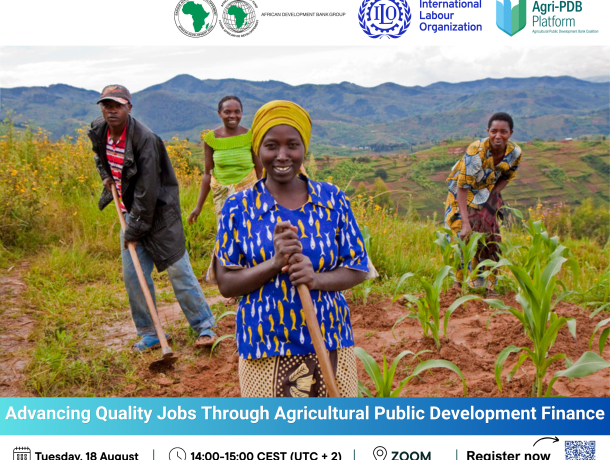
LEARNING EVENT: Advancing Quality Jobs Through Agricultural Public Development Finance
18 August 2026 | Online
How can agricultural public development banks create more employment while making sure that work is safe, stable and fairly rewarded? This question framed a learning event organised by the Agri-PDB Platform and the International Labour Organization (ILO), with contributions from the Asian Development Bank (ADB) and the Global Impact Investing Network (GIIN).
The speakers examined how public development banks (PDBs) can make job quality part of their strategies and operations. The discussion covered public policy, sovereign operations, private investment, technical assistance and impact measurement, with examples drawn from agricultural finance in Africa and Asia.
Why job quality matters in agricultural finance
Patricia Richter of ILO Social Finance opened the technical discussion by placing employment impact in three dimensions: creating more jobs, widening access to jobs and improving the quality of those jobs.
This distinction is particularly relevant in agriculture. A job count does not show whether work is permanent or seasonal, formal or informal, safe or hazardous. It also says little about earnings, social protection, skills development, equal treatment or workers’ ability to raise concerns. These issues sit at the centre of ILO’s Decent Work Agenda.
For a PDB, the practical implication is that employment targets should go beyond the number of positions supported. Banks also need to understand who gains access to work and what conditions those workers experience.
How PDBs can influence employment outcomes
The event identified several points at which PDBs can act. Through sovereign operations and policy dialogue, they can support labour market institutions, enterprise development and wider access to social protection. Through private sector financing, they can include employment objectives in project selection, due diligence, financing agreements and monitoring. Technical assistance can then help clients improve occupational safety and health, workforce skills, labour practices and reporting systems.
Carlos A. Coca Gamito presented two examples from ADB’s work. In Bhutan, support for a national entrepreneurship strategy examined the obstacles facing entrepreneurs, including those in agriculture, and considered how access to finance and preferential lending could encourage better employment outcomes. In Uzbekistan, ADB supported work to extend social insurance to informal workers, including agricultural workers, alongside research and outreach on workers’ needs.
Both examples showed that finance works within a wider system. Lending can support enterprises, but lasting improvements in employment also depend on public policy, capable institutions, worker protection and services that businesses can use.
Building measurement into investment decisions
The session then turned to the question of measurement. Joint work by ILO and GIIN organises quality jobs around five strategic goals: skills for the future; health and wellbeing; security and stability for workers in precarious employment; earnings and wealth, especially for disadvantaged groups; and rights, respect and cooperation in the workplace.
These goals can be tracked through indicators such as training, occupational injuries, access to benefits, permanent employment, wage equity, collective bargaining coverage and grievance mechanisms. The right set of indicators will vary by institution and market. A seasonal agricultural business, for example, should not be assessed in exactly the same way as a permanent industrial workforce.
GIIN presented IRIS+, its free system for impact measurement and management. IRIS+ includes core metric sets and a catalogue of more than 750 metrics. It is designed to help investors choose measures that match their objectives and to align reporting with other established frameworks. The speakers cautioned against collecting data without a clear purpose. A short set of indicators that informs decisions is more useful than a large reporting system that clients cannot maintain.
AATIF: applying the approach throughout an investment
ILO’s collaboration with the African Agriculture Trade and Investment Fund (AATIF) showed how job quality can be addressed from appraisal through implementation. AATIF, launched in 2011, invests across African agricultural value chains.
Before an investment, a sustainability assessment identifies gaps and priorities. Agreed improvements can then be included in the financing arrangement, with technical assistance available during implementation. Examples discussed during the event included occupational safety and health training, personal protective equipment, workforce development and support for a dedicated environmental, health and safety function.
The case also showed that institutions do not always need a separate system to begin measuring job quality. Existing environmental and social due diligence often contains useful workforce information. PDBs can build on it, focus monitoring on the most material issues and use technical assistance where an investee lacks the capacity to make improvements on its own.
What agricultural PDBs can do next
The presentations pointed to five practical steps for agricultural PDBs.
- Assess who benefits. Look at who gains access to employment as well as how many jobs are supported.
- Set focused objectives. Select a manageable set of job quality goals that fits the bank’s mandate and portfolio.
- Connect objectives to operations. Include them in appraisal, due diligence, financing agreements and monitoring.
- Start with existing systems. Use environmental and social processes as an entry point for workforce data and action plans.
- Support clients and partners. Combine finance with policy engagement, technical assistance and partnerships with local financial institutions.
This approach allows PDBs to treat employment quality as part of investment management rather than as a separate reporting exercise. It also creates a clearer basis for working with clients on improvements that are realistic, measurable and relevant to workers.
Watch the recording: https://youtu.be/SNmIlsVvaYU
Access the event slides and materials: https://www.agri-pdb.org/resources/advancing-quality-jobs-through-agricultural-public-development-finance/
Questions and answers
The final session gave participants an opportunity to connect the presentations with questions from their own institutions and regions.
Is there peer learning across regions and company types?
Question: Leonard Mizzi asked whether ILO or GIIN had conducted peer review across Asia and the Pacific, Latin America and the Caribbean, and Africa. He was interested in comparisons between export-oriented multinational companies, which face growing environmental, social and due diligence requirements, and local micro, small and medium-sized enterprises. He also asked where quality jobs are being created at scale, especially for young people.
Answer: Patricia Richter explained that ILO Social Finance approaches the topic mainly through investment in the financial sector. ILO work on foreign direct investment and multinational enterprises is led by specialised colleagues, who also address quality jobs in guidance for investment promotion agencies and related country work. She offered to connect the participant with the relevant team.
GIIN noted that many organisations already produce standards, tools and evidence on impact measurement. IRIS+ is intended to work alongside other frameworks, while GIIN impact reports and case studies can help institutions see how investors adapt measurement to different organisations and locations. For smaller institutions, the key is to begin with measures that reflect their strategy and data capacity rather than trying to apply every available metric.
Leonard also pointed to blended finance vehicles such as AATIF, the ABC Fund, AgriFI and the Huruma Fund as examples of operations seeking to give greater priority to quality jobs.
How can future work focus more closely on women and young people?
Participant proposal: Soma Chakrabarti proposed a dedicated webinar on women and young people. Leonard’s question also highlighted the need to understand where jobs for young people are being created at scale and how agricultural work can become more attractive to them.
Discussion: The recording and chat did not include a detailed panel response to this proposal. A future session could look beyond disaggregated job counts and examine the finance, skills, working conditions and support systems that help women and young people enter agricultural value chains, remain in employment and progress into better roles.
How can PDBs and local financial institutions work together?
Question: Samira Hotobah-During asked about cooperation between PDBs and local financial institutions to support local employment and investment in food and nutrition supply chains.
Answer: Patricia Richter welcomed further exchange on the subject and said that PDBs and local financial institutions can scale their impact considerably when they work together. The wider discussion identified several possible roles for PDBs, including dedicated credit lines, technical assistance and business development support for institutions serving small and informal enterprises. Any subsidy or risk-sharing mechanism should be designed carefully so that the local financial institution can continue operating sustainably.
The exchange closed with interest in further work on regional case studies, employment for women and young people, and practical partnerships between PDBs and local lenders.
Similar articles