

Stabilising Food Systems in a Poly-Crisis: The Countercyclical Role of Public Development Banks in Response to the Persian Gulf Crisis
In response to the ongoing disruption of shipping through the Strait of Hormuz and its growing implications for global food security, the Agri-PDB Platform, together with IFAD, IFPRI, the Agroecology Coalition, and partners, convened a high-level webinar examining the impacts of the crisis on smallholder farmers and the role of Public Development Banks (PDBs) in crisis response and long-term resilience building. With the participation of over 130 attendees across the world, the session reaffirmed the important role of PDBs, and development partners in supporting smallholders, maintaining financial access during crises, and advancing more resilient and sustainable food systems.
Stabilising Food Systems in a Poly-Crisis: The Countercyclical Role of Public Development Banks in Response to the Persian Gulf Crisis
13 May 2026 | Online
Introduction
Since early 2026, disruptions in shipping through the Strait of Hormuz have begun to affect smallholders and low-income farmers, with risks extending to the 2026 harvest and 2027 food availability. In response, the Agri-PDB Platform, in collaboration with International Fund for Agricultural Development (IFAD), International Food Policy Research Institute (IFPRI), the Agroecology Coalition , and Sandra Martinsone, Policy and Advocacy Manager at Bond UK, organised a timely webinar to assess the scale and implications of the Persian Gulf Crisis, and the role that Public Development Banks (PDBs) can take.
Opening the session, Ms. Pieternel Boogaard, Managing Director of IFAD’s Office of Technical Delivery, recalled that global food security depends heavily on agricultural production and supply chains. Disruptions in this key trade chokepoint are already generating short- and long-term impacts, including reduced food availability, higher prices, and increased pressure on rural households. She also highlighted regenerative approaches as long-term solutions to help farmers cope with increasingly volatile weather patterns. These are already part of IFAD’s development and resilience agenda.
In this context, she explained that PDBs play a key role in supporting farmers in transitioning toward more sustainable production systems, reduce risk for local banks, and improve farmers’ access to finance and insurance. The countercyclical role of PDBs, demonstrated during COVID-19, remains critical for supporting governments and the private sector in current and future crises, by:
- In the short term: stabilizing livelihoods, sustaining production, and maintaining access to credit during shocks.
- In the long term: financing the transition that reduces exposure to the next shock.
Background
Joseph Glauber, Research Fellow Emeritus in the Director General’s Office at IFPRI, argued that unlike recent past crisis, the current global food an energy crisis, due by the shipping blockades and regional conflict has not yet caused major spikes in grain prices and is mainly a supply-side shock, not a demand-driven one. He explained that wheat prices have risen somewhat due to U.S. drought conditions, but rice and many other crop prices remain relatively low. This reflects weaker demand pressures: China’s growth has slowed and biofuel demand has stabilized. In fact, he noted that the immediate concern resides in:
- High fertilizer costs, which may reduce fertilizer use and lower future crop yields.
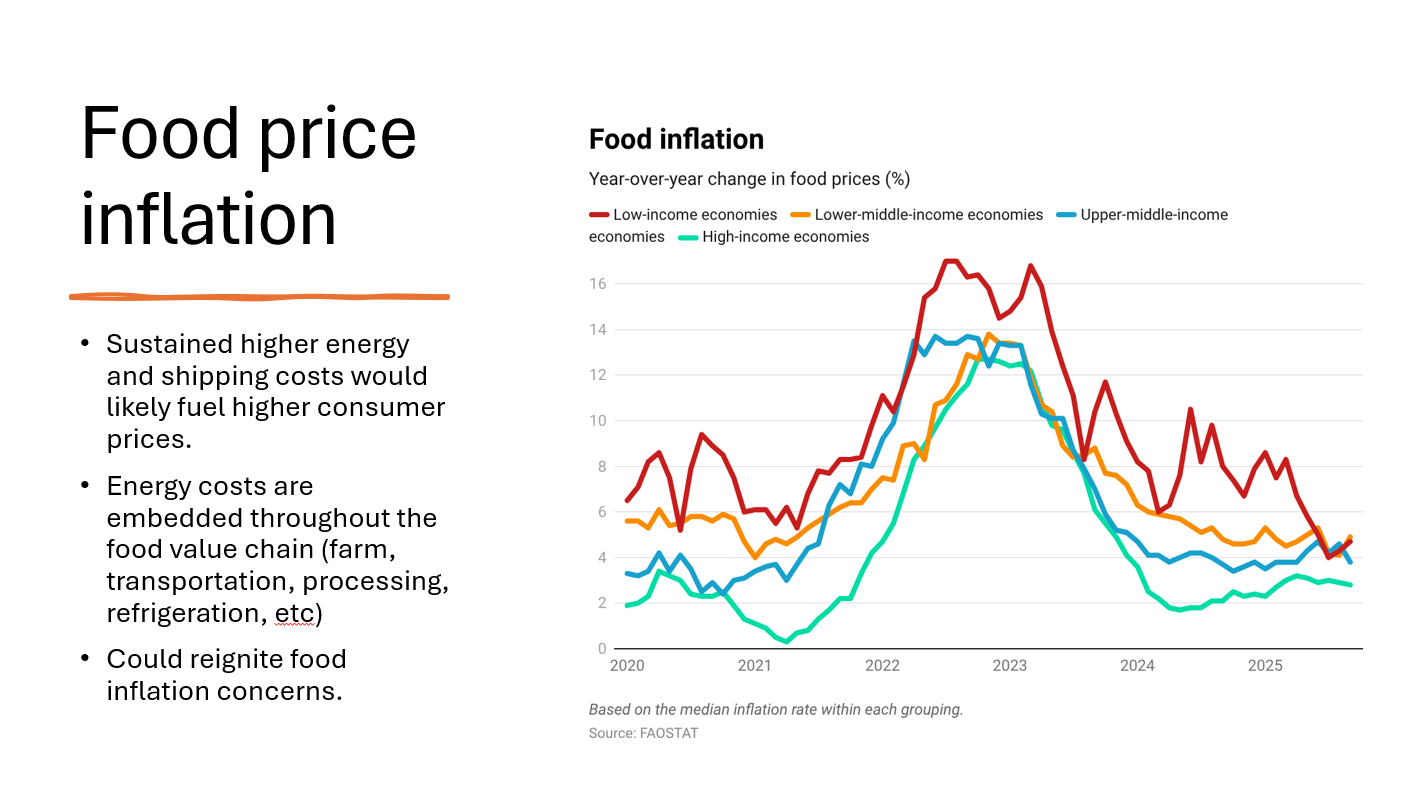
- Higher food inflation, driven mainly by energy and transportation costs rather than farm prices.
- Potential future risks from El Niño, droughts, biofuel expansion, and export restrictions, which could eventually push food prices much higher.
Implications for Rural Communities and IFIs Role in responding to the crisis
Going further, Carola Alvarez, Managing Director of the Office of Development Effectiveness at IFAD, provided insights into the effects of the crisis on smallholder farmers. She noted that rural communities face rising input costs, while farmgate prices lag behind. As a result, many small farmers are forced to reduce fertilizer use, switch to less productive crops, or sell productive assets just to survive. Another important risk impacting farmers is the declining of remittances, which for many households represent the primary buffer allowing families to purchase input and avoid stress asset sales. She emphasized the need for resilient value chains that can:
- protect household consumption and preventing distress asset sales,
- maintain yields while protecting natural resources,
- ensure continued access to inputs, financing, logistics, and markets.
To build such resilient value chains she presented some key recommendations. Firstly, in the short term she noted: (i) emergency financing for fertilizer and inputs; (ii) liquidity support and flexible loans; and (iii) and avoiding harmful policies like export bans and poorly targeted subsidies. Secondly, in the medium to long-term she advocated investing in: (i) biofertilizers; (ii) agroecological farming systems; (iii) diversified and lower-carbon agriculture; and (iv) more sustainable food systems overall.
She concluded saying that crisis responses, which must prioritize inclusion, must be quickly enough to prevent immediate harm while also building more resilient agricultural systems for the future.
Agroecology as a Resilient Response to the Crisis
Oliver Oliveros, Executive Coordinator at the Agroecology Coalition started off highlighting the role of agroecology in transforming food systems that are currently unsustainable, fail to address the triple burden of malnutrition, and reinforce social inequities and cultural loss. He explained that agroecology represents a transformative pathway towards sustainable food systems, thanks to a precise set of principles and elements:
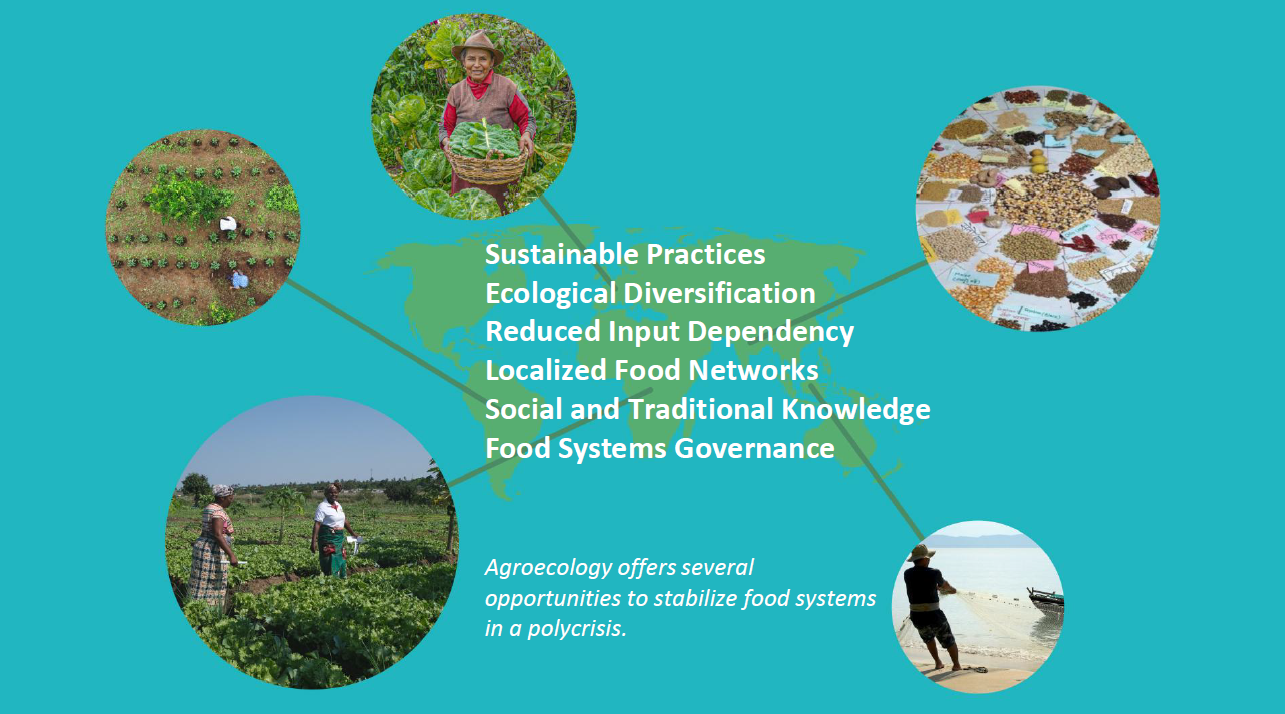
He pursued providing evidence that agroecology has proven highly effective in stabilizing food systems during various global and local crises. Unlike industrial farming, which may collapse when external supply chains fail, these systems use local biological diversity to absorb shocks. As an example, Ethiopia’s Gamo Highlands, farmers maintain over 50 plant species, including hundreds of varieties of enset and 40 varieties of barley. This biodiversity allows farmers to maintain food security even when specific crops fail. In Angola as well, projects like the Smallholder Resilience Enhancement Project focused on rainwater harvesting and drought tolerant crops, which reduced dependence on external aid and protected farmers from global price spikes of synthetic fertilizers caused by geopolitical conflicts. His presentation concluded by emphasizing that policymakers, funders, and development banks now have a major opportunity to integrate agroecological approaches into long-term strategies for food security and sustainability.
Following the situational analyses, public development banks shared their experience in addressing the current crisis, both in the short term and in the longer term.
Practical Examples: PDB Crisis Response in Action – Representative from Banco Agrícola, Dominican Republic
Ariana Nunez-Cabrera, coordinator at the IDB project management unit, presented the experience of state-owned Banco Agrícola of the Dominican Republic. This development finance institution is the backbone of the country’s agro-financial ecosystem, serving over 200,000 producers across the entire territory and covering more than 60% of agricultural credit.
Banco Agrícola plays a systemic role across the agri-food value chain, particularly for small and medium producers with limited access to finance.
In response to recent crises, Banco Agrícola has implemented a series of targeted interventions.
During COVID-19, the Dominican government launched a USD 100 million recovery fund, implemented through Banco Agrícola, to provide zero-interest loans to small producers.
This expanded the bank’s portfolio by over 80% and helped stabilize food supply and rural incomes.
Following Hurricane Melissa in October 2025, Banco Agrícola played a central role in channelling emergency support to affected farmers. The government allocated approximately USD 33 million for recovery, which the bank rapidly deployed through emergency loans targeting the most impacted regions and subsectors. Thanks to the bank’s extensive territorial presence, existing client networks, and sector-specific expertise, the emergency fund quickly disbursed to approximately 3,300 affected farmers across the country.
In the context of recent global disruptions, the country agricultural sector faced significant increases in production costs, given its dependence on imported inputs. In response, the government implemented a comprehensive stabilization package of approximately USD 80 million aimed at maintaining affordability of inputs while safeguarding national food production. Banco Agrícola ensures continued access to credit and monitors sector conditions, helping farmers maintain liquidity and continue operations despite input cost pressures.
Practical Examples: PDB Crisis Response in Action – Representative from Agricultural Finance Corporation (AFC) Kenya
Building on the Latin American experience, the session then turned to Africa, where Tom Akeno, Head of Strategy and Business Development at the Agricultural Finance Corporation (AFC), presented the case of Kenya.
AFC, a government-owned development finance institution, provides access to affordable credit across the agricultural value chain, from production as last-mile” financier to processing and marketing. AFC operates through both direct lending to farmers and wholesale financing to intermediaries, helping address constraints such as limited collateral.
To respond to interrelated pressures affecting the agricultural sector in Kenya (rising input and production costs, logistical and market disruptions, and macroeconomic instability and forward-looking risks), AFC and the Government of Kenya have implemented a combination of short-term mitigation measures and structural interventions:
- Government-led stabilization of input markets
The government introduced fiscal and subsidy measures to cushion farmers from rising costs (e.g., an 8% reduction in VAT on petroleum products, and a fertilizer subsidy programme to ensure farmers could access inputs at more affordable prices).
In parallel, authorities have promoted the use of organic fertilizers as a longer-term alternative, reducing dependency on imported inputs. - Liquidity support and financial flexibility through AFC
AFC plays a key role in maintaining financial access during the crisis to MSMEs and smallholder farmers requiring inputs for the planting season. In addition, AFC has shown flexibility by restructuring loans on a case-by-case basis, enabling affected clients to maintain operations despite adverse conditions. - Targeted financial outreach and coordinated response across stakeholders
Through a multi-stakeholder approach to coordinate responses to the crisis, AFC has continued to deploy financing at scale, disbursing approximately USD 31 million to farmers across different value chains to address financing gaps. Key actions include strengthening agricultural advisory services and improving farmer access to information and inputs.
Interactive Dialogue and Discussion
The Q&A session highlighted key cross-cutting themes around resilience and structural transformation. AFC emphasized Kenya’s multi-sectoral approach, combining input subsidies, improved import coordination, and longer-term investments in irrigation and arid land productivity.
At a global level, panellists noted that food systems have shown remarkable resilience so far but warned that simultaneous shocks could stretch this capacity. Concerns were raised about policy responses such as export restrictions, which can unintentionally amplify global price volatility. A part of the conversation noted the obstacles preventing wider investment in agroecology and sustainable farming encouraging PDBs to simplify financing mechanisms, provide concessional and farmer-friendly loans, support direct market access, and increase investment in agroecological research and innovation.
The discussion also pointed to the importance of maintaining financial access and flexibility, with public development banks playing a stabilizing role during crises. Finally, panellists underscored that reducing dependence on imported inputs will require diversification and a transition toward more sustainable and resilient production systems, including agroecology.
Conclusion
The webinar concluded reaffirming the critical role of PDBs in:
- mobilizing finance during crises,
- supporting farmers,
- and driving long-term transformation toward resilient and sustainable food systems.
Click here to access the webinar recording and slides.
Similar articles