

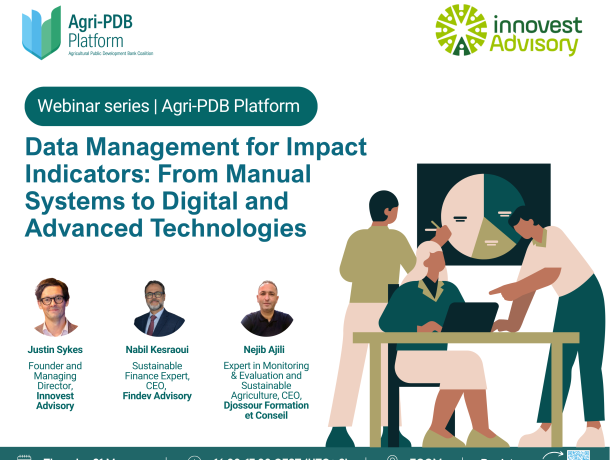
3rd Working Group on Data Management for Impact Indicators: From Manual Systems to Digital and Advanced Technologies
For the last sessions of the webinar series dedicated to Key Performance Indicators, Kodjovi Lagno, Operations and Projects Manager at MIFA, Togo; Justin Sykes, Founder and Managing Director of Innovest Advisory; Béchir Ben Brika, Founder of Smart Farm; Nabil Kesraoui, Sustainable Finance Expert, CEO of FindevAdvisory; and Nejib Ajili, Monitoring & Evaluation and Sustainable Agriculture Expert, CEO of Djossour Formation & Conseil, explored practical approaches to building reliable, relevant, and actionable impact indicators. The webinar addressed key challenges related to data quality, heterogeneous systems, and incomplete datasets, while discussing concrete and proportionate solutions tailored to the operational realities and capacities of agricultural Public Development Banks.
3rd Working Group on Data Management for Impact Indicators: From Manual Systems to Digital and Advanced Technologies
21 May-12 June 2026 | Online
The Key Performance Indicators Working Group concluded with a final discussion on a more practical question: how can banks actually collect, manage, and validate the data needed to measure impact? The last two sessions concluded the series launched earlier in the year to help agricultural public development banks strengthen their impact measurement systems. This series of event was made possible thanks to the German development bank KfW and the CEOs of Findev Advisory, and Djossour Conseil & Formation.
From Basic Data Collection to Advanced Impact Measurement
To set the stage, participants were asked about their own institutions’ data collection practices. The results revealed that many organizations are still at an early stage of maturity. More than a third rely primarily on paper forms and Excel spreadsheets, while only a fifth have integrated impact indicators into their management information systems. When asked about the biggest challenge they face, most respondents pointed to the difficulty of linking financing provided by the bank to real-world outcomes on the ground. Others highlighted incomplete data and limited internal capacity.
Building on these findings, Nabil Kesraoui, Sustainable Finance Expert and CEO of Findev Advisory, explained that robust impact measurement starts with robust data management. Despite noted structural challenges, institutions should not be discouraged from measuring impact. Instead, they should adopt a gradual and pragmatic approach that improves data quality step by step.
The presentation then explored the different sources of information available to agricultural PDBs. Internal systems such as core banking platforms and management information systems provide basic client and portfolio data. Operational databases offer more detailed information on loan applications, repayment behavior, and customer profiles. Field surveys can capture outcomes that banking systems cannot, such as yield improvements, job creation, adoption of sustainable agricultural practices, and food security outcomes. Finally, external sources including national statistics, World Bank and FAO databases, weather information, and satellite data can complement internal records.
A major theme throughout the session was the concept of a data maturity journey. Three levels of maturity where described:
- At the first level, institutions depend on manual systems using paper forms and spreadsheets. Although inexpensive, these processes are prone to errors and make impact reporting difficult.
- The second level, described as the most practical and cost-effective option for most agricultural PDBs, involves semi-digital systems using tools such as Kobo Toolbox or ODK. These solutions allow institutions to collect geo-referenced data, capture photos, automate validations, and significantly improve data reliability while remaining affordable.
- The third level involves fully integrated digital systems where impact indicators become part of the institution’s MIS or ERP. At this stage, advanced technologies such as GIS, remote sensing, and satellite imagery can automate monitoring and support sophisticated reporting requirements such as sustainability bonds and green financing instruments.
To illustrate how impact indicators can be measured in practice, M. Kesraoui presented examples across the economic, social, and environmental dimensions. Economic indicators included the proportion of first-time borrowers, financial leverage ratios showing how much additional capital is mobilized, and producer price premiums received by farmers. Social indicators focused on women’s empowerment, youth participation, and food security. While gender and age data are often already available in banking systems, food security requires targeted household surveys using representative samples. Environmental indicators covered the adoption of regenerative agricultural practices, water efficiency, greenhouse gas emissions reductions, and biodiversity protection. Importantly, the speakers stressed that many of these indicators do not require expensive measurements. Standardized methodologies and proxy models can often provide reliable estimates at a reasonable cost.
The presenters then outlined a set of practical recommendations for institutions seeking to strengthen their impact measurement systems:
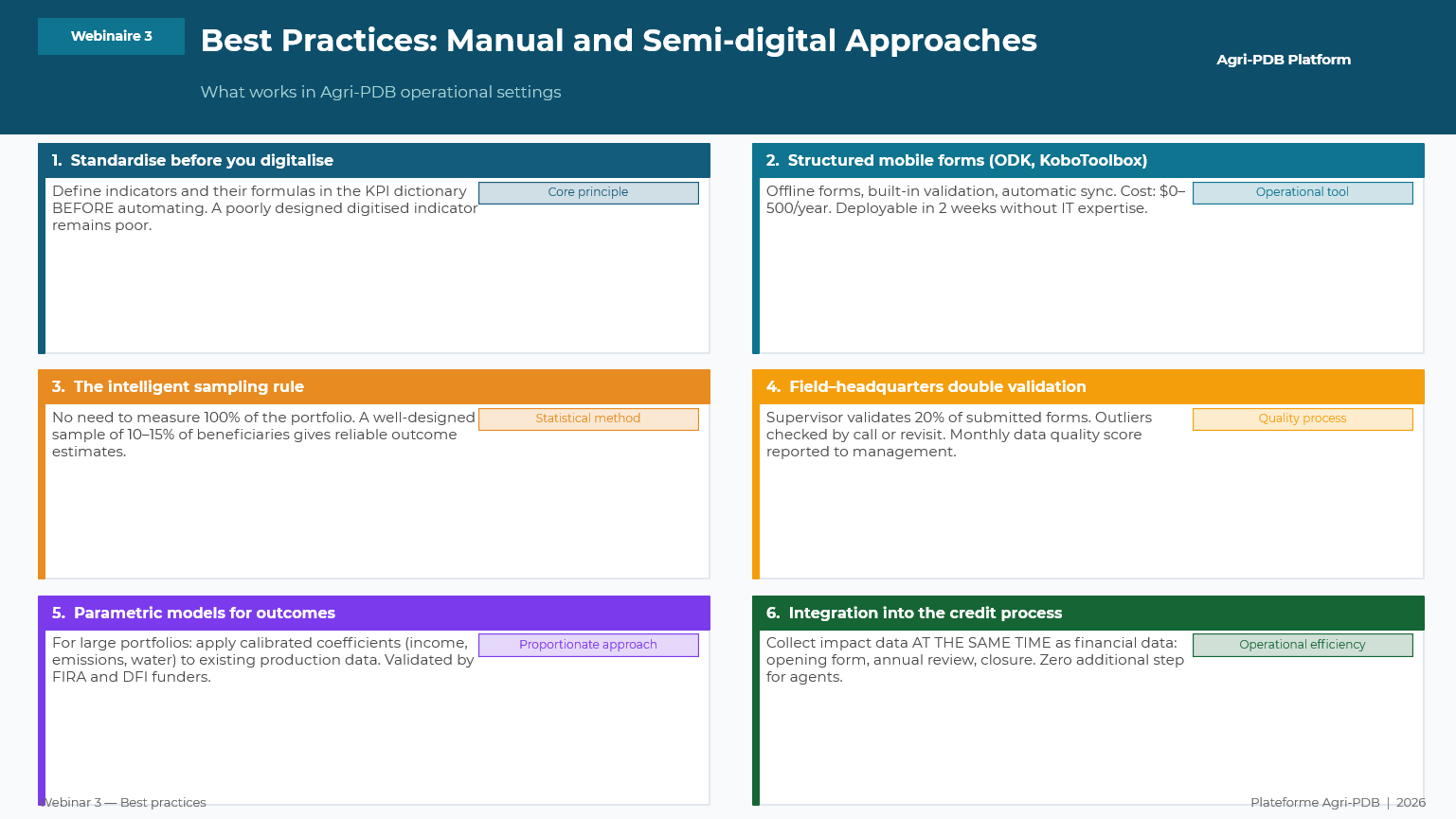
Nejib Ajili, Monitoring & Evaluation and Sustainable Agriculture Expert, CEO of Djossour Conseil & Formation then expanded on the role of technology. He reviewed five major tools available to financial institutions: integrated Management Information System (MIS) and Enterprise Resource Planning (ERP) systems, mobile data collection applications, remote sensing technologies, Geographic Information System (GIS) platforms, and satellite-based indicators such as rainfall and vegetation indices. His key message was that institutions should not adopt technology for its own sake. Instead, they should choose solutions that directly address their most pressing measurement challenges and provide clear value relative to their cost and complexity.
Turning Impact Data into a Strategic Asset
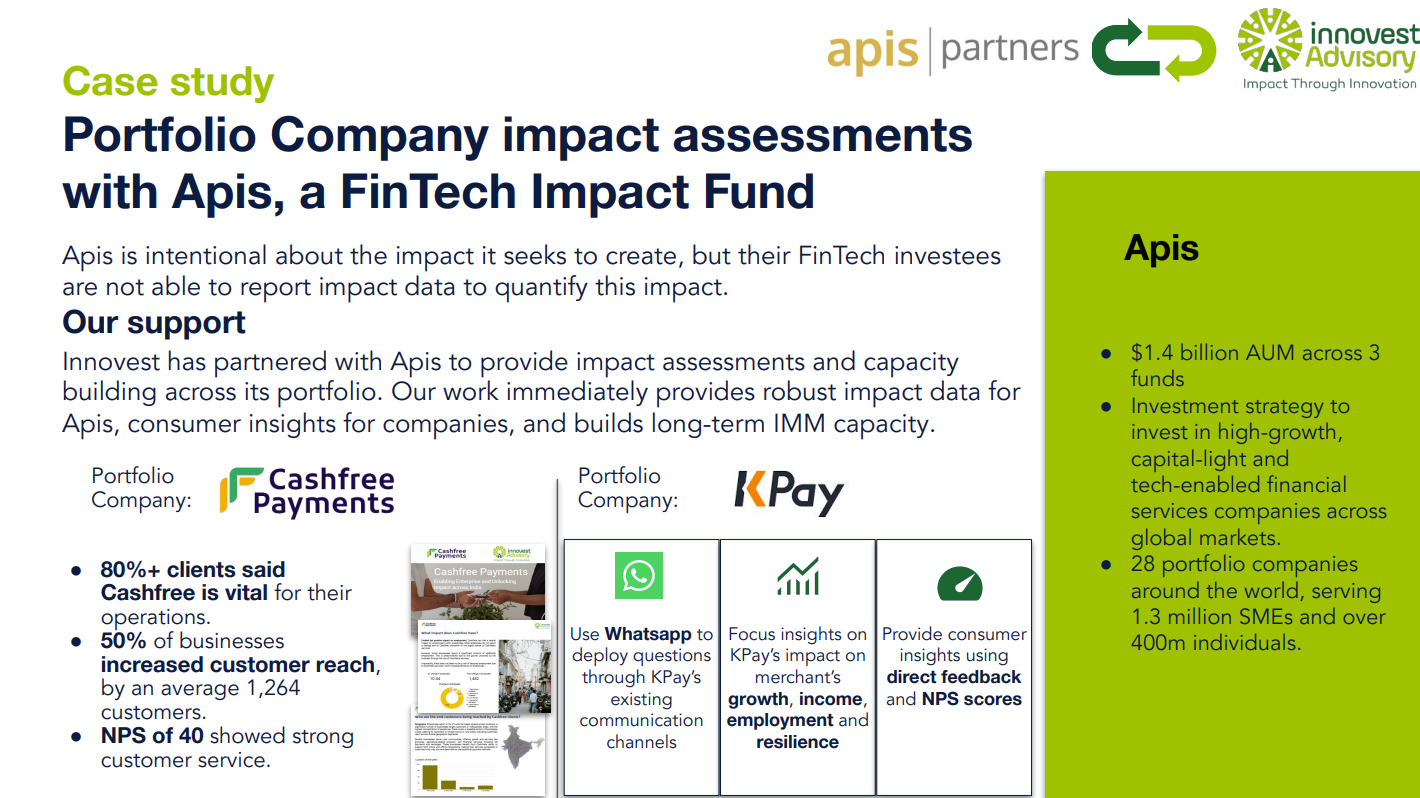
Justin Sykes, CEO of Innovest Advisory shared his experience advising investors, development finance institutions, and financial service providers, explaining that expectations around impact measurement are changing rapidly. Investors increasingly want evidence of outcomes at the beneficiary level rather than simple output indicators. Thus, high-quality impact data has become a strategic asset helping institutions attract impact investment capital, communicate their contribution to sustainable development, improve customer understanding, and comply with reporting requirements associated with sustainability finance.
Drawing on practical examples from India, Somalia, Ghana, and international investment funds, he demonstrated how institutions can combine operational data with beneficiary surveys to create credible impact reports. One of his strongest recommendations was to leverage communication channels that already exist within organizations, such as call centers, SMS systems, WhatsApp messaging, and customer service platforms. These channels can often provide a much cheaper and more efficient way of collecting impact data than implementing entirely new systems.
Experience of Togo’s Agricultural Financing Incentive Mechanism (MIFA S.A)
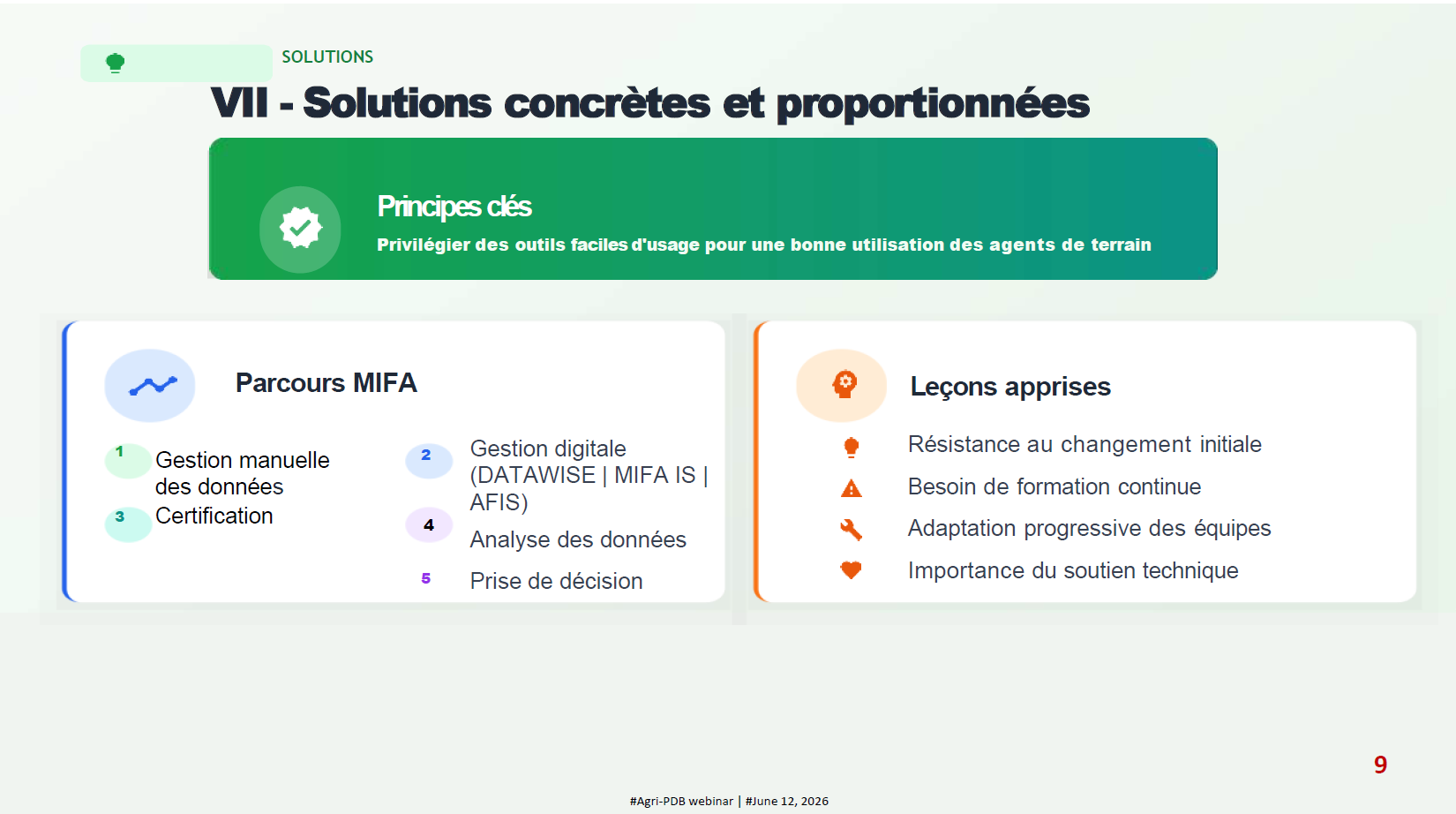
The discussion was enriched by a practical case study from Kodjovi Lagno, Operations and Projects Manager at MIFA, Togo, who described how it evolved from a completely manual system based on paper forms to a sophisticated digital architecture. MIFA first adopted KoboCollect and later developed customized solutions, including DataWise and the MIFA Information System, to centralize information, improve traceability, and support decision-making.
A major benefit of the new system was the ability to collect GPS coordinates and integrate geospatial analysis through GIS software. This allowed MIFA to map beneficiaries, monitor interventions geographically, and gain a comprehensive view of field operations. It was stressed that digitalization required significant investments in servers, equipment, training, and technical support. Yet the benefits far outweighed the costs. The institution now enjoys faster reporting, greater data reliability, better beneficiary monitoring, and much stronger decision-making capabilities.
The webinar then turned briefly to technological innovation through a presentation by Béchir Ben Brika, founder of Smart Farm in Tunisia. He introduced a digital irrigation management solution that combines connected sensors, satellite data, weather forecasts, artificial intelligence, and farmer support services. The platform monitors soil moisture and environmental conditions in real time, generating irrigation recommendations aimed at optimizing water use and agricultural productivity. Among the examples shared was a case where irrigation time was reduced from twelve hours per day to just one hour while maintaining optimal crop conditions. It was emphasized that the technology is only one part of the solution; continuous support, training, and even AI-powered chatbots play an equally important role in ensuring successful adoption by farmers.
Q&A discussions
During the discussion, participants raised questions about food security measurement and the use of proxy indicators. The panellists clarified that food security is ideally measured at the household level because conditions vary significantly between families, although aggregated analysis can still be useful for comparing regions and understanding broader trends. They also pointed participants toward established frameworks such as IRIS+, the 2X Challenge framework, FAO tools, and IPCC methodologies as sources of standardized indicators and proxy measurements.
Key Takeaways
- Technology alone cannot solve data quality problems; it can only automate existing weaknesses if institutions have not first established clear definitions and sound processes.
- Most of the data needed for impact measurement already exists within institutions and simply needs to be structured and combined more effectively.
- Representative sampling is often more practical and cost-effective than exhaustive surveys.
- Digitalization should not be seen as a destination or a quick fix, but as a gradual journey that strengthens data quality, improves impact measurement, supports better decision-making and enables agricultural public development banks to demonstrate their contribution to sustainable development with greater credibility.
In closing, the panellists emphasized that: effective impact measurement is not primarily about technology. It is about establishing clear indicators, reliable processes, and good-quality data. Institutions do not need sophisticated systems from the outset. By starting with practical, affordable solutions and progressively strengthening their capabilities, agricultural public development banks can build credible impact reporting systems that support better decision-making, attract investors, and demonstrate their contribution to sustainable development.
Similar articles