

Islamic Finance in Agriculture for Sustainable Food Systems: From Principles to Practice in Public Development Banks
Islamic Finance in Agriculture
11 November 2026 | Online
In a time of polycrisis, domestic financing must be strengthened so that countries can drive their own food-system agendas and break the cycle of recurring food crises. On 11 November 2026, the Agri-PDB Platform brought together leading experts to explore what Islamic finance can offer agricultural public development banks (PDBs). The webinar, moderated by Badriyyakhanim Soltanli, moved from principles and instruments to experience from Malaysia and Tunisia, and closed with proposals for the way forward.
Why it matters
Smallholders often lack collateral, earn their income at harvest rather than monthly, and face droughts, floods and price swings. Fixed-interest debt leaves most of that risk with the smallest producers. Agri-PDBs exist to reach the producers commercial lenders avoid, which makes them among the strongest channels for new instruments. Islamic finance is one such option, though much of the industry still relies on loan-like products, and many PDBs face limited capacity, fragmented regulation and little familiarity with the instruments.
Principles and instruments
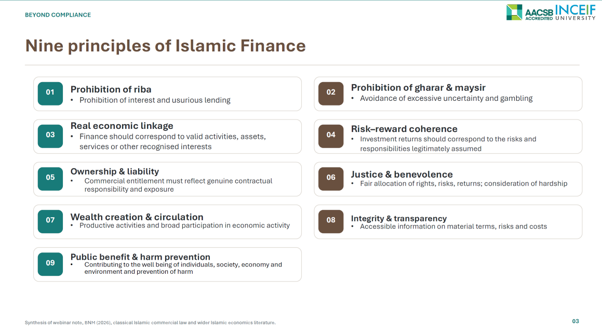
Professor Emeritus Dato’ Dr. Azmi Omar, President and CEO of INCEIF University and Member of the IsDB President’s International Advisory Panel, explained that Islamic finance goes beyond financial intermediation. It aims at a just and ethical system that creates sustainable prosperity, judged by outcomes and impact as well as by Sharia compliance. Its nine principles include the prohibition of interest (riba) and of excessive speculation and gambling (gharar and maysir); a link to the real economy; no return without risk; asset ownership; justice; the circulation of wealth, supported by zakat; transparency; and public benefit.
These principles translate into contracts suited to agriculture: Salam (advance payment) for pre-harvest working capital; Murabaha (cost-plus sale) for inputs and equipment; Ijara (leasing) for irrigation and machinery; Istisna for assets to be built; Musharakah and Mudarabah for profit-and-loss-sharing partnerships; and Takaful for crop protection.
His central message was that no single instrument is the answer. Islamic finance works as a continuum: social finance from zakat and waqf for the poorest (in Malaysia, waqf funds have built rice mills and zakat funds have trained farmers), then commercial finance as farmers become bankable, and finally risk-sharing partnerships for established producers.
Agrobank Malaysia: advancing agriculture beyond banking
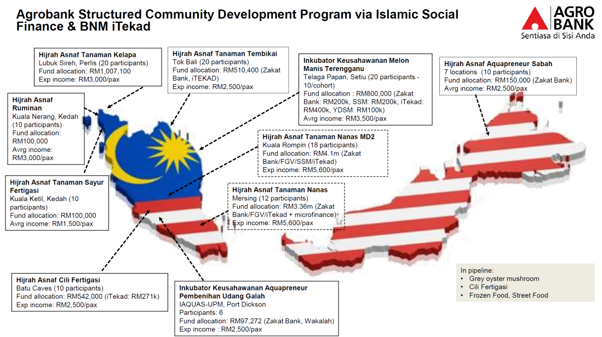
Rosli Bin Jusoh, Senior Vice President and Head of the Excellence Centre at Agrobank, showed what a fully Islamic agricultural development bank looks like. Founded in 1969 as a conventional institution, Agrobank opened an Islamic window in 1997 and has been fully Sharia-compliant since 2015. Its mandate covers the whole value chain, from planting to processing, logistics and export.
Agrobank has moved from capital provider to strategic partner. Contract-farming schemes, such as pineapple programmes for low-income (B40) communities in Pahang and Johor, link farmers with anchor companies that commit to buying their crops. Financial-literacy and digital-marketing training, together with SME-friendly financing based on Salam and Murabaha, feed its Upward Migration Programme, which turns the unbankable into the bankable and grows clients from start-ups into corporate businesses.
The Islamic window: Tunisia’s experience
Nabil Kesraoui, sustainable finance expert and CEO of FinDev Advisory, showed that a PDB need not convert entirely. It can open an Islamic window with its own Sharia governance and segregated funds, accounting and systems, drawing resources from the Islamic Development Bank (IsDB) and other investors to serve farmers, cooperatives and Islamic microfinance institutions.
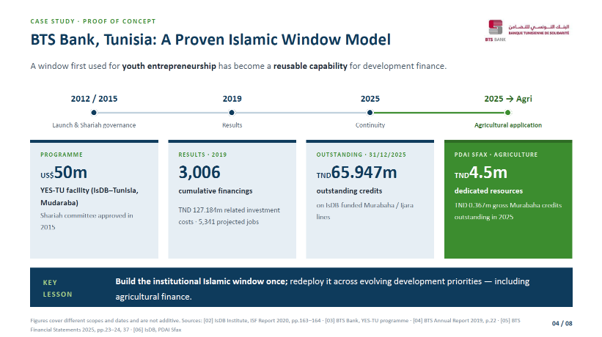
The Banque Tunisienne de Solidarité illustrates the model. Its window began under the YES2 youth-entrepreneurship programme, with an IsDB facility of about $50 million, and reported around 3,006 cumulative financings by 2019. The same capability was later redeployed for agriculture in Sfax.
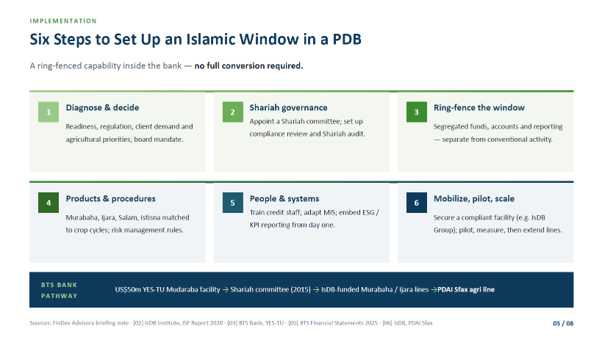
Kesraoui recommended six steps: diagnose readiness; establish Sharia governance; segregate the window; develop products and procedures; invest in people and systems; then pilot, measure and scale. One window can carry separate portfolios for climate finance, social finance and sustainable value chains. But he stressed, Sharia-compliant does not automatically mean green: credible portfolios need explicit environmental and social criteria, with impact measurement designed from the start.
The climate link
Dr Moutaz Abojeib, co-founder of the Global Islamic Climate Finance Alliance (GICFA), presented the alliance, to be launched on 14 November at COP31 in Antalya. Islamic finance is closely aligned with climate goals but not yet mobilised at scale. Acting as a neutral platform that links projects and financial institutions, GICFA aims to close gaps in awareness, standardisation, Sharia-compliant risk mitigation and blended finance (gicfa.org).
Keeping the momentum
Clear next steps have been proposed clear next steps:
- A pilot agricultural Islamic window in two or three interested PDBs over 12–18 months, starting with a joint scoping exercise to assess readiness and select priority value chains.
- Building on the IFAD–IsDB partnership announced on 14 October 2026, which targets up to $750 million in co-financing for food systems and rural transformation. The pilot is a proposal for discussion, not an allocation under that agreement.
- Given the strong interest in sukuk, we are exploring the possibility of a dedicated follow-up session.
The way forward, as suggested during the discussion, can be mobilising suitable resources, financing productive agricultural assets, measuring development outcomes, and then scaling what works.
Recording and presentations
Similar articles