

School Meals as a Food Systems Investment
School meal programmes can improve children’s diets while creating markets for local producers, cooperatives and agri-SMEs. A webinar organised by the Agri-PDB Platform and the Sustainable Financing Initiative explored how agricultural public development banks can connect this demand with investment across food value chains. Contributions from SFI, the African Development Bank, BNDES and IFAD highlighted the importance of reliable procurement, appropriate financing and coordinated support to suppliers and public institutions.
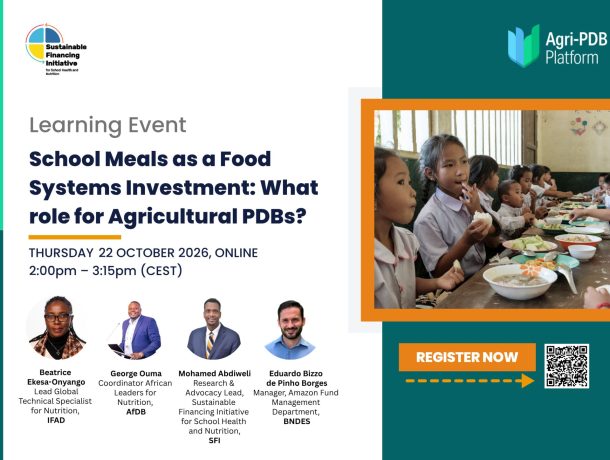
The Role of Agricultural Public Development Banks
22 October 2026 | Online
Connecting school nutrition with agricultural investment
School meal programmes connect children’s nutrition and education with agricultural production, local enterprise development and rural livelihoods. When procurement arrangements enable local suppliers to participate, schools can provide an institutional market for nutritious foods. Realising this potential requires investment in the people, enterprises, infrastructure and services that bring food from producers to school kitchens.
On 22 October 2026, the Agri-PDB Platform, together with the Sustainable Financing Initiative (SFI), convened the webinar “School Meals as a Food Systems Investment: What Role for Agricultural PDBs?” The exchange brought together perspectives from SFI, the African Development Bank (AfDB), the Brazilian Development Bank (BNDES) and IFAD.
Opening the discussion, Thierry Latreille, Coordinator of the Agri-PDB Platform, highlighted the opportunity to connect school nutrition with areas that agricultural public development banks already finance: production, aggregation, storage, processing, transport and working capital. The task is to connect these investments more deliberately with school food markets, supported by technical assistance and partnerships.
Amy Bellinger, Director of the Learning Generation Initiative, introduced SFI’s work and highlighted the wider development potential of homegrown school feeding. She emphasised that government purchasing decisions influence what farmers grow, how food is produced and who benefits from agricultural markets. Suppliers need investment to respond, while governments need sustainable financing arrangements to maintain predictable demand.
An important distinction underpins this approach. School meal programmes need sustained funding to purchase food and deliver meals. Their suppliers need finance to produce, purchase, process and distribute that food. Agricultural lending can strengthen the supply response, while credible programme budgets and procurement arrangements provide the foundation on which suppliers and lenders can plan.
Turning school food demand into viable investment
Mohamed Abdiweli, Research and Advocacy Lead at SFI, highlighted the scale of the opportunity: school meals reach approximately 466 million children globally and represent around USD 84 billion in annual spending. However, demand for food does not automatically translate into viable demand for credit.
For local producers, cooperatives and agri-SMEs, participation depends on what schools purchase, the quantities required, contract sizes, prices, delivery schedules and payment terms. These conditions influence both suppliers’ ability to participate and their capacity to repay financing.
SFI identified three complementary financing opportunities: seasonal credit for farmers and producer groups, working capital for cooperatives and aggregators, and asset finance for processors and logistics providers.
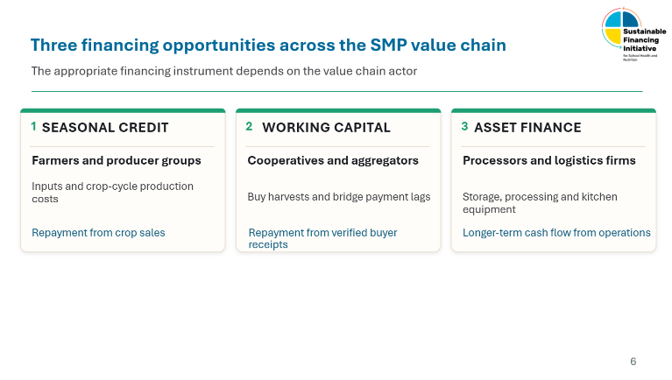
The appropriate instrument depends on the borrower’s activities, cash flow and repayment capacity. Some suppliers first need grants and technical assistance to strengthen production, management and financial capabilities before they can use credit effectively.
The Ghana example illustrated how these connections can work. Agricultural Development Bank financing linked farmers with the National Food Buffer Stock Company, which purchases produce and supplies public institutions, including senior high schools. The lesson is that financing intermediaries can connect agricultural producers with institutional markets and support several actors within the same value chain.
MDB and PDB cooperation
Ouma George, Coordinator of the Ending School Age Hunger Programme and African Leaders for Nutrition at the African Development Bank (AfDB), explored how multilateral development banks can work with national PDBs to expand financing for agricultural value chains serving school meal programmes.
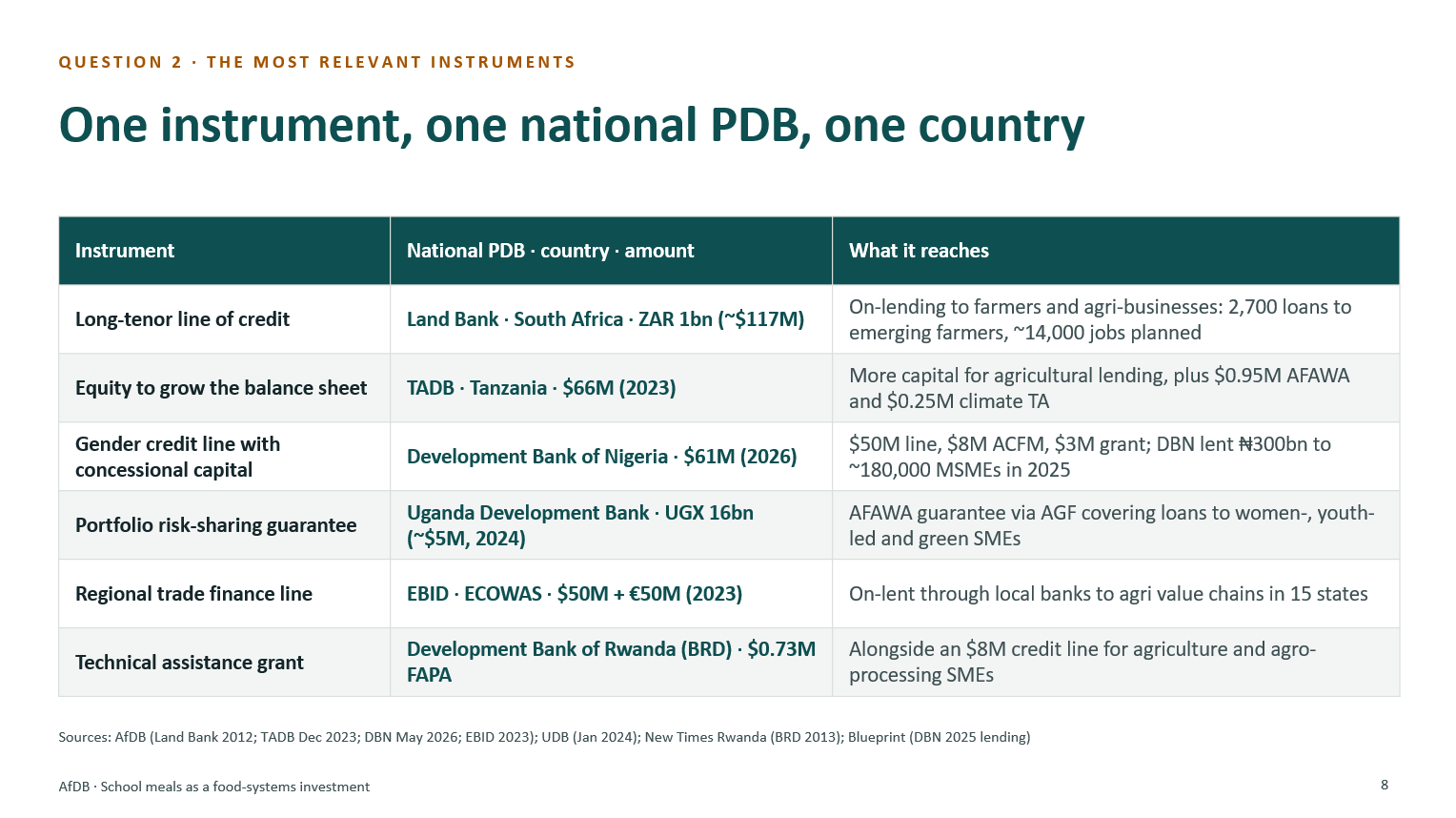
Relevant instruments include longer-term credit lines, concessional finance, guarantees and technical assistance. These can strengthen national lenders’ capacity to serve producers, cooperatives and agri-SMEs whose financing needs are not adequately met.
AfDB presented existing agricultural financing partnerships alongside potential applications to school meal supply chains. Established agricultural credit and risk-sharing mechanisms offer a basis for developing school meal supplier finance, but their connection to school procurement must be deliberately designed.
One approach discussed was financing suppliers against credible purchasing contracts. A contract can provide evidence of future revenue, but its financing value depends on the reliability of the buyer, payment performance, delivery obligations and the supplier’s capacity to fulfil the agreement.
The presentation therefore emphasised conditions beyond the financing instrument itself: predictable public budgets, timely payments, investment-ready suppliers and a visible pipeline of opportunities. Proposed next steps included piloting supplier financing arrangements with national PDBs and exploring working capital backed by contracts, accompanied by risk-sharing and technical assistance.
Brazil and investment in both supply and demand
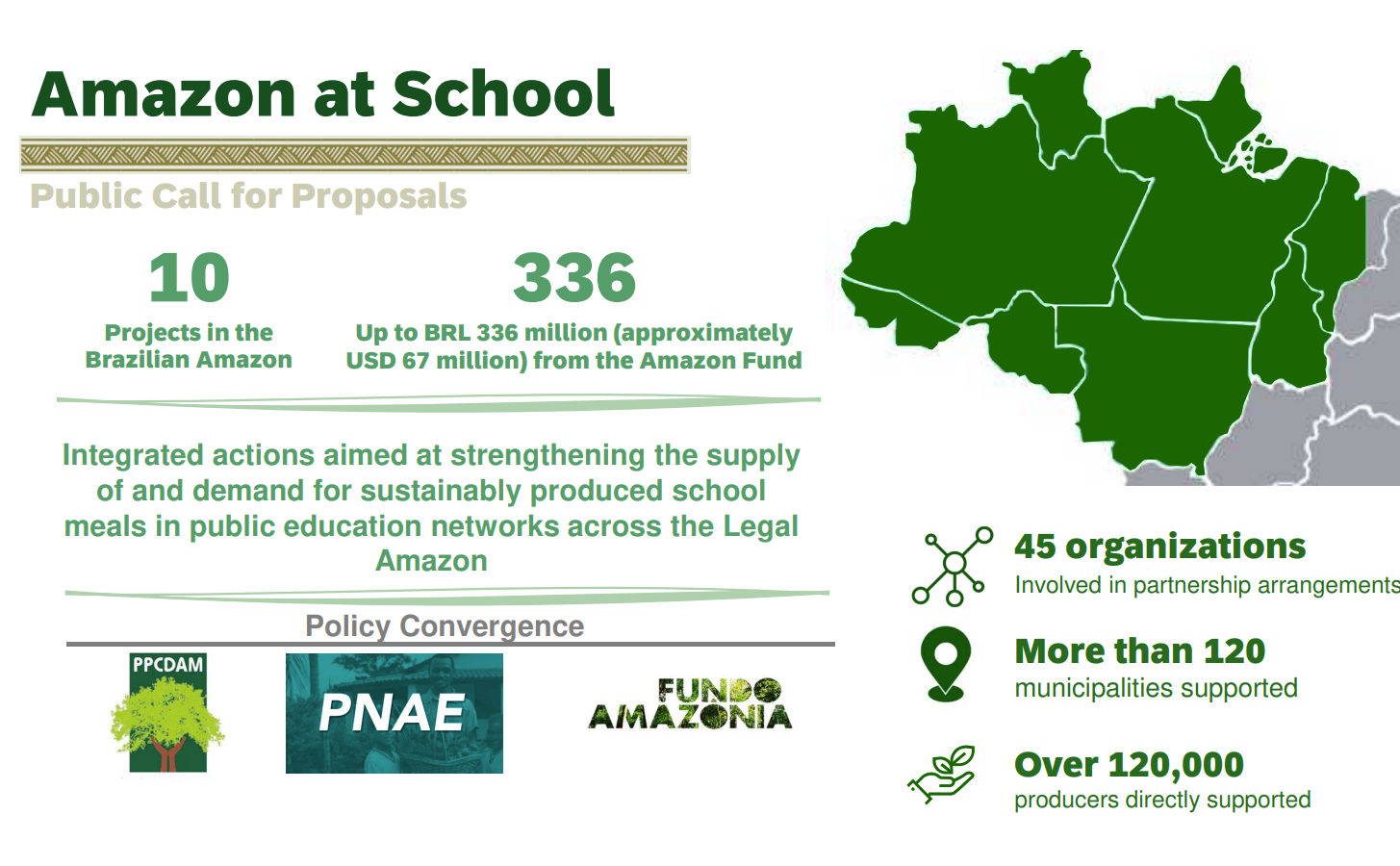
Eduardo Bizzo de Pinho Borges, Manager of the Amazon Fund Management Department at the Brazilian Development Bank (BNDES), presented “Amazon at School”, supported by the Amazon Fund, as an example of coordinated investment in sustainable production and school food procurement.
The initiative connects family farming with public education networks in the Brazilian Amazon. It supports producers’ infrastructure and organisations while strengthening the capacity of education systems to purchase and use sustainably produced food.
The presentation outlined ten projects supported through an allocation of up to BRL 336 million. The approach brings together production, procurement and consumption, with particular relevance for family farmers, Indigenous Peoples and traditional communities.
Its significance for PDBs extends beyond lending. Non-repayable resources can address constraints that individual suppliers cannot finance through commercial borrowing alone, including organisational capacity and the coordination needed to connect producers with public buyers.
The central lesson is that supply and demand must develop together. Producers need the capacity to deliver, while schools and public authorities need effective procurement, food management and meal preparation arrangements. Coordinating these investments can connect school nutrition with local livelihoods and environmental objectives.
Keeping nutrition central to investment decisions
The development value of school food markets depends on the food they deliver. Greater production or higher procurement volumes alone do not establish that children’s diets have improved.
School menus and nutrition requirements should inform which value chains receive support and what infrastructure is needed. Supplying diverse foods may require different investments, such as storage for pulses, cooling for dairy products, or handling and transport systems for fresh produce.
Food safety, dietary diversity and nutritional quality therefore need to remain explicit considerations from production through procurement and meal preparation. Monitoring should examine the quality and reliability of food supplied, alongside supplier participation and financial performance.
IFAD closing remarks on enabling suppliers to meet demand
In her closing remarks, Beatrice Onyango-Ekesa, Lead Global Technical Specialist for Nutrition at IFAD, reinforced that school food demand must be accompanied by the capacity to meet it consistently and profitably.
Drawing on around 60 projects with school nutrition activities, IFAD highlighted the contribution of producer organisations, rural enterprises, infrastructure, technical assistance and market information. Examples included farmer federations supplying school feeding programmes in Guinea-Bissau, maize cooperatives securing school canteen contracts in Benin, and digital tools connecting farmer groups with schools in Bhutan.
These experiences demonstrate the importance of practical support: organising suppliers, improving production planning, meeting food safety requirements and strengthening connections with institutional buyers.
Priorities for agricultural public development banks
The discussion identified a clear direction for further engagement:
- Connect school procurement opportunities with existing agricultural financing portfolios.
- Match financing to the needs and repayment capacity of actors across the school food value chain.
- Combine finance with grants, technical assistance and investment preparation where needed.
- Work with governments, multilateral development banks and development partners to align procurement, supplier support and financing.
- Keep children’s access to safe, nutritious and diverse food central to investment design and monitoring.
Agricultural PDBs can contribute both as financiers and as partners in developing inclusive school food markets. Their opportunity is to support viable local supply chains within a wider system of reliable public purchasing, capable suppliers and clear nutrition objectives.
Recording and presentations
Similar articles