

Mainstreaming Nutrition in Public Development Banks Investments: Entry Points and the NutrInvest Tool
As global challenges around food systems, health, and sustainable development intensify, nutrition is increasingly recognized as a central pillar of development finance. In collaboration with GAIN and IFAD, the Agri-PDB Platform organised a webinar to explore how nutrition can be effectively integrated into investment strategies. The session highlighted practical experiences, conceptual frameworks, and innovative tools, such as NutrInvest, demonstrating that integrating nutrition into finance is not only necessary but also achievable.
Mainstreaming Nutrition in Public Development Banks Investments: Entry Points and the NutrInvest Tool
8 April 2026 | Rome, Italy
Introduction
Given the growing priority that represents nutrition the Agri-PDB Platform collaborated with International Fund for Agricultural Development (IFAD) and Global Alliance for Improved Nutrition (GAIN) to organise a webinar centred around “Mainstreaming Nutrition in Public Development Bank (PDBs) Investments: Entry points and the NutrInvest Tool”. The interactive session opened with Marco Camagni, Lead Global Technical Specialist, Rural Institutions, at IFAD, who emphasized how nutrition is a cross-cutting issue influencing agriculture, food systems, climate resilience, and economic productivity leading to far-reaching consequences in a context of poor nutrition. As in many other sectors, public development banks (PDBs) can be the driving force behind meaningful change. Therefore, integrating nutrition into their investments represents both a responsibility and an opportunity.
PDB Experiences – Senegal’s La Banque Agricole (LBA)
Representing LBA, Alioune Seydi, Head of Monitoring and Evaluation, illustrated how the bank is actively integrating nutrition into its investment operations. In practice the bank aligns closely with national agricultural and nutrition strategies, prioritising crop diversification, support for horticulture and agroforestry, while also financing women-led processing activities such as vegetable processing and the nutritious oils. Beyond financing, LBA promotes nutrition through partnerships with development programs enabling the provision of technical assistance, capacity building, and development structured nutrition sensitive value chains. Drawing from LBA’s experience, Mr. Seydi emphasized that advancing nutrition sensitive investments remains a challenge. Key constraints include the absence of dedicated financial instruments for nutrition, limited incentives to prioritize nutrition outcomes, and the continued reliance on external partnerships to drive implementation. Thus, looking forward, LBA will explore:
- Concessional interest rates for nutrition-related activities;
- Investment grants for SMEs and farmer organizations; and
- More targeted financial products designed to incentivize nutrition outcomes.
With their strong local presence and close alignment with national priorities, PDBs have a critical role to play in ensuring that financial flows contribute to improved nutrition outcomes, healthier populations, and more resilient economies. They can achieve this by applying a nutrition lens across multiple investment areas including agricultural value chains, rural finance, infrastructure (markets, roads, storage), climate and resilience projects, as well as income generation and financial inclusion.
Understanding Nutrition-Sensitive Investments
The discussion pursued emphasizing that nutrition is not just about food quantity, but about the quality (nutrient-rich foods), the diversity (balanced diets), and the safety (free from contamination). Providing IFAD’s perspective, Dr. Beatrice Ekesa-Onyango (IFAD) focused on the key entry points for integrating nutrition into agricultural and financial investments. She began by clarifying what constitutes a nutrition-sensitive (NS) investment for IFAD, one that intentionally improves the underlying determinants of nutrition, such as food availability, access to diverse diets, income, and knowledge. Nutrition outcomes, she noted, are shaped by multiple factors—including food systems, income, care practices, and the broader environment making a systems approach essential when designing investments.
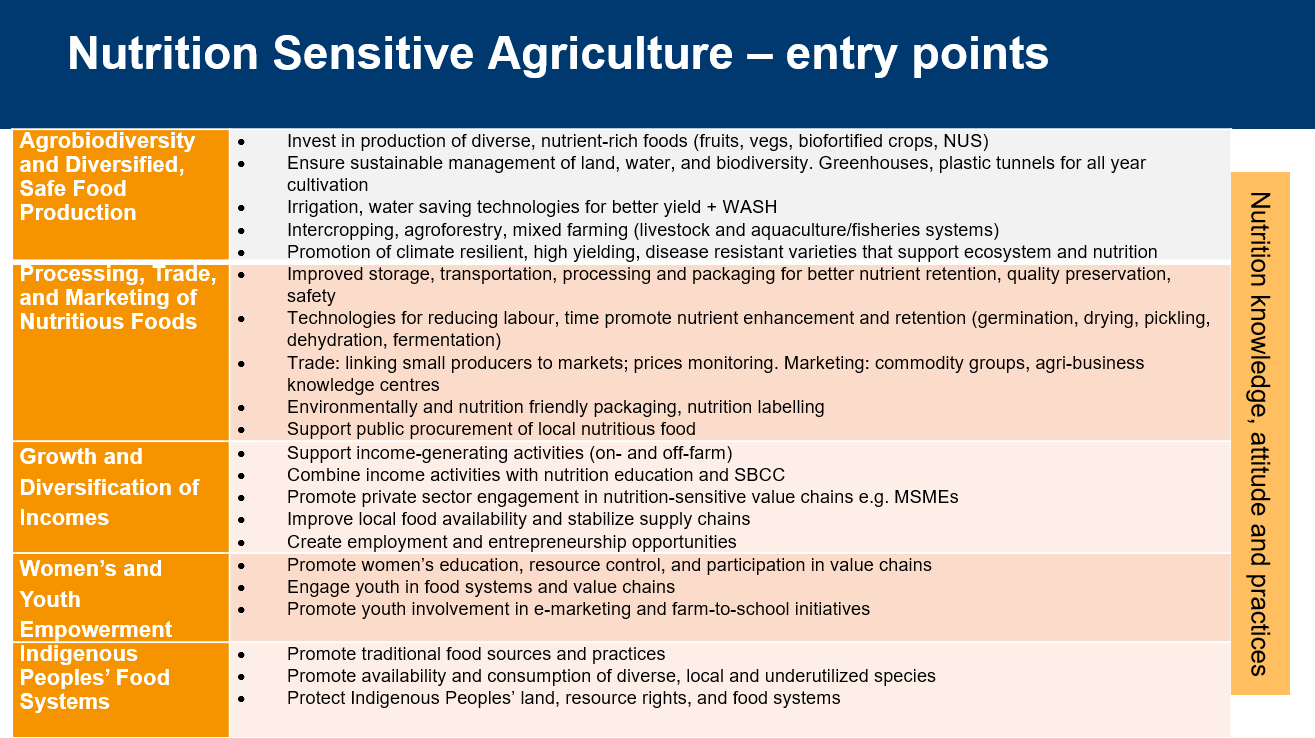
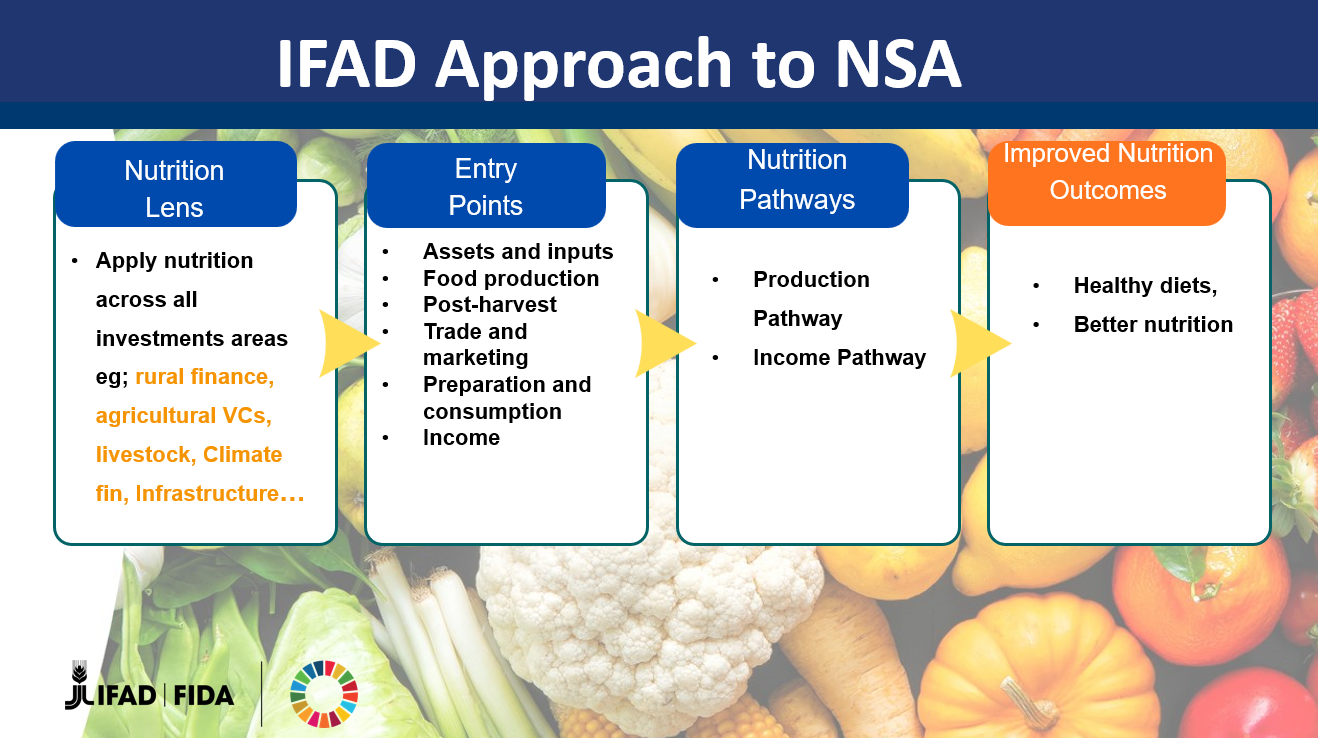
She further identified key entry points across the agri-food system and related investment areas, including improving access to diverse and nutrient-rich inputs, promoting diversified food production, strengthening post-harvest management, and enhancing the processing, trade, and marketing of nutritious foods. The importance of supporting income-generating activities, empowering women and youth, and complementing investments with nutrition education and behaviour change was also emphasized. These approaches were illustrated through a case study from IFAD’s Climate Change Adaptation and Agribusiness Support Programme (CASP) in Nigeria, demonstrating how such interventions can improve diets, reduce post-harvest losses, and strengthen resilience to food insecurity and malnutrition. Overall, this highlights how applying a nutrition lens can enhance the impact of investments on nutrition outcomes.
Innovative Financing: The Nutritious Food Financing Facility
An example of innovation in this space is the Nutritious Food Financing Facility (N3F), launched in Africa to address a major gap: the lack of investment vehicles focused specifically on nutrition. Roberta Bove, Senior Lead for Innovative Finance and Team Lead of the Nutritious Food Enterprise Unit at GAIN presented the fund’s key pillars: (i) Focus on SMEs producing safe and nutritious food; (ii) Combination of debt financing and technical assistance; and (iii) Integration of nutrition impact assessment throughout the investment cycle. She further noted that impact has been integrated in every stage of the investment process, from the initial eligibility assessment, the quantitative portfolio scoring, to the assessment of additional aspects of nutrition contribution.
The N3F food classification system was also presented, as detailed below:
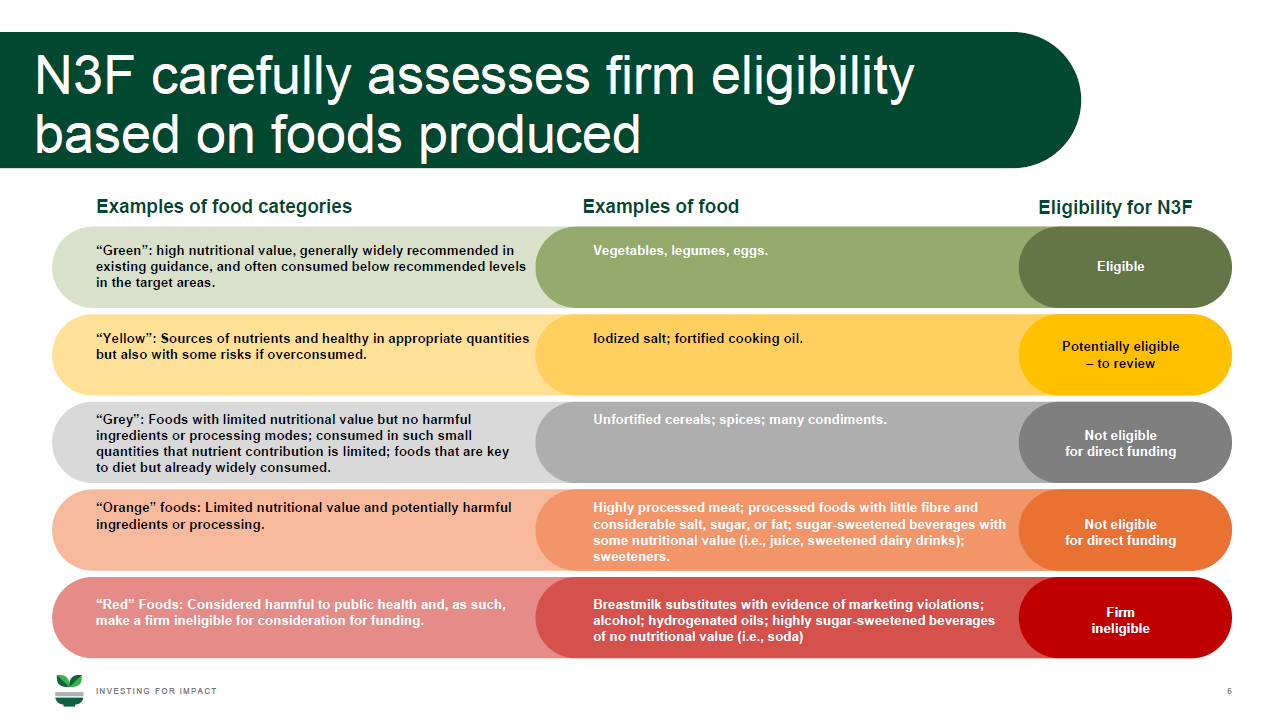
Since its launch the fund made significant progress as it has deployed half its capital and invested in 10 SMEs across six African countries, including Kenya, Rwanda, Senegal, Tanzania, Uganda, and Zambia, with a portfolio spanning a wide range of activities.
Following up, Stella Nordhagen, Implementation Research Advisor at GAIN, acknowledged that most investors do not have nutrition as their primary focus or the same level of in-house expertise. This gap led to the development of the NutriInvest tool, a “light-touch” screening tool designed to make nutrition-focused investment decisions more accessible and practical for a wider range of investors. Developed initially by USAID and Wellspring and later completed by GAIN and Wellspring, the tool aims to increase both the volume and quality of nutrition-focused investments by providing clear, science-based guidance. Participants could see the concrete demonstration of how users can assess either a single product or multiple products within a company. Through the example of flour mill, where 90% of revenue comes from unfortified refined flour and 10% from fortified flour, the tool determined that this does not qualify as a nutrition investment because the main product does not significantly improve diet quality. Instead, through the same company, but using a different product mix—now 80% fortified flour and 20% unfortified, the tool classified the investment as nutrition-positive, since the majority of products are nutritionally beneficial.
Q&A discussion
The discussion explored whether the tool could be applied to investments in financial institutions. It was noted that with enough transparency into a financial institution’s investment portfolio, the tool could be applied at the level of the companies being financed. Alternatively, financial institutions could be trained to use the tool themselves to assess their portfolios, with guidance on how much of their investments should meet nutrition-sensitive criteria.
More questions were raised regarding whether the tool accounts for country specific foods as well as the size of the fund and the possibility of financing PDBs. The speakers clarified that the tool does not account for country-specific nutritional needs, as foods that are considered healthy in one context are generally relevant across others. They also noted that the fund does not directly invest in PDBs.
Upon request, several approaches to assessing a country’s “nutrition gap” were outlined, including nutrient-level analysis and outcome-based methods. A practical strategy was highlighted: comparing a country’s food supply with what is required to meet population-wide healthy diet standards. The discussion concluded with a broader question on how to balance financial returns with nutrition impact, particularly in underdeveloped markets. It was noted that nutrition-focused investments—especially at the MSME level—can be financially viable, while humanitarian contexts may require subsidized approaches. it was emphasized that many companies successfully deliver nutritious foods and products through channels such as schools, hospitals, and emergency programs without compromising financial performance.
Conclusion
Concluding remarks highlighted that the integration of nutrition into development finance is no longer optional—it is essential for achieving sustainable and inclusive growth. As this webinar demonstrated, the tools, frameworks, and real-world examples already exist. The next step is scaling implementation, deepening collaboration, and transforming how investments are designed.
To access the slides and recordings, please click here.
Similar articles