

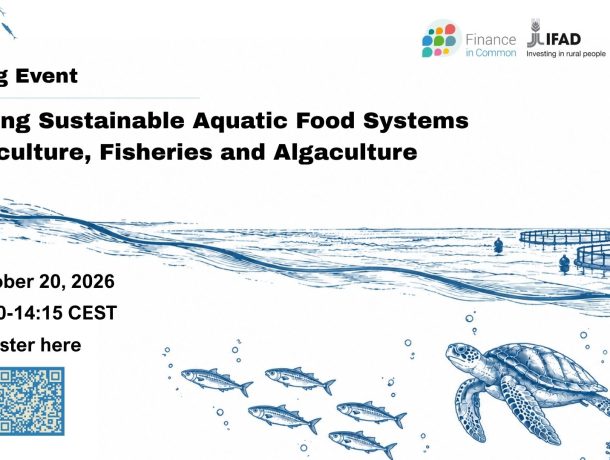
Learning Event: Financing Sustainable Aquatic Food Systems — Aquaculture, Fisheries and Algaculture
How can public development banks support sustainable fisheries, aquaculture and seaweed farming? Drawing on experiences from Fiji, Belize and West Africa, this learning event explored how tailored loans, blended finance and partnerships can strengthen aquatic enterprises while protecting marine ecosystems and coastal livelihoods.
Learning Event: Financing Sustainable Aquatic Food Systems — Aquaculture, Fisheries and Algaculture
20 October 2026 | Online
How can public development banks finance aquatic food systems while protecting the ecosystems and livelihoods on which they depend? On 20 October 2026, the Agri-PDB Platform, hosted by IFAD, and the Finance in Common (FiCS) Ocean Coalition jointly organised a learning event on Financing Sustainable Aquatic Food Systems – Aquaculture, Fisheries and Algaculture.
The session brought together Lise Enezian of Agence Française de Développement (AFD); Ramesh Chand, Acting Chief Relationship and Sales Officer at Fiji Development Bank (FDB); Henry N. Anderson, Chief Executive Officer of Development Finance Corporation (DFC), Belize; and Aïssatou Diagne of the West African Development Bank (BOAD). Their experiences showed how lending conditions, technical support and partnerships can help finance reach artisanal fishers, coastal enterprises and emerging value chains.
AFD links investment with sustainable fisheries management
Lise Enezian explained that AFD combines support for fisheries production and value chains with knowledge, governance and ecosystem protection. Stock assessments, monitoring systems, management plans and institutional capacity help ensure that investment supports sustainable use of marine resources. AFD requires a management component in its fisheries projects and does not directly finance fleet building or activities that increase fishing pressure to unsustainable levels.
Its financing tools include project loans, policy-based lending, credit lines through financial intermediaries, grants, guarantees and equity. These are combined with capacity building and technical expertise according to the needs of governments, businesses and communities.
A persistent challenge is reaching smaller actors. Small loan sizes can be costly to appraise, while community initiatives and conservation activities often depend on grants. With grant availability declining, Enezian raised an open question for PDBs: how can they continue to support these actors and encourage the sector’s transition towards sustainability? AFD combines financial instruments with capacity building and expertise sharing to support the fisheries and aquaculture sectors 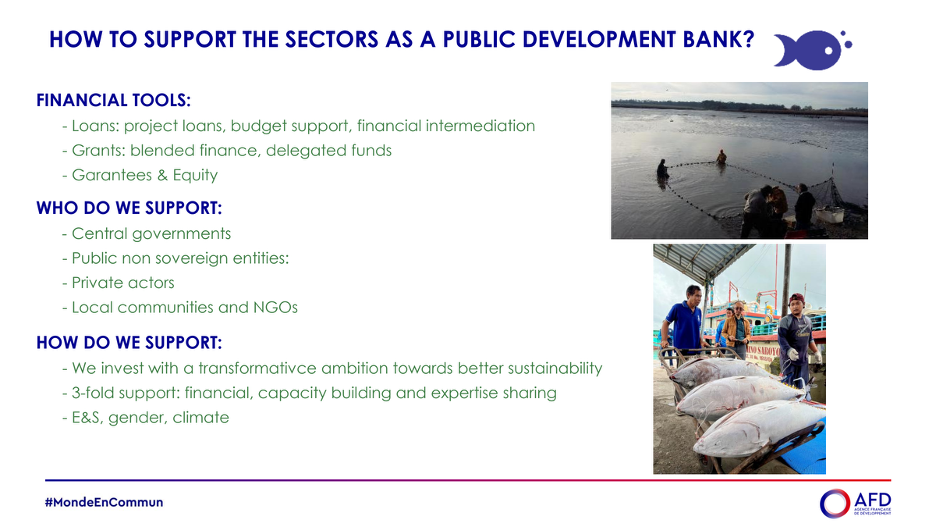
Fiji combines blue lending with enterprise development
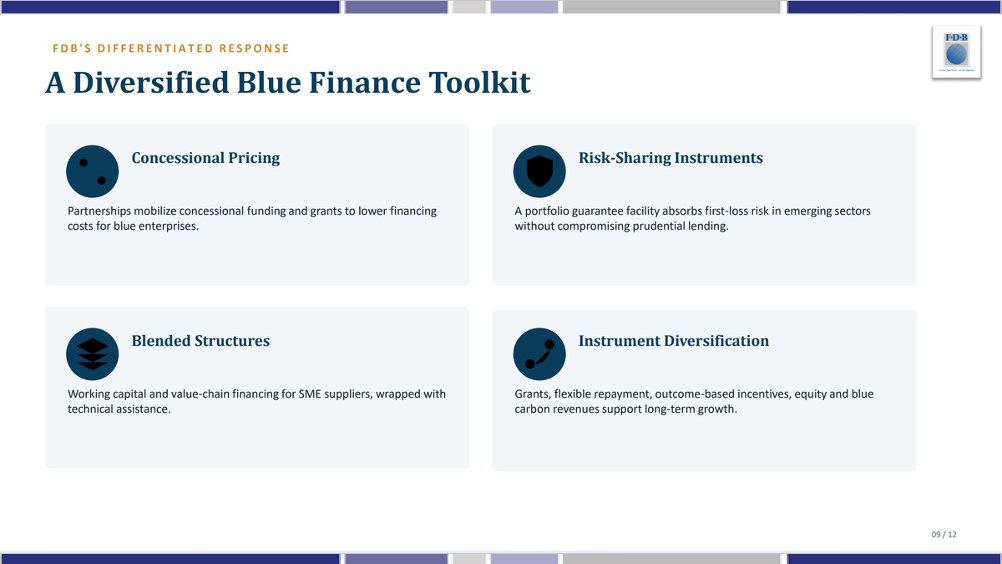
Ramesh Chand described FDB’s approach to developing bankable blue enterprises in Fiji’s maritime and coastal communities. Its sustainable blue finance framework connects the bank’s development mandate with national ocean, climate and green growth priorities. A partnership with the United Nations Capital Development Fund (UNCDF) provides guarantee support for its sustainable blue lending.
The Lau Seascape Stewardship Impact Facility, developed with Conservation International Fiji, illustrated why local enterprise development needs finance and technical support together. The pilot identified business opportunities in fisheries, tourism and products based on local resources, alongside barriers including high transport costs, limited market access, weak business capabilities and insufficient technical assistance. FDB’s response combines concessional pricing, risk sharing, working capital and value-chain finance with technical assistance. Chand also described opportunities to explore grants, outcome-based incentives, equity and blue carbon. For remote island businesses already facing high operating costs, affordable lending can determine whether a sustainability investment is financially viable.
He linked this approach to lessons from FDB’s peer-to-peer exchange with Thailand’s Bank for Agriculture and Agricultural Cooperatives (BAAC): specialised products, stronger relationships with technical agencies and producer groups, better data, and partnerships that connect producers to buyers and markets. FDB is seeking partners to expand the Lau experience and develop wider ocean stewardship financing facilities.
Belize designs loans around fishing and harvest cycles
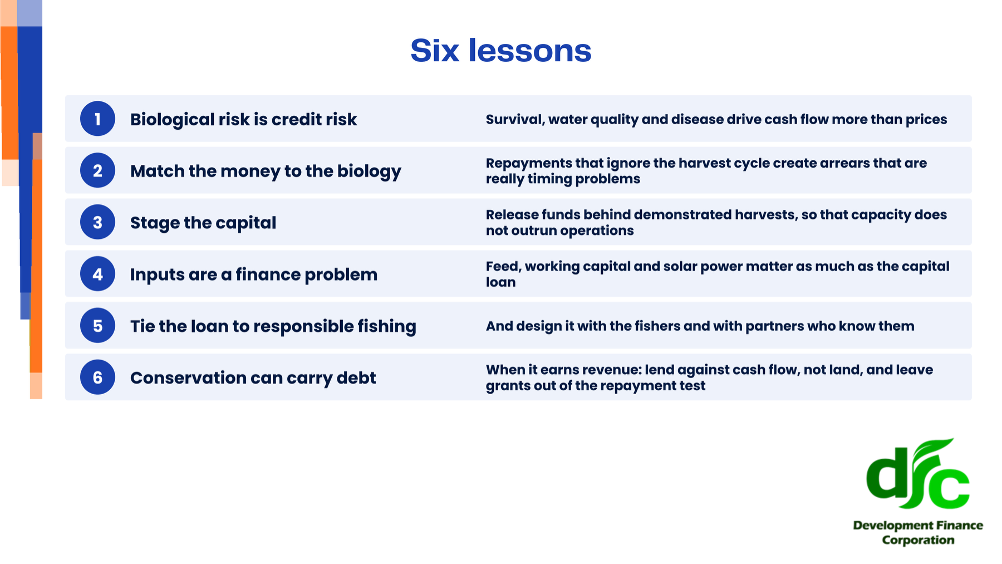
Henry N. Anderson presented DFC Belize’s experience across artisanal fisheries, aquaculture and marine conservation. His central lesson was that biological conditions and production cycles must inform credit decisions: water quality, disease and survival rates can determine a shrimp farm’s ability to repay.
For artisanal fishers, DFC offers small asset loans whose repayments can follow the fishing season. Licensing, compliance with fisheries rules and participation in training form part of the approach. Engagement with fishers and partner agencies also helps borrowers understand loan requirements and access formal finance. A pilot with the Belize Fund for a Sustainable Future adds a loan rebate for fishers who meet agreed repayment and responsible-fishing criteria. It connects conservation funding associated with Belize’s Blue Bond to incentives at borrower level.
In aquaculture, DFC combines longer-term finance for ponds and tanks with working capital for feed, post-larvae and energy. Expansion is financed in stages as farms demonstrate results over successive harvests, helping prevent investment in capacity from outpacing operational performance. Anderson also described a facility for the Turneffe Atoll Sustainability Association (TASA), which co-manages a marine reserve used by many of DFC’s fisher clients. DFC refinanced an offshore loan locally, provided liquidity and financed solar equipment. The assessment relied on earned income, including visitor fees, and excluded grants from the repayment test. The example showed how a conservation organisation with dependable revenues can access debt finance.
BOAD develops a regional approach to aquatic value chains
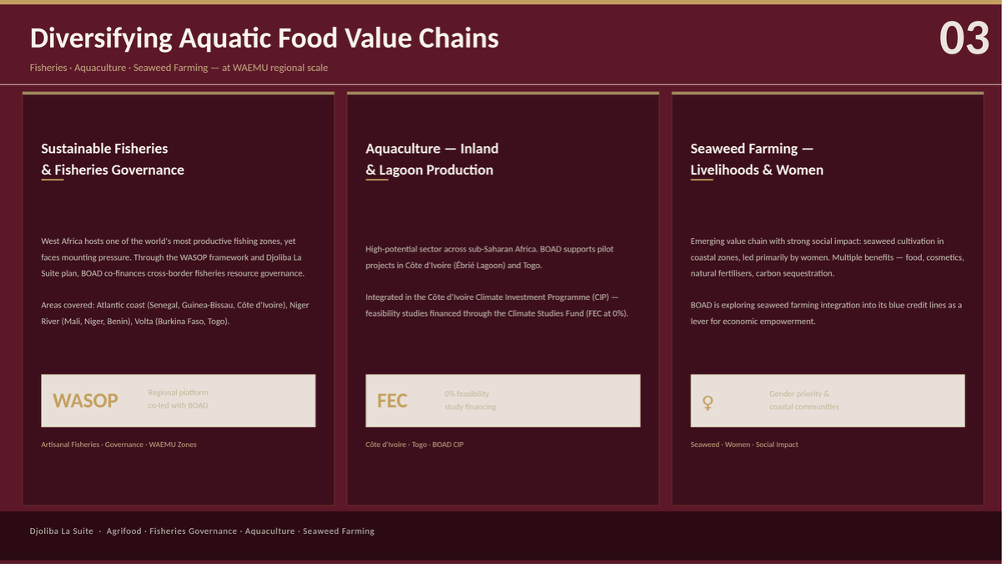
Aïssatou Diagne explained why aquatic food systems require regional cooperation in West Africa. Fish stocks, river basins and coastal ecosystems cross national boundaries, making coordinated governance and investment essential. BOAD is developing its blue finance approach through regional partnerships and country-level investment programmes.
She outlined three areas of work: sustainable fisheries and fisheries governance; inland and lagoon aquaculture; and seaweed farming. BOAD is supporting aquaculture pilots in Côte d’Ivoire and Togo, while exploring how seaweed cultivation could be incorporated into blue credit lines to support coastal livelihoods and women’s economic opportunities.
Project preparation is a key part of this approach. BOAD’s Climate Studies Fund provides zero-interest financing for feasibility studies, helping projects become ready for investment. Other instruments discussed included blue credit lines through local financial institutions, blended finance using multilateral climate resources, and capital-market financing.
Diagne presented an ambition to deploy around EUR 150 million annually in blue finance by 2030 and noted that a potential debt-for-nature swap with Guinea-Bissau remained at an early stage of exploration. Her call to fellow PDBs focused on blue taxonomies adapted to regional conditions, guarantees and other risk-sharing mechanisms, and continued peer exchange. BOAD’s regional approach covers sustainable fisheries governance, inland and lagoon aquaculture, and emerging seaweed value chains.
Discussion on insurance and access to credit
The Q&A examined how financial institutions can manage risk and extend finance to smaller producers.
- What insurance options are available for fisheries and aquaculture?
DFC Belize reported work, supported by a FiCS Lab grant, to integrate parametric insurance into its portfolio, including fisheries. FDB also described discussions on parametric insurance, while clarifying that it did not yet have dedicated blue finance coverage and that existing insurance primarily covered collateral. The exchange highlighted an area still under development.
- How can PDBs encourage commercial banks to lend to the sector?
DFC described a guarantee fund under preparation to encourage commercial banks and credit unions to enter underserved sectors. Earlier in the session, BOAD had also discussed blue credit lines through local banks and microfinance institutions. These approaches aim to combine PDB support with financial institutions that can reach local borrowers.
- How can the FiCS Ocean Coalition support institutions interested in blue bonds?
The Coalition invited interested institutions to make contact for a dedicated discussion on how it could support their work. Blue bonds and blue taxonomies were identified as possible subjects for further exchanges between the coalitions and member banks.
Key takeaways for public development banks
- Design lending around the sector. Align repayment schedules and working capital with fishing seasons and harvest cycles, and include biological and climate risks in credit assessment.
- Finance sustainable resource use. Combine investment in enterprises with fisheries governance, environmental and social safeguards, and ecosystem protection.
- Support investment readiness. Pair affordable finance and risk sharing with feasibility studies, business skills, technical assistance and market connections.
- Use partnerships to reach smaller actors. Work with local lenders, conservation organisations, technical agencies and producer groups, and share experience across PDBs.
The event identified practical ground for further collaboration between the Agri-PDB Platform and the FiCS Ocean Coalition, particularly on insurance, blue taxonomies and financing instruments. Sharing experience across regions can help PDBs adapt these approaches to the needs of fishing communities and aquatic enterprises.
Recording and presentations
Similar articles