

Learning Event: Webinar Series II: Carbon Credits in Agriculture – From Frameworks to Field Implementation
Making agricultural carbon projects credible, bankable and farmer-centred.
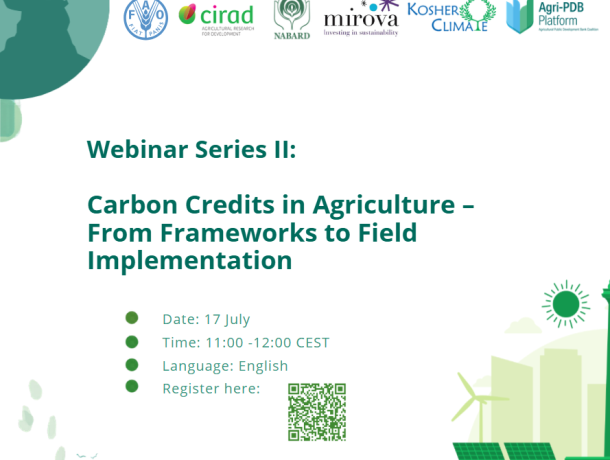
Carbon Credits in Agriculture: From Frameworks to Field Implementation
17 July 2026 | Online
Following the first session, which introduced key concepts, the second session of the Agri-PDB Platform’s webinar series on carbon credits in agriculture shifted from market concepts to field implementation. It brought together Ivano Assenza of FAO and the Food and Agriculture for Sustainable Transformation (FAST) Partnership; Alain Karsenty of CIRAD; Gautier Quéru of Mirova; Aftab Khairdi, Assistant Manager at the National Bank for Agriculture and Rural Development (NABARD); and Vamsi Krishna M of Kosher Climate.
The discussion examined how agricultural carbon projects are designed, financed, monitored and scaled—and what must be in place for farmers and local communities to receive a fair share of the value they create.
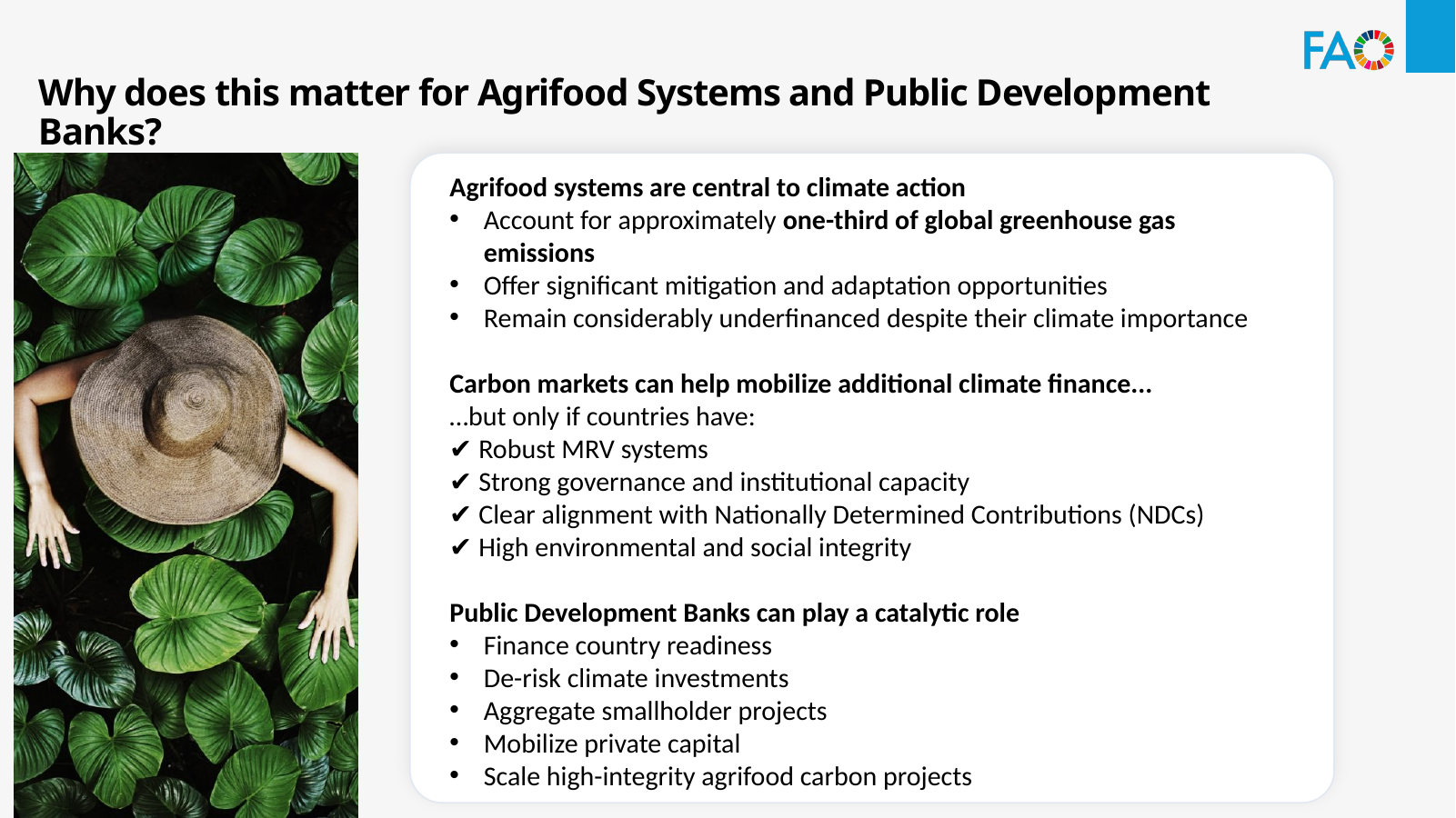
The opening message was clear: public development banks (PDBs) are well positioned to connect international climate finance with local agricultural realities. They understand the needs of farmers and rural institutions, while their public mandate and financial capabilities enable them to de-risk investment, aggregate small projects, mobilize private capital and promote equitable benefit-sharing.
Readiness comes before carbon credits
Ivano Assenza of FAO opened with an update on Article 6 of the Paris Agreement and the shift from international rulemaking to national implementation. Countries are now working to establish designated national authorities, authorization procedures, registries, accounting systems and institutional arrangements for internationally transferred mitigation outcomes.
For agrifood systems, this transition creates both an opportunity and a responsibility. FAO”s slides noted that the sector receives only 3.8% of global mitigation finance despite accounting for approximately one-third of global greenhouse gas emissions and offering significant mitigation and adaptation potential. Carbon markets can help narrow this financing gap, but they cannot substitute for strong public institutions.
High-quality projects depend on credible baselines, robust monitoring, reporting and verification (MRV), clear links to nationally determined contributions (NDCs), transparent carbon accounting, social and environmental safeguards, and rules that prevent double counting. Capacity-building therefore remains a central part of carbon-market development.
Three principles framed the rest of the session:
- Readiness must precede credit generation.
- Integrity is what creates confidence among governments, investors, buyers and communities.
- Partnerships are essential to turn national climate ambition into investable projects that deliver value to farmers.
Integrity, additionality and the question of carbon rights
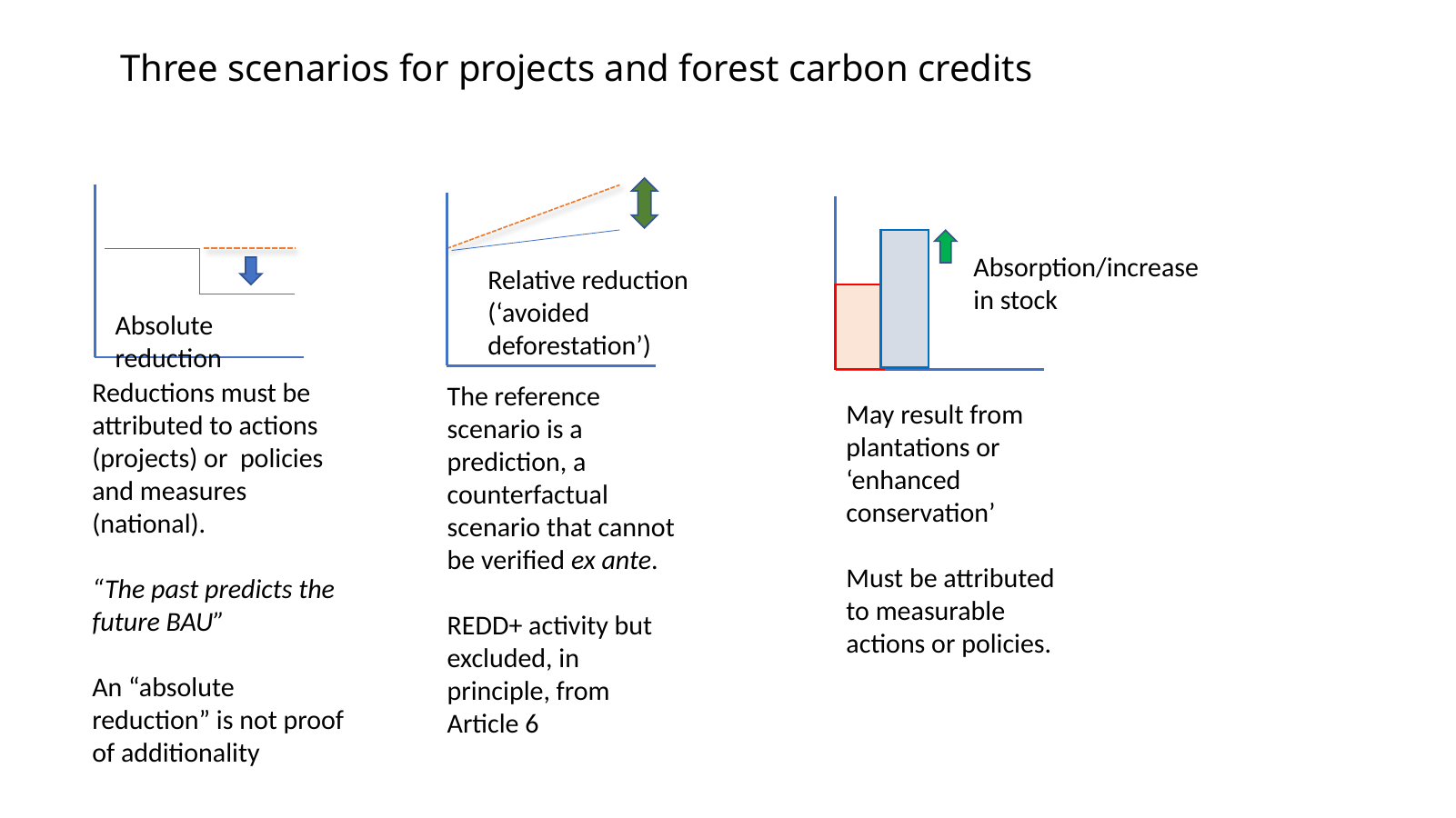
Alain Karsenty of CIRAD drew on experience from forest carbon markets and the emerging issue of “sovereign carbon” to highlight questions that are also relevant to agriculture. Carbon stored in trees or soils does not by itself generate a tradable credit. A project-based claim must attribute reductions or removals to specific actions and demonstrate that the result is additional to what would have happened without the intervention.
Environmental integrity is therefore central. Additionality is necessary when credits are used to offset or neutralise emissions, but it is difficult to demonstrate and verify. Non-permanence and leakage are further risks: protecting or restoring land in one place has limited value if the pressure for deforestation or land conversion simply shifts elsewhere. Baselines, project boundaries and the scale of accounting are consequently fundamental.
The presentation also distinguished cap-and-trade systems, which ration emissions through allowances or quotas under a cap, from project-based crediting mechanisms, which issue credits against a counterfactual baseline. Depending on the rules of a jurisdiction, credits may be used as emission permits only to a limited extent, and quotas and credits do not carry the same value.
“Sovereign carbon” is another rapidly evolving issue. Karsenty outlined approaches ranging from state-only selling or buying, to nested accounting, taxes or mandatory credit-sharing, domestic-only use, and more permissive voluntary-market sales. Under Article 6, international transfers require host-country authorization and, where applicable, corresponding adjustments so that the same mitigation outcome is not counted by both the host country and the buyer. Uncertainty over these rules affects who may sell credits and whether projects can become bankable.
From carbon revenue to project finance
Gautier Quéru of Mirova explained how the voluntary carbon market is becoming more structured as investors and corporate buyers use a wider range of financial instruments. His slides reported that close to US$20 billion was committed through forward carbon-credit purchases between 2023 and 2025, including US$12.25 billion announced in 2025. The value of those offtake contracts was more than 12 times the value of credits retired in 2025.
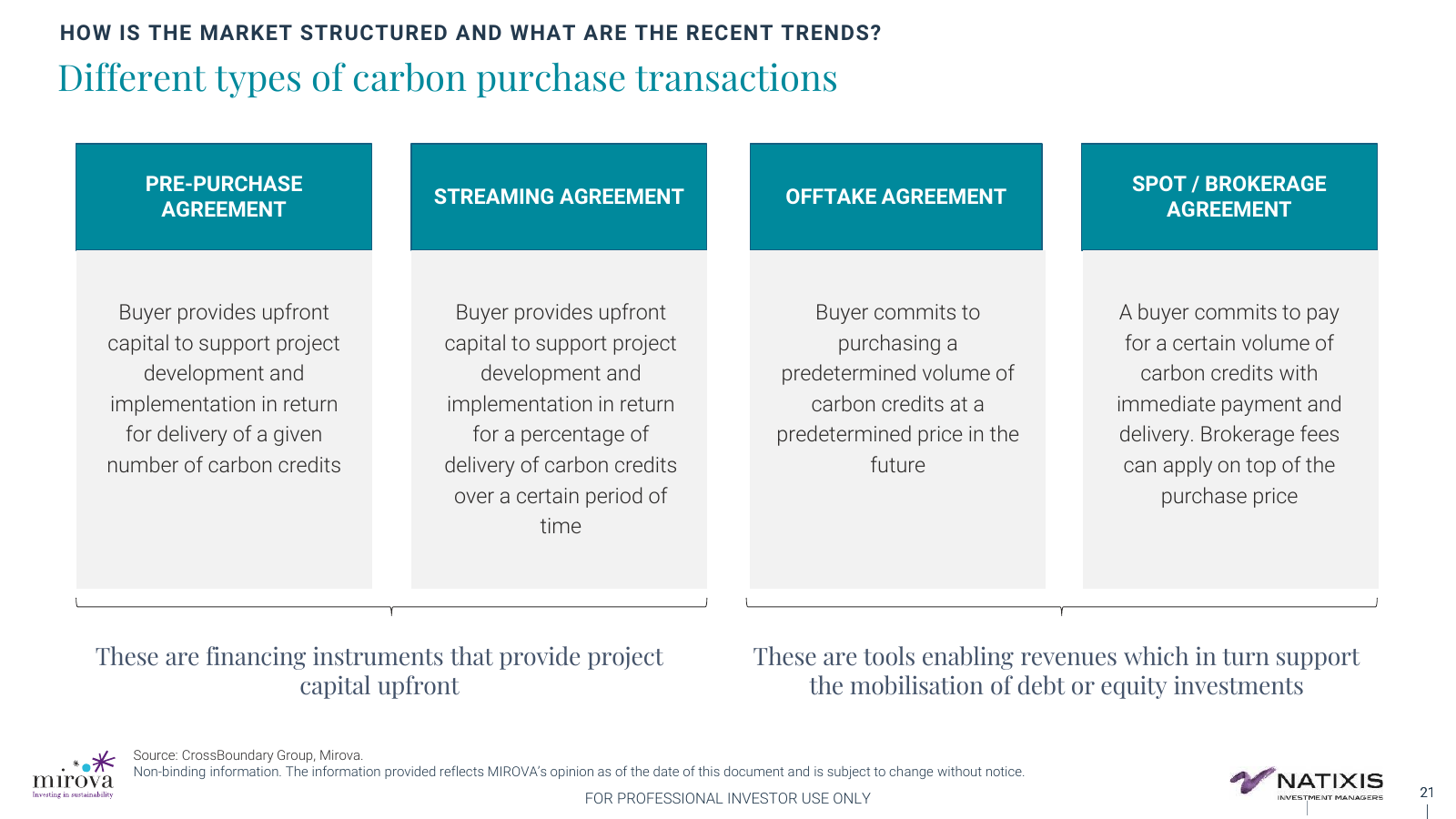
Four transaction types were highlighted:
- Pre-purchase agreements, in which a buyer provides upfront capital in return for a specified future volume of credits.
- Streaming agreements, in which upfront capital is exchanged for an agreed share of future credit issuance over a defined period.
- Offtake agreements, which commit a buyer to purchase a predetermined future volume at an agreed price, without necessarily providing upfront capital.
- Spot or brokerage transactions, which cover immediate payment and delivery of credits that have already been issued.
Quéru illustrated these structures with Mirova-backed projects in Madagascar, India, Costa Rica and South Africa. The examples covered community agroforestry, regenerative agriculture, reforestation, rotational grazing and restoration of degraded agricultural land. They also showed how special-purpose vehicles, pre-purchase arrangements, development-finance participation and guarantees can improve project risk profiles and mobilize larger pools of capital; in the South African case, the World Bank later supported an outcomes-bond financing.
A public development bank perspective: NABARD
Aftab Khairdi, Assistant Manager at NABARD, presented a cross-project view of four dimensions: project design, operational setup, critical field challenges and lessons learned. In settings with small and fragmented landholdings, projects need farmer aggregation, reliable data infrastructure, legal verification of land rights, scrutiny by validation and verification bodies, and transparent benefit-sharing. He compared three pathways: ARR (afforestation, reforestation and revegetation), which requires degraded-land stratification, standard selection, plantation design and attention to undocumented tenure; ALM (agricultural land management), which requires agricultural baselines, methane-reduction design and MRV across fragmented parcels; and biochar, which requires a removal methodology, lifecycle assessment, certified pyrolysis systems and viable uses beyond carbon revenue.
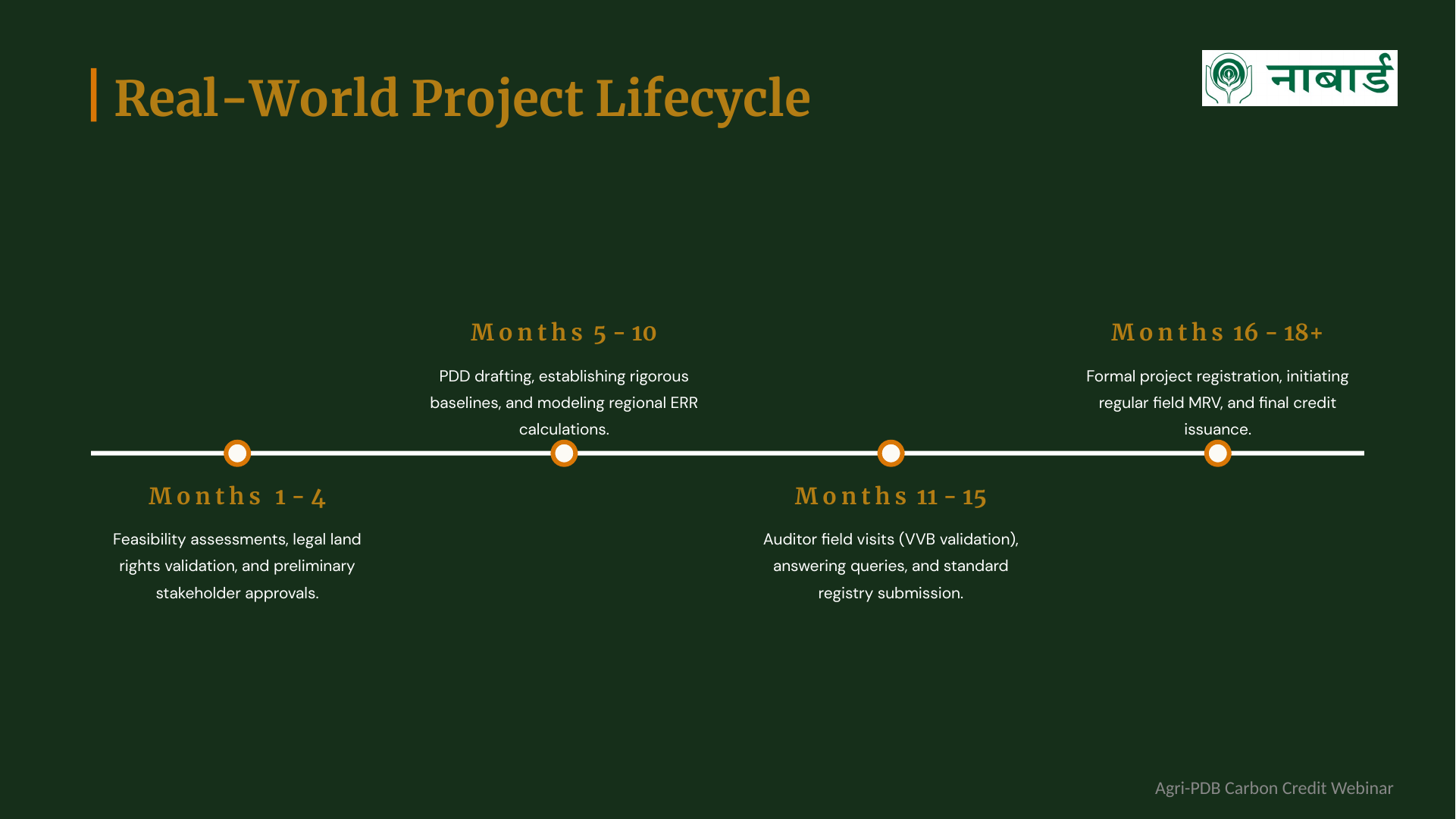
The project lifecycle presented by NABARD typically extends beyond 18 months before payouts: feasibility assessments, legal land-rights checks and preliminary stakeholder approvals are followed by project design documentation, baseline modelling, validation and verification body field visits, registry submission, formal registration, monitoring and eventual credit issuance. Farmers may invest field labour long before carbon revenue is available, making patient communication and early-stage finance essential.
NABARD had recently established a Carbon Fund focused on debt financing and grant assistance for carbon-project development. Khairdi also described financing features intended to bridge long revenue lags: future carbon credits as collateral, interest-during-construction support and term-loan moratoria of up to four years. The broader lesson was that technical compliance with a carbon standard must be integrated with the economic realities of local communities.
Lessons from rice methane reduction
Vamsi Krishna M of Kosher Climate presented a field-level case study on alternate wetting and drying (AWD) in rice cultivation. Kosher Climate’s slides stated that AWD can reduce methane (CH4) emissions by up to 48% compared with continuously flooded fields, where anaerobic decomposition produces methane. The practice lets water levels fall before irrigation resumes, and farmers use a perforated water tube to monitor the level and time irrigation correctly.
Kosher Climate reported scaling AWD to more than 50,000 hectares in India, alongside pilots of about 500 hectares in the Lao People’s Democratic Republic and 700 hectares in Cambodia. Its field implementation sequence covers site selection, baseline and feasibility studies, identification and training of local partners, farmer awareness and stakeholder consultation, free, prior and informed consent, farmer onboarding, seasonal training, and installation of GPS-mapped water tubes.
After implementation, the three-tier verification model combines:
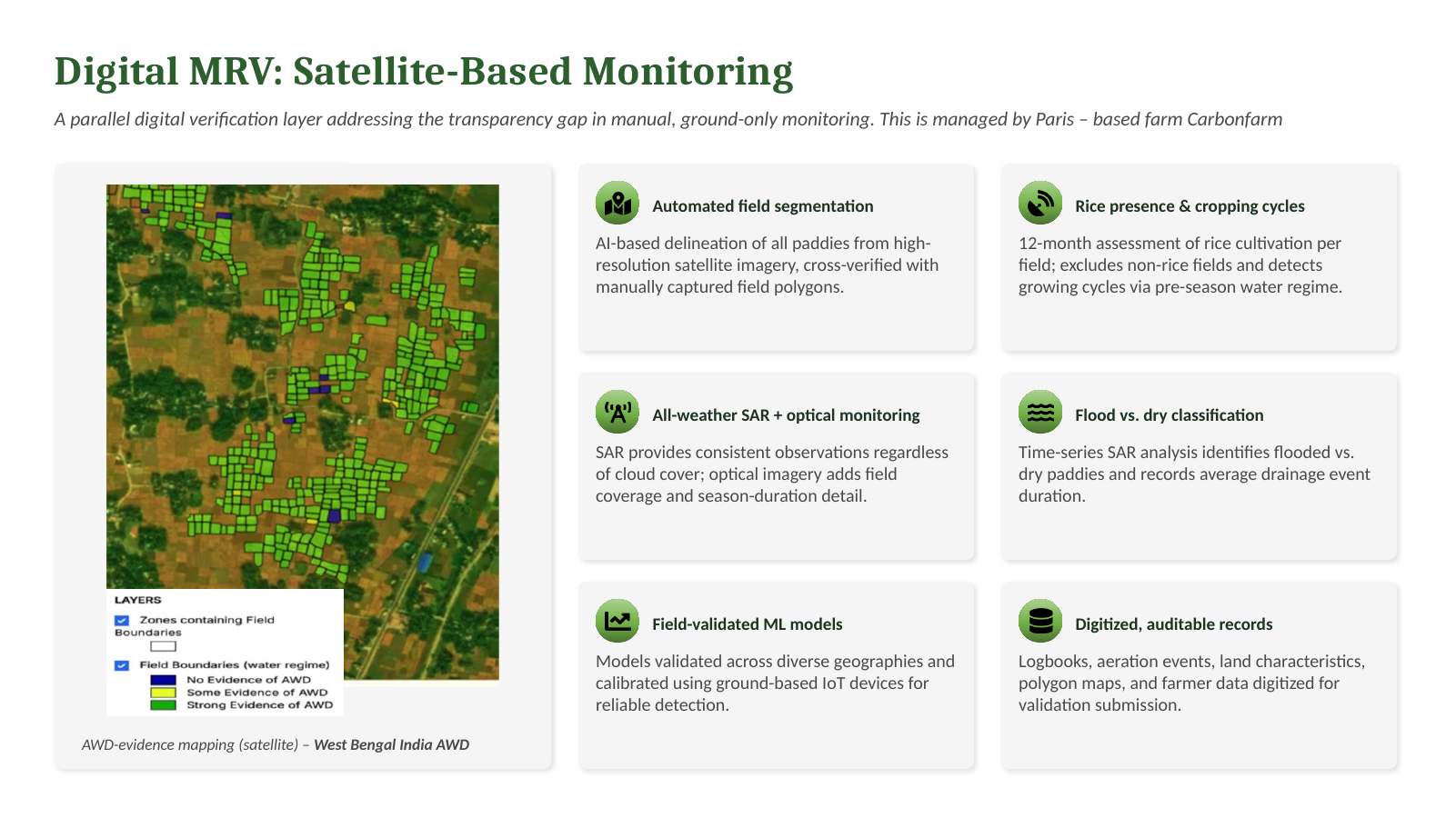
- Satellite imagery, including SAR and optical data, to map field boundaries, rice cropping cycles and drainage events.
- Ground-truth data from farmer logbooks and a geofenced mobile application, including aeration events, land records and farmer details.
- Internet of Things water-depth sensors in sample plots to calibrate and refine satellite-based monitoring.
Triangulating these three layers improves traceability, but technology does not remove the need for local trust. Farmers may fear yield losses, hesitate to adopt unfamiliar practices, face social pressure or leave when credit issuance and payments take longer than expected. Kosher Climate’s experience showed the value of starting with trusted early adopters, using local yield results for peer demonstration, and aligning participation through signed revenue-sharing agreements.
The case study also reinforced the importance of piloting before scaling. A pilot allows a project developer and its financing partners to test farmer engagement, field operations, data collection, digital tools and the selected methodology before committing to a much larger area.
What the discussion means for PDBs
Across the presentations, several practical entry points emerged for public development banks:
- Finance readiness and project preparation. Baseline assessments, feasibility studies, stakeholder mapping and methodology selection require funding before a project can generate revenue.
- Support pilots. Smaller demonstrations can validate technical assumptions, reveal local constraints and generate evidence for subsequent investment.
- Strengthen aggregation and local delivery. Cooperatives, farmer producer organizations, local banks and trusted implementation partners can reduce transaction costs and improve long-term participation.
- Invest in MRV and data systems. Shared digital infrastructure, remote sensing, local data collection and independent verification can improve credibility and lower monitoring costs.
- Use blended and patient finance. Grants, concessional loans, guarantees, grace periods and long-term offtake arrangements can bridge the gap between early expenditure and later credit revenue.
- Connect projects with credible buyers. Early buyer engagement can clarify quality requirements and support financing, but forward agreements must be sufficiently firm and transparent to provide real comfort to lenders.
- Protect farmers and communities. Carbon rights, free, prior and informed consent, transparent payment systems and fair benefit-sharing should be established before project implementation.
Credit integrity, de-risking and benefit-sharing
Kosher Climate linked credit integrity to recognized standards, robust and transparent MRV, digital technologies and independent verification. Its proposed de-risking tools for PDBs included early-stage project preparation, pilot finance, blended finance, long-term offtake agreements and investment in local capacity.
The presentation also emphasized transparent benefit-sharing, early adoption incentives, traceable payment systems, reinvestment in long-term sustainability and community benefits beyond carbon revenue. Coordination between international and national PDBs can combine climate-finance expertise and global market access with local knowledge, policy alignment and institutional relationships.
Q&A
The Q&A focused on the practical limits of project development.
- Question: What upfront finance and financing period are appropriate when starting a carbon project for smallholder farmers?
- Answer: Vamsi Krishna recommended beginning with a representative pilot of about 200-1,000 hectares. A technically successful pilot can test field operations and MRV; at around 1,000 hectares, the project may also run the carbon registration and verification process in parallel. Once the pilot and DMRV/MRV system are proven, a larger area can be added in later seasons, subject to the applicable standard and project-size rules.
- Question: What is the main MRV challenge in smallholder carbon-sequestration systems?
- Answer: Two linked challenges were identified: designing a robust system when a methodology may specify what must be recorded but not exactly how to record it, and executing that system within short agricultural windows. In AWD, for example, field teams may have only three or four days to document drying across many dispersed plots before irrigation resumes. Timely ground-data collection, accurate records and high transaction costs are therefore major constraints.
- Question: What are the main challenges in negotiating a VERPA (Verified Emission Reduction Purchase Agreement) or another forward purchase agreement with prospective investors?
- Answer: The main challenge is aligning the project timeline with the buyer’s due-diligence and deal-closing timeline. Large buyers may take six to eighteen months or longer to complete due diligence, and developers must identify buyers with a specific demand and an internal deadline. The agreement must also be sufficiently firm: open-ended or heavily conditional term sheets generally do not provide the certainty that a lender such as NABARD would need to finance the project.
- Question: For family farming and extensive livestock systems, what approach can support reliable MRV? What should an agricultural bank do if the country has no registry and its Article 6 strategy is still at an early stage?
- Answer: The voluntary carbon market may be an option while the national Article 6 framework is still developing, although demand may increasingly shift toward Paris Agreement Crediting Mechanism (PACM) credits. Alain Karsenty argued that plot-level carbon crediting is often poorly suited to smallholders because rigorous MRV and non-permanence management create very high transaction costs. A more practical option may be a payment-for-environmental-services programme that rewards agro-sylvo-pastoral practices. Such a national or jurisdictional programme could be partly funded by carbon revenue assessed at territorial scale, without paying each farmer directly for measured carbon stored on an individual plot.
Key takeaways
The session showed that agricultural carbon finance is not simply a matter of identifying mitigation potential and issuing credits. Successful projects require an enabling public framework, a viable underlying agricultural activity, patient capital, trusted local partners, credible data and a benefit-sharing model that farmers understand.
For PDBs, the opportunity is not limited to buying or selling carbon credits. Their greatest contribution may be to build the system around the credit: financing readiness, reducing early-stage risk, aggregating smallholders, strengthening MRV, connecting projects with buyers and ensuring that climate finance supports resilient rural livelihoods.
Carbon markets can be one part of the solution—but only when integrity, local economic value and farmer participation are designed into the project from the beginning.
Recording and presentations
Similar articles