

Insurance in Agricultural Finance Lessons for Public Development Banks from the Agri-PDB Platform Learning Event
Learn how public development banks can embed insurance in agricultural finance to reduce risk, support smallholders and strengthen climate resilience.
Insurance in Agricultural Finance: Lessons for Public Development Banks from the Agri-PDB Platform Learning Event
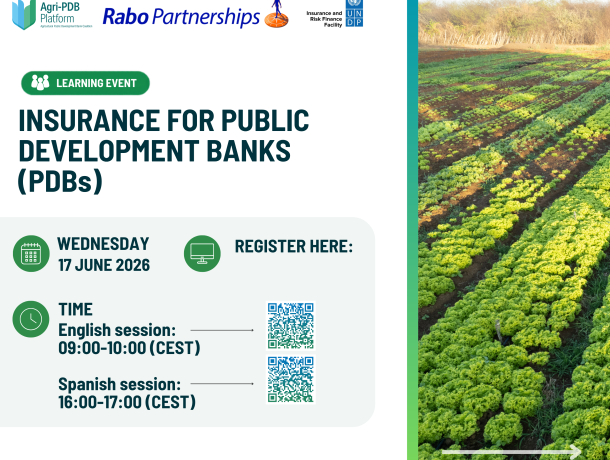
17 June 2026 | Online
Executive summary
Agriculture remains one of the sectors most exposed to risk, particularly in developing and emerging economies. Farmers face climate variability, droughts, floods, pests, price volatility, production losses, and market disruptions. These risks affect rural livelihoods and food security, but they also affect the financial institutions that finance agriculture by increasing uncertainty, weakening repayment capacity, and limiting the willingness of lenders to serve agricultural clients.
The learning event on Insurance for Public Development Banks (PDBs) addressed a central question for agricultural public development banks: how can insurance be effectively embedded into financial products to reduce risk for farmers and financial institutions, while promoting financial inclusion and climate-resilient agriculture? The event emphasized that agricultural insurance should not be treated as a standalone product. Instead, it should be integrated into a broader financial ecosystem that combines credit, insurance, guarantees, subsidies, technical assistance, data, and partnerships.
The discussion highlighted three core messages for PDBs. First, insurance can reduce the vulnerability of both farmers and lenders by providing protection against shocks, improving repayment capacity, and supporting greater investment in productive activities. Second, insurance uptake remains limited because of affordability constraints, low financial literacy, lack of trust, high last-mile delivery costs, weak data, and limited integration with broader financial products. Third, PDBs are well positioned to address these barriers because of their public mandate, their portfolio data, their links with governments and insurers, and their capacity to aggregate demand at scale.
The event presented practical examples from Bangladesh and Ethiopia, technical assistance approaches from UNDP, and Colombia’s experience through the Comisión Nacional de Crédito Agropecuario (CNCA) and FINAGRO. Together, these cases show that insurance is most effective when it is designed as part of a broader risk management strategy, rather than as an isolated financial product.
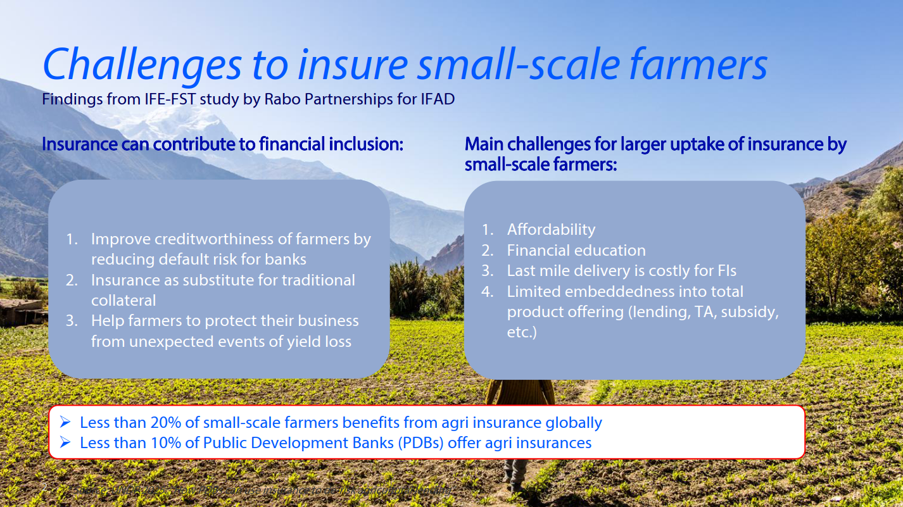
Challenges to ensuring coverage for smallholder farmers. Source: Rabo Partnership
Introduction and Context
The webinar was organized as a learning event to introduce the role of insurance in agricultural finance and provide practical insights for Agri-PDBs on how to embed insurance into their operations. Its objectives included explaining how insurance reduces risk for both farmers and lenders, presenting models for bundling insurance with financial products, showcasing case studies from different regions, discussing enabling conditions for scale, and highlighting the role of PDBs in collaboration with insurers and policymakers.
The starting point of the discussion was that agriculture is structurally exposed to risk. Farmers are vulnerable to climate shocks, biological risks, price fluctuations, production losses, and market disruptions. When these risks materialize, they can affect not only individual producers but entire loan portfolios, especially where systemic events such as droughts or floods occur. This reinforces the perception of agriculture as a high-risk sector, often resulting in higher interest rates, limited credit penetration, and financial exclusion of smallholders.
For PDBs, this creates both a challenge and an opportunity. Credit alone is often insufficient when borrowers remain fully exposed to external shocks. A farmer who receives a loan but has no protection against drought, disease, flooding, or price volatility remains vulnerable, and so does the lender. Agricultural insurance can help address this vulnerability, but only when it is integrated into a broader financing and risk management approach. As emphasized during the opening remarks, insurance should be combined with credit, guarantees, technical assistance, better data, and other forms of public support.
Why Insurance Matters for Public Development Banks
Insurance matters for PDBs because it directly addresses one of the main constraints to agricultural finance: uncertainty. In agriculture, risk is often difficult to predict and data may be limited. As a result, financial institutions can apply conservative lending assumptions, reduce their exposure to agriculture, or price loans in ways that make them less accessible to smallholder farmers.
When appropriately designed, insurance can contribute to agricultural finance in several ways. It can strengthen farmers’ resilience after shocks, reduce default risk for banks, facilitate access to credit, improve the climate risk profile of PDBs, and enable longer-term investment in agriculture. It can also help farmers avoid negative coping strategies after a shock, such as selling productive assets, reducing savings, or increasing debt.
The webinar also highlighted the broader protection gap. Over the past three decades, climate-related hazards have caused an estimated USD 3.8 trillion in agricultural losses, while more than half of the world is affected by drought and nearly two billion people face rising risks of frequent and severe flooding. In 2024, only 37% of USD 417 billion in global natural disaster losses were insured, and the insurance gap is wider in emerging and developing economies.
For PDBs, the implication is clear: insurance is not only a farmer-protection tool. It is also a portfolio risk management tool, a financial inclusion tool, and potentially a climate finance tool. It can help lenders distinguish between perceived risk and actual risk, improve portfolio resilience, and support more informed agricultural lending decisions.
From Concept to Practice: Integrating Insurance into Agricultural Finance
Rabo Partnerships presented findings from the Inclusive Financial Ecosystem for Food Systems Transformation (IFE-FST) work carried out for IFAD, focusing on how insurance can be integrated into agricultural finance systems. The presentation emphasized that insurance can support financial inclusion by improving farmers’ creditworthiness, reducing default risk for banks, acting as an alternative to traditional collateral, and helping farmers protect their businesses against unexpected production losses.
However, the presentation also underlined that insurance uptake remains low. According to the Rabo Partnerships slide deck, less than 20% of smallholder farmers benefit from agricultural insurance globally, and less than 10% of public development banks offer agricultural insurance. The main barriers identified were affordability, financial education, costly last-mile delivery, and limited integration of insurance into broader product offerings such as loans, technical assistance, and subsidies.
The key lesson for PDBs is that insurance should not be offered as a separate add-on to credit. When the insurance premium simply sits on top of the interest rate, the total product can become too expensive for farmers and less competitive for banks. Instead, insurance should be embedded into the design of agricultural finance products, supported by advisory services, data, and risk reduction measures.
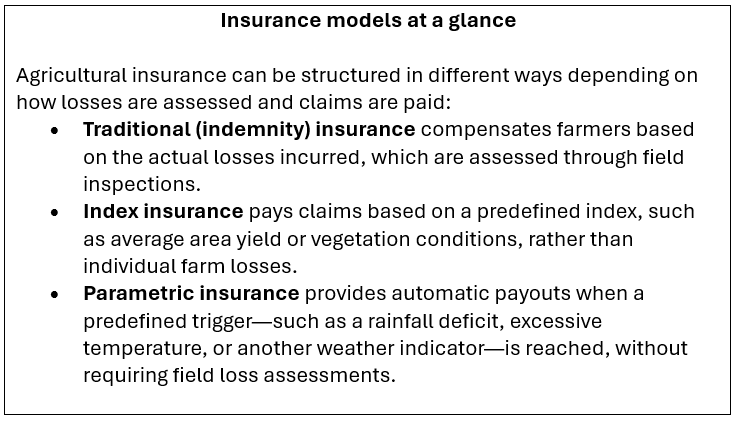
Case Example: Bangladesh Livestock Insurance
The Bangladesh case showed how insurance can be successfully integrated into microfinance. Palli Karma-Sahayak Foundation (PKSF), in collaboration with the Asian Development Bank and 40 local microfinance institutions, developed a livestock no ce scheme linked to cattle loans. The product combined a loan for a cow with livestock insurance, with a premium of 0.7%. It covered conventional mortality as well as losses related to natural disasters and epidemics.
A critical feature of this model was that insurance was bundled with preventive and advisory services. The scheme included vaccination, feeding advice, veterinary attention, and collaboration with government agencies and research institutions. As a result, the mortality rate of cattle reportedly fell from 5–10% to 0.5%. This reduction in mortality lowered the underlying risk, creating the possibility of reducing insurance premiums over time.
This example illustrates an important principle: insurance works best when paired with risk reduction. The product did not only transfer risk after a loss; it helped reduce the probability of loss in the first place. For PDBs, this suggests that insurance should be linked to technical assistance, extension services, climate-smart practices, animal health services, or other interventions that reduce the borrower’s exposure.
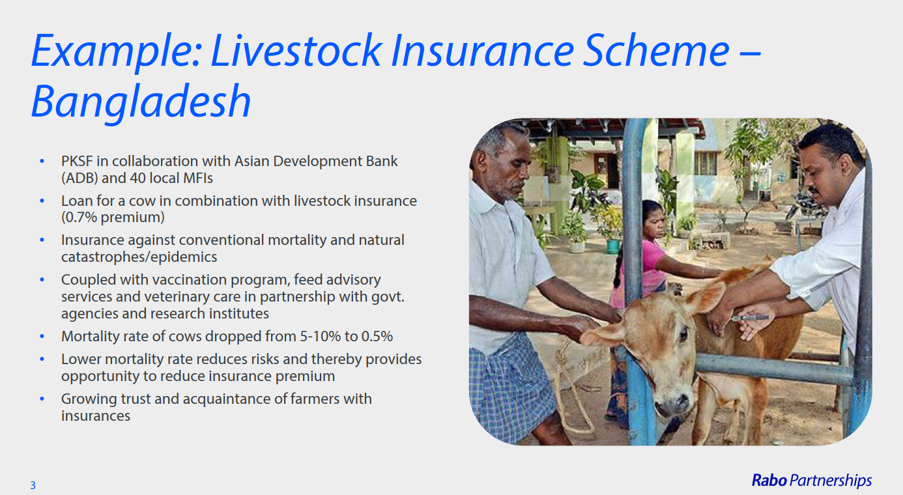
Bangladesh livestock insurance slide here. Bundled model: loan + insurance + vaccination + advisory services + veterinary support. Source: Rabo Partnership
Case Example: Ethiopia Parametric Crop Insurance
The Ethiopia example focused on parametric agricultural insurance and ecosystem collaboration. The model involved the Government of Ethiopia, CoopBank of Oromia, insurers such as Oromia Insurance and Nyala, and intermediaries such as Pula and Agtuall. The government’s role included providing data infrastructure and premium support, while CoopBank combined insurance with loan products and technical assistance. Insurers and intermediaries provided parametric or index-based coverage.
Parametric insurance can reduce operational costs because payouts are based on predefined triggers, such as rainfall, heat, or area-yield indicators, rather than time-consuming individual loss assessments. This can provide faster liquidity to farmers after shocks and help financial institutions reduce default rates and improve portfolio resilience.
The Ethiopia case also demonstrates the importance of data infrastructure. Parametric insurance depends on reliable weather, satellite, geographic, and farmer identification data. It also requires collaboration between public authorities, banks, insurers, and technical providers. For PDBs, the lesson is that parametric insurance can help scale agricultural protection, but only when the data, institutional partnerships, and product design are sufficiently robust.
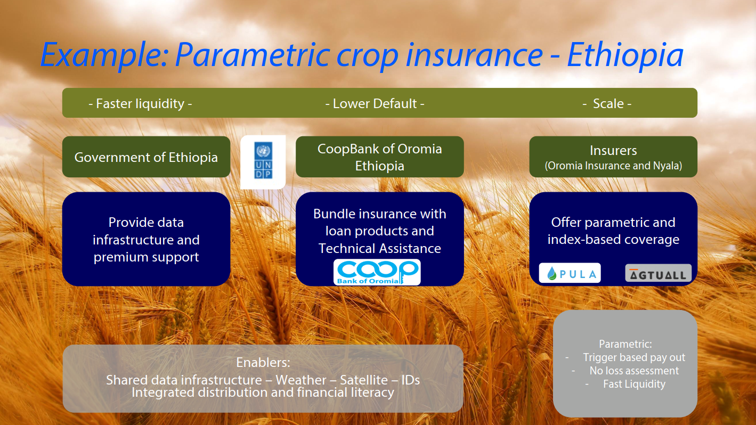
Parametric insurance example in Ethiopia. Source: Rabo Partnership
Technical Assistance for PDBs: Moving from Distribution to Co-Design
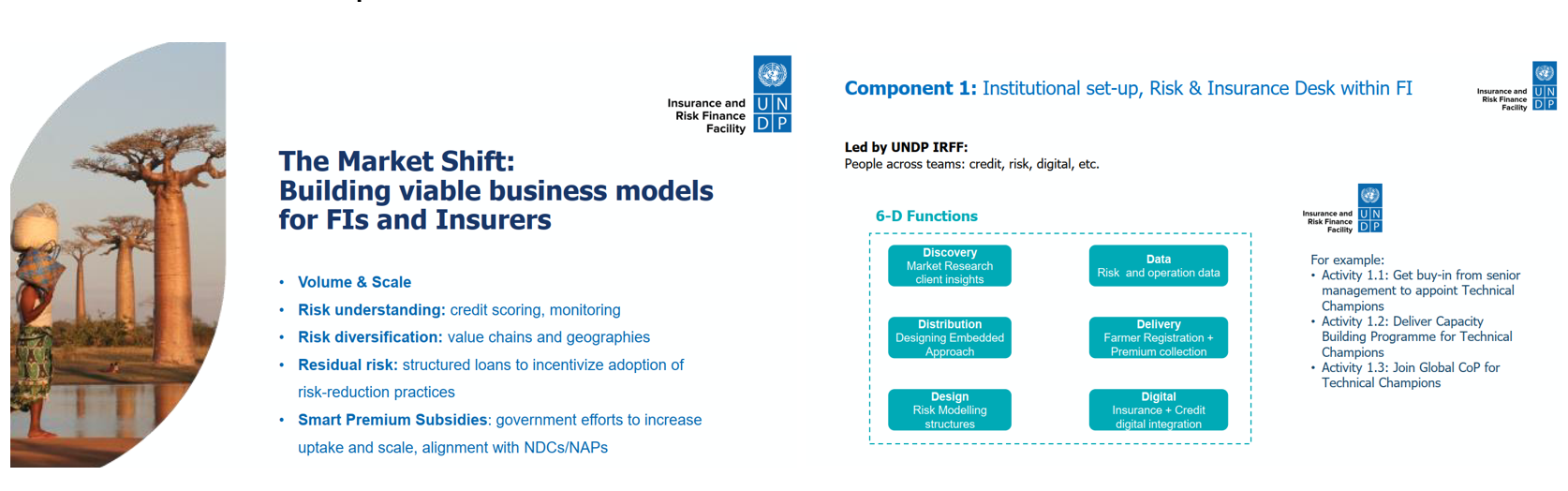
UNDP’s Insurance and Risk Finance Facility presented a technical assistance approach for agricultural PDBs. The central message was that PDBs should not be treated merely as distribution channels for insurance products. Instead, they should become active co-designers of insurance solutions that are embedded into credit-risk management and adapted to their portfolios.
This represents a shift in the market. In the traditional model, the financial institution distributes insurance, and the insurance premium is added on top of the interest rate. This can make the final product costly for farmers and less competitive for banks. In the embedded model, the financial institution incorporates insurance as a credit-risk mitigation instrument within its core operations.
UNDP’s approach also emphasized the construction of viable business models for both financial institutions and insurers. PDBs can offer insurers several advantages: portfolio volume and scale, knowledge of borrower risk, data from credit scoring and monitoring systems, risk diversification across value chains and geographies, and the ability to transfer residual risk after risk-reduction measures have been applied. Smart premium subsidies can also help increase adoption and scale, especially when aligned with climate and development objectives.
The proposed technical assistance components included the creation of an internal risk and insurance team within the financial institution, capacity-building for technical champions, climate risk analytics to integrate climate risk into credit risk, and co-design of bundled credit-insurance products with insurers.
For PDBs, this approach suggests that the first step is institutional readiness. Banks need internal teams that understand credit, risk, digital systems, client data, product design, and insurance partnerships. Without this capacity, they may remain passive distributors of externally designed products rather than active shapers of solutions that fit their clients and portfolios.
Source: UNDP Insurace and Risk Finance Facility
Country Experience: Colombia, CNCA and FINAGRO
The Spanish session included a country experience from Colombia through the Comisión Nacional de Crédito Agropecuario (CNCA), focusing on the relationship between public policy, agricultural credit, FINAGRO, and insurance. Colombia’s case is relevant for other PDBs because it shows how insurance can be framed as part of an integrated public policy architecture, rather than as a standalone market product.
Colombia’s National Agricultural Credit System was created by Law 16 of 1990 to formulate agricultural credit policy and coordinate the use of financial resources for the sector. The CNCA acts as the governing body for agricultural financing and risk management, while FINAGRO participates as a key second-tier development finance institution responsible for technical design and structuring of instruments.
The Colombian presentation emphasized the articulation between three levels: the strategic level, led by CNCA through policy direction and financial conditions; the tactical level, where FINAGRO designs and structures instruments; and the operational level, where banks, cooperatives, and insurers implement credit and insurance programs directly with agricultural producers.
A central message from Colombia was that financing and risk management cannot be treated separately. Producers need financing to implement agricultural projects, and insurance becomes meaningful when it is integrated into that broader financing package. The CNCA representative stressed the need for an integrated risk management policy combining credit, guarantees, incentives, insurance, technical assistance, and knowledge transfer.
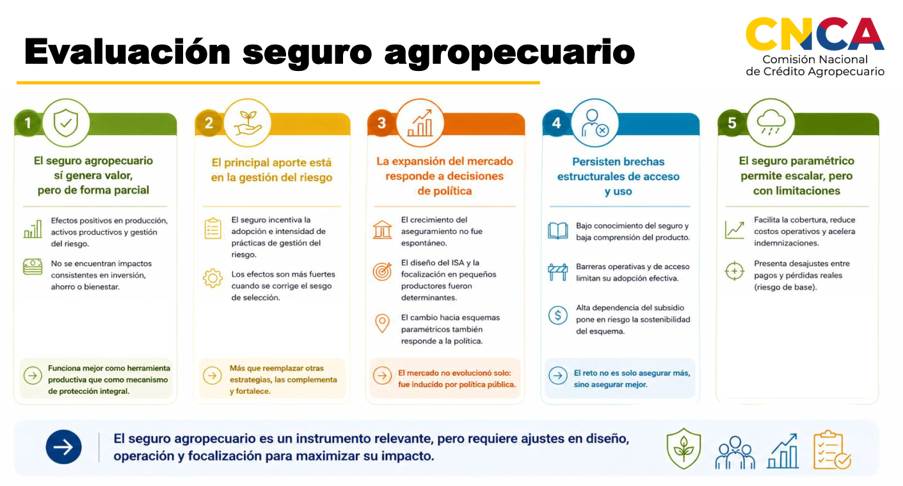
Colombia’s experience with the Incentivo al Seguro Agropecuario also illustrates the role of public subsidies in market creation. Through FINAGRO and the National Agricultural Risk Fund, the government subsidizes part of agricultural insurance premiums. Over more than ten years, this helped expand the market from fewer than two insurers to more than eleven insurers offering agricultural insurance products, with close to 100,000 annual beneficiaries through the incentive.
The evaluation results presented during the session showed positive effects, including a social benefit-cost ratio of 3.48, an estimated welfare measure of 12.15 relative to a direct transfer, and estimated fiscal savings of 10.7% compared with direct emergency response. However, the presentation also noted important limitations: the agricultural insurance branch represents only 0.2% of Colombia’s total insurance industry, the current market depends heavily on the insurance incentive and its design, and only around 3–4% of planted area is insured.
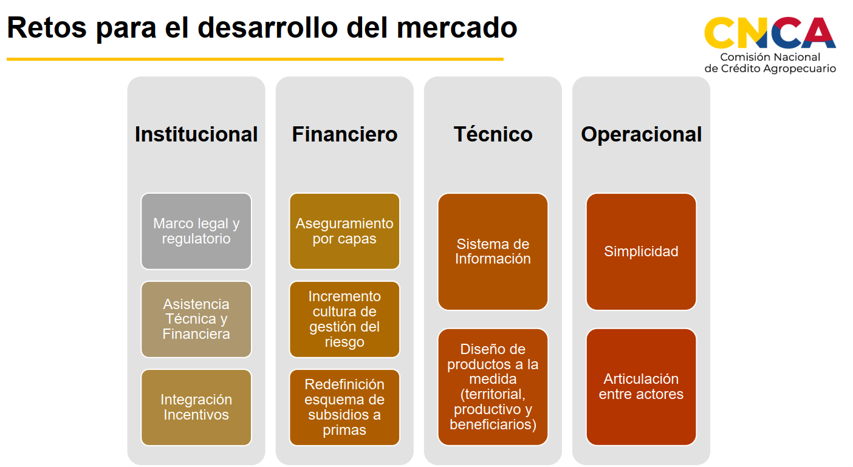
The Colombian case therefore offers a balanced lesson. Public subsidies and institutional coordination can help create an agricultural insurance market, but the next challenge is to develop that market sustainably. This requires improved product design, better targeting, stronger financial education, reduced basis risk in parametric products, more tailored products by territory and value chain, and stronger coordination among actors.
Challenges for the development of Insurance market. Source: CNCA
Key Lessons for Public Development Banks
- Insurance should be embedded into finance, not treated as an add-on
The event repeatedly emphasized that insurance is most useful when integrated into agricultural credit products and risk management systems. A separate insurance product sold alongside a loan may increase costs and reduce uptake. By contrast, embedded insurance can improve portfolio resilience, reduce default risk, and make the total financial product more relevant to farmers.
- Insurance must be combined with risk reduction
The Bangladesh case demonstrated that insurance can be more affordable and effective when paired with preventive services. Vaccination, veterinary support, training, advisory services, and technical assistance reduced actual mortality risk, making the insurance product more sustainable. For crop finance, similar principles can apply through climate-smart agriculture, improved seeds, irrigation, storage, extension, or other risk-reducing investments.
- PDBs can use their portfolios to create viable markets
PDBs can bring scale, borrower data, geographic diversification, value-chain coverage, and public policy links to insurers. This gives them a stronger role than simple distribution. PDBs can help insurers understand demand, price risk more accurately, and design products that respond to real portfolio needs.
- Data infrastructure is essential
Data is central to product design, pricing, targeting, monitoring, and claims. Parametric insurance in particular depends on reliable climate, satellite, farmer-location, yield, and identification data. PDBs can play an important role in improving data systems, sharing portfolio-level insights, and working with governments and technical partners to strengthen the insurance ecosystem.
- Subsidies can support adoption, but they must be smart and transitional
Premium subsidies can help overcome affordability barriers and stimulate market creation. However, the event highlighted that subsidies should not become the only foundation of the market. They should be designed to encourage scale, promote risk reduction, support vulnerable groups, and gradually transition as products become more efficient and risks are better managed.
- Financial education and trust are not optional
Low awareness, weak understanding of insurance, lack of trust, and misunderstanding of payouts remain major barriers. Farmers need to understand what is covered, what is not covered, how premiums are calculated, and when payouts occur. This is especially important for parametric products, where payouts depend on triggers rather than individual observed losses.
- Institutional coordination determines success
Agricultural insurance requires collaboration among PDBs, governments, insurers, reinsurers, technical assistance providers, data providers, farmer organizations, and intermediaries. Colombia’s experience shows the importance of clearly defined roles between policy bodies, development finance institutions, operational intermediaries, and insurers.
Source: CNCA
Recommendations
As a first step, PDBs should assess their readiness to integrate insurance into agricultural finance. This includes evaluating their agricultural portfolio exposure to climate and production risks, identifying opportunities to bundle insurance with existing lending products, mapping potential insurance and reinsurance partners, and assessing the availability of data needed to support index-based or parametric insurance products.
PDBs should approach agricultural insurance as part of a broader transition from reactive risk response to proactive risk management. This means shifting from compensation after disasters to integrated systems that help farmers reduce risk, access finance, invest with confidence, and recover faster when shocks occur.
At the institutional level, PDBs should strengthen internal capabilities to understand insurance, climate risk, and portfolio exposure. They should create cross-functional teams capable of working with insurers, governments, and technical partners. This is particularly important because product design, pricing, targeting, and monitoring require knowledge from several departments.
At the product level, PDBs should prioritize bundled solutions that combine credit, insurance, and services. The Bangladesh and Ethiopia examples show that bundled models can reduce risk, improve uptake, and create better value for farmers and lenders. However, product simplicity remains essential, particularly for smallholder farmers with limited prior exposure to insurance.
At the ecosystem level, PDBs should use their mandate and market position to convene actors. Governments can provide data infrastructure and smart subsidies; insurers can provide underwriting capacity; technical partners can support product design and risk analytics; and PDBs can aggregate demand and connect solutions to agricultural finance.
At the policy level, the Colombia case shows that public incentives can help create markets, but sustained development requires a broader focus on product quality, basis risk, market depth, insurance culture, information systems, and coordination. Subsidies should be linked to clear policy objectives and evaluated based on outcomes.
Conclusion
The learning event demonstrated that agricultural insurance is not a silver bullet, but it is a critical component of a more resilient agricultural finance system. For farmers, insurance can provide protection after shocks and support greater confidence to invest. For PDBs, it can reduce uncertainty, improve portfolio resilience, expand lending capacity, and strengthen their contribution to rural financial inclusion.
The central lesson is that insurance should be embedded into agricultural finance rather than treated as a separate product. When combined with credit, guarantees, data, technical assistance, risk reduction, and public support, insurance can help PDBs move from risk avoidance to risk management. This shift is essential for expanding access to finance, supporting smallholder farmers, and building more climate-resilient agricultural systems.
The webinar therefore offers a practical agenda for PDBs: understand portfolio risks, build internal capacity, co-design solutions with insurers, use data strategically, integrate insurance into credit products, and work with governments to create enabling conditions for scale. In doing so, PDBs can play a central role in transforming agricultural insurance from a limited protection product into a strategic instrument for inclusive and resilient agricultural finance.
Similar articles