

Peer-to-Peer Learning: DBE to DFC Belize on GCF Accreditation Process
Peer-to-Peer Learning: DBE to DFC Belize on GCF Accreditation Process
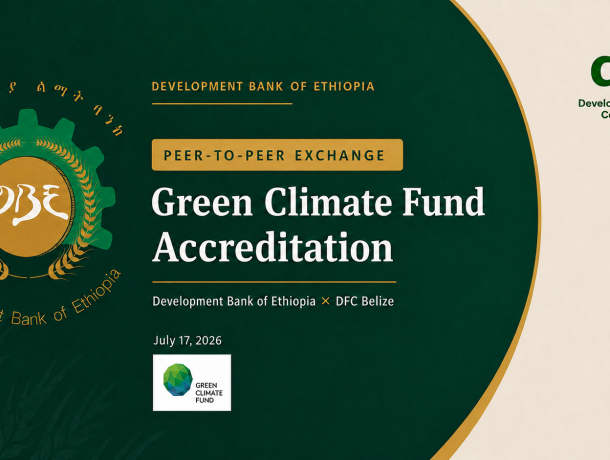
Following of multiple expressions of interest from Agri-PDB Platform members regarding the Green Climate Fund (GCF) accreditation process, the Development Bank of Ethiopia (DBE) expressed a need for peer support on this topic. To meet this demand, the experience of the Development Finance Corporation (DFC) of Belize was identified as a valuable case study: DFC had achieved GCF accreditation swiftly and effectively, offering DBE a chance to learn directly from a peer that had recently gone through the same journey.
DFC Belize’s accreditation journey
DFC’s path to accreditation began with an initial GCF gap analysis in 2018 and ultimately succeeded a number of years later, including roughly several months lost to technical issues on GCF’s former digital application platform (since replaced). A turning point came when DFC moved away from a single-person approach and adopted a cross-departmental model: every review question was consolidated into a shared tracker, assigned to the relevant department leads to answer, and reviewed by the CEO before submission — cutting turnaround time to about two weeks per round. When review questions from the Accreditation Panel were unclear or repetitive, DFC also found it effective to request a direct meeting with the panel rather than continuing a prolonged written back-and-forth. In addition, DFC chose to broaden its application beyond concessional lending to also cover guarantees and equity, allowing it to access all except one of the full range of GCF’s financial instruments from the outset.
Institutional requirements: ESMS, governance and culture
A recurring theme – and one of the clearest lessons from DFC’s experience – was that an Environmental & Social Management System (ESMS) cannot be treated as a compliance document to be filed and forgotten, but it must be actively implemented, evidenced and embedded across the institution’s day-to-day operations.
DFC’s experience illustrates just how far this extends in practice. It requires recurring investment, not a one-off exercise. DFC runs annual refresher training for its credit officers and keeps records as evidence of implementation, precisely because GCF accreditation and its maintenance depend on demonstrated practice, not stated intent. It requires governance-level ownership: DFC’s board itself receives dedicated environmental and social (E&S) training and reviews projects on E&S soundness alongside financial soundness — including rejecting financially strong projects that did not pass E&S review.
DFC stressed that embedding an ESMS requires deliberate change management, particularly with the credit teams, who often initially perceive it as an additional burden rather than a core part of their mandate. DFC’s choice to run intensive, whole-institution training – rather than a lighter-touch train-the-trainer model – reflects how seriously this resistance needs to be addressed head-on. For DBE, this suggests the conversation should move beyond the technical requirements of the ESMS document itself, toward a frank internal assessment of whether its governance structures, credit processes, and organisational culture are currently equipped to sustain this kind of system – and if not, what change management effort would be needed to get there.
Partnerships and stakeholder engagement
Since September 2025, GCF’s revised Accreditation Framework has simplified the process: entities can now apply across all financial instruments at once, and some project-specific assessments have been deferred to the project or concept stage. Panellists also underscored that a close working relationship with the National Designated Authority (NDA) is essential, since concept notes and project proposals must align with national climate priorities — misalignment can lead to automatic rejection. GCF also offers a fast-track option for entities already working with multilateral or bilateral institutions, a route several Agri-PDB members may wish to explore depending on their existing partnerships.
Post-accreditation and sustaining momentum
Looking beyond accreditation itself, DFC shared how it created a dedicated Sustainable Development Division after accreditation — covering monitoring, evaluation and accountability learning, ESMS oversight, and climate finance/project development — while keeping financial modelling integrated within its core finance team. Importantly, concept note development can start before accreditation is finalised: DFC began working with its NDA and with assistance from another GCF Accredited Institution in Belize, engaged a consultant to develop project concepts in parallel with its readiness proposal. Since accreditation, DFC’s network with regional and international climate finance institutions has grown, and it is now pursuing further climate finance opportunities on the strength of that status. DFC also noted that GCF financing is increasingly catalytic rather than purely grant-based: grants tend to concentrate in specific strategic areas (indigenous peoples, rural communities, women, youth, climate-smart agriculture), while sectors such as e-mobility and solar are financed more on concessional or lending terms.
This exchange offered DBE — and, through the Agri-PDB Platform, its fellow members — concrete, field-tested lessons on navigating one of the more demanding accreditation processes in climate finance, from documentation and governance through to sustaining institutional momentum after accreditation is achieved.
Both institutions agreed to remain available for further peer-to-peer exchange, with an in-person engagement later this year, as set out in the original agenda.
Similar articles