

Public Development Banks as Catalysts for Food Systems Transformation: Opportunities under the Food Systems Integrated Programme
The Agri-PDB Platform and the IFAD Food Systems Integrated Programme (FSIP) organised a webinar to present the FSIP and highlight the role that agricultural public development banks (PDBs) can play in the design and implementation of food systems transformation initiatives. Drawing on experiences from the Brazilian Development Bank (BNDES) and the Development Bank of Southern Africa (DBSA), the webinar explored how PDBs can mobilise and deploy different forms of finance, de-risk investments, support policy implementation, and bring together public and private actors to scale sustainable and inclusive food systems investments.
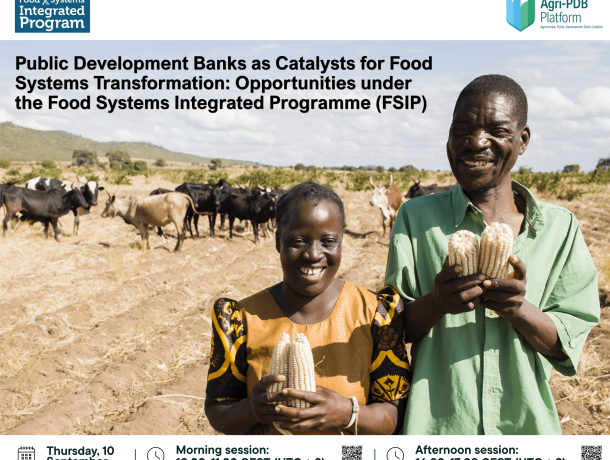
10 September 2026 | Online
Transforming food systems is a major global challenge requiring coordinated action across public and private actors. National agricultural public development banks are uniquely positioned to contribute to this transition towards sustainable, inclusive, and resilient food systems. With their public policy mandates and development objectives, PDBs can deploy a range of financial instruments to reach underserved rural areas, align public and private incentives, and support initiatives that may not otherwise attract commercial finance.
Through its commitment to strengthening and showcasing the potential of PDBs to promote green and sustainable agricultural finance, the Agri-PDB Platform contributes to the objectives of the Food Systems Integrated Programme (FSIP). Organised in collaboration with the IFAD FSIP team, the webinar presented the programme in greater detail and explored how PDBs can contribute to its implementation, drawing on practical experiences from BNDES and DBSA.
The Food Systems Integrated Program (FSIP)
Michael Von During, Technical Specialist at FSIP IFAD walked the participants through the FSIP program. He explained that this GEF-8 initiative, co-led by IFAD and FAO, aims to identify and develop investment opportunities in sustainable food systems, and connect those opportunities with PDBs and other financiers. To do so, analysis have been conducted to identify gaps in access to finance, markets, and private-sector engagement in each country. Building on this, 32 child projects have been designed with a toolkit of partners, services, and financial solutions to address those gaps and build a pipeline of investable projects. In parallel, a global coordination project helps identify common needs and opportunities across countries. The program covers 32 countries, with about $280 million in GEF funding and an ambitious $2 billion co-financing target.
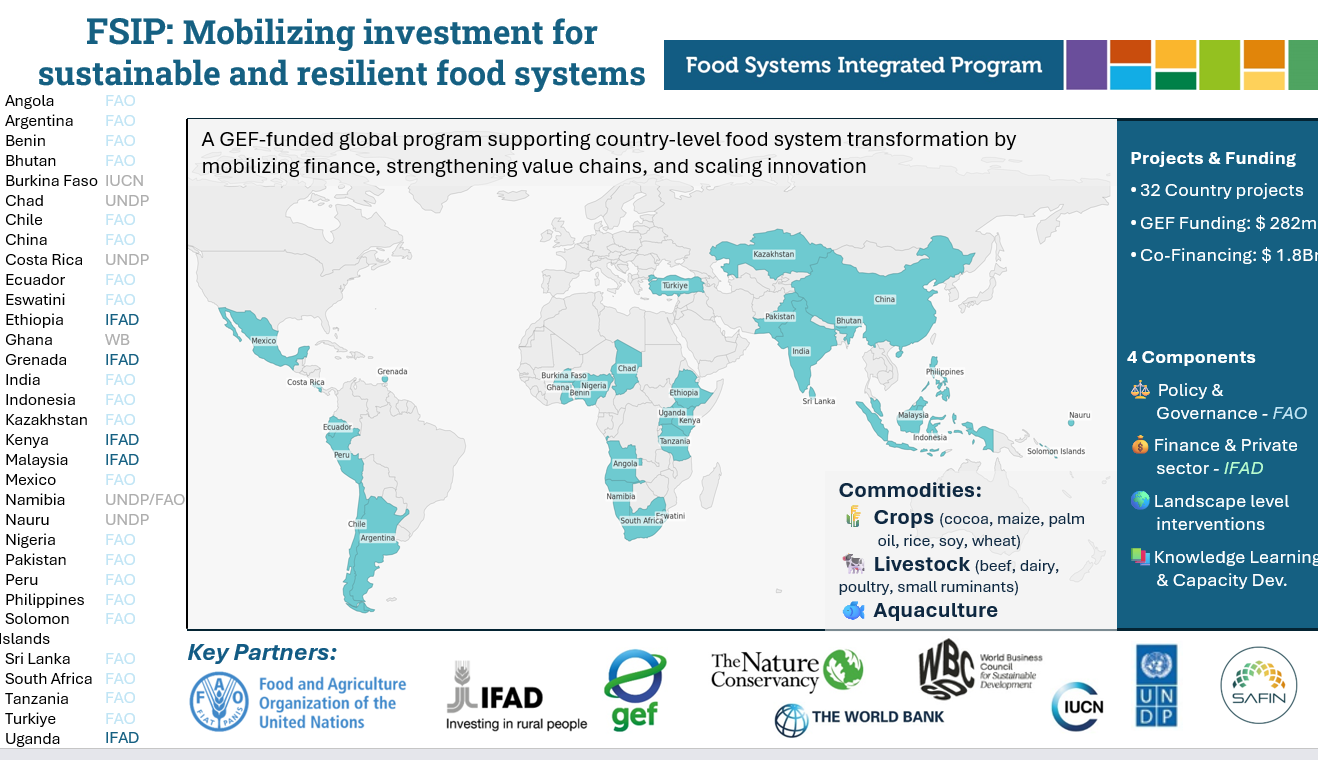
In this context, PDBs are key actors to create and de-risk a pipeline of sustainable food-system investments as they can bring the local presence, financial expertise, development mandate, and capital needed to finance and scale that pipeline.
From the analysis of the 32 country projects significant opportunities for PDB engagement have emerged, although priorities differ across regions. In Africa, there is particularly strong demand for financial mechanisms and investment facilities, including blended finance, revolving funds, matching grants, concessional finance, and value-chain finance. In Asia, the emphasis is more strongly placed on strengthening financial-sector strategies, policies, and enabling frameworks to facilitate the flow of finance. In Latin America, there is greater demand for tailored agriculture and climate-finance products.
Within this context, PDBs can play an important role in translating the emerging demand from FSIP countries into investable opportunities. Their contribution help bringing the local presence, financial expertise, development mandate, and capital needed to finance and scale that pipeline.
Advocating for Food Systems Transformation
Following up, Nevena Bakalar, Knowledge Management Officer at FSIP IFAD, explained how the Program will use communications tools to ensure that the knowledge and experience generated through FSIP are shared across global, regional, and country levels. This includes showcasing the expertise of FAO and IFAD, particularly in areas such as access to finance, markets, private-sector engagement, and PDBs, while creating opportunities for countries, partners to exchange experiences and learn from implementation, and help attract expertise, partners, and additional financing. This will be done through the organization and participation in webinars, conferences, knowledge events, and the creation of communities of practice, including around FSIP’s three priority areas: crops, aquaculture, and livestock.
Experience of the Development Bank of South Africa (DBSA) and the Brazilian Development Bank (BNDES)
Representing DBSA, Mookho Mathaba, Principal Climate Finance and Nature Specialist presented the bank’s core mandate in financing infrastructure development and regional integration across Africa, working mainly with governments, cities, and municipalities, while also investing in private-sector entities. She explained that DBSA began its climate-finance work through South Africa’s Green Fund in 2010, using grant funding to build expertise and demonstrate what was possible. This helped it become accredited with international climate and environmental funds, including the Green Climate Fund (GCF) and Global Environment Facility (GEF).
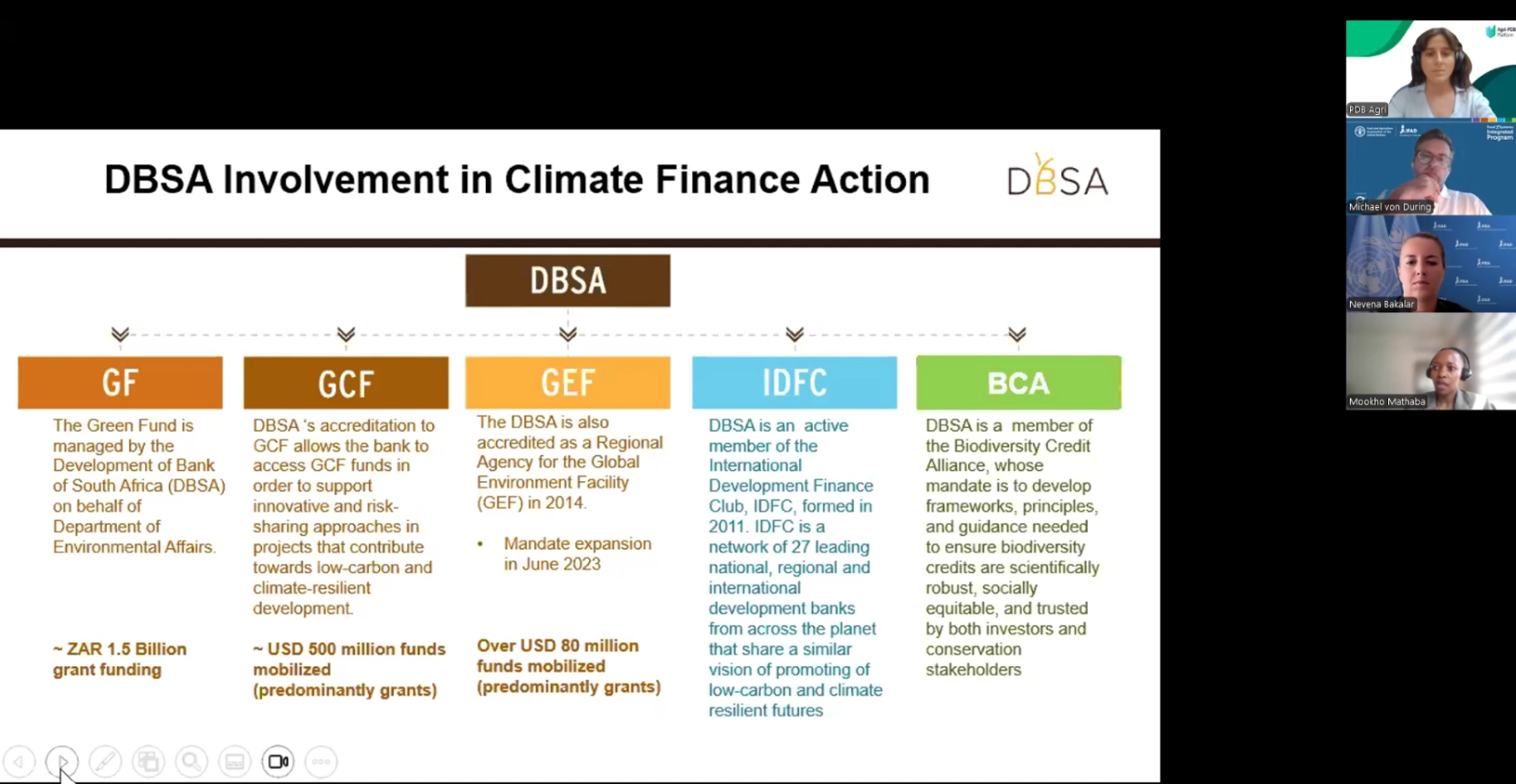
Through this the bank aims to increase productive infrastructure and economic growth while protecting natural capital. In practice DBSA uses concessional climate funding and grants to de-risk projects and attract private-sector capital. It blends these funds with its own financing to: (i) Offer below-market interest rates; (ii) Provide longer-term financing—sometimes 15–20 years—when commercial lenders typically prefer 5–8 years; (iii) Use subordinated financing and guarantees to protect private lenders from losses; and (iv) Structure financing specifically around the needs of the project rather than relying on traditional lending models.
Raquel Silvestrin Zanon, Manager of the Department of Productive Inclusion and Education at BNDES emphasized that addressing such transition requires collaboration among governments, PDBs, international financial institutions, and the private sector. A key example is the Sertão Vivo Programme in Brazil, which represents the first time IFAD raised funds together with a development bank. The programme has been designed by IFAD, then submitted to the Green Climate Fund and is now executed by BNDES as the national executing entity who makes the contracts with the different states in the region and encompasses a unit for planning, monitoring and evaluating that helps to bring uniformity in the operation. This is a complex financing initiative that combines resources from BNDES, IFAD, and the GCF, alongside grants and technical expertise. The different sources of finance and institutional arrangements required substantial coordination to align the rules, procedures, and contractual requirements of the three institutions. The programme includes approximately US$202 million in non-reimbursable resources for family farmers.
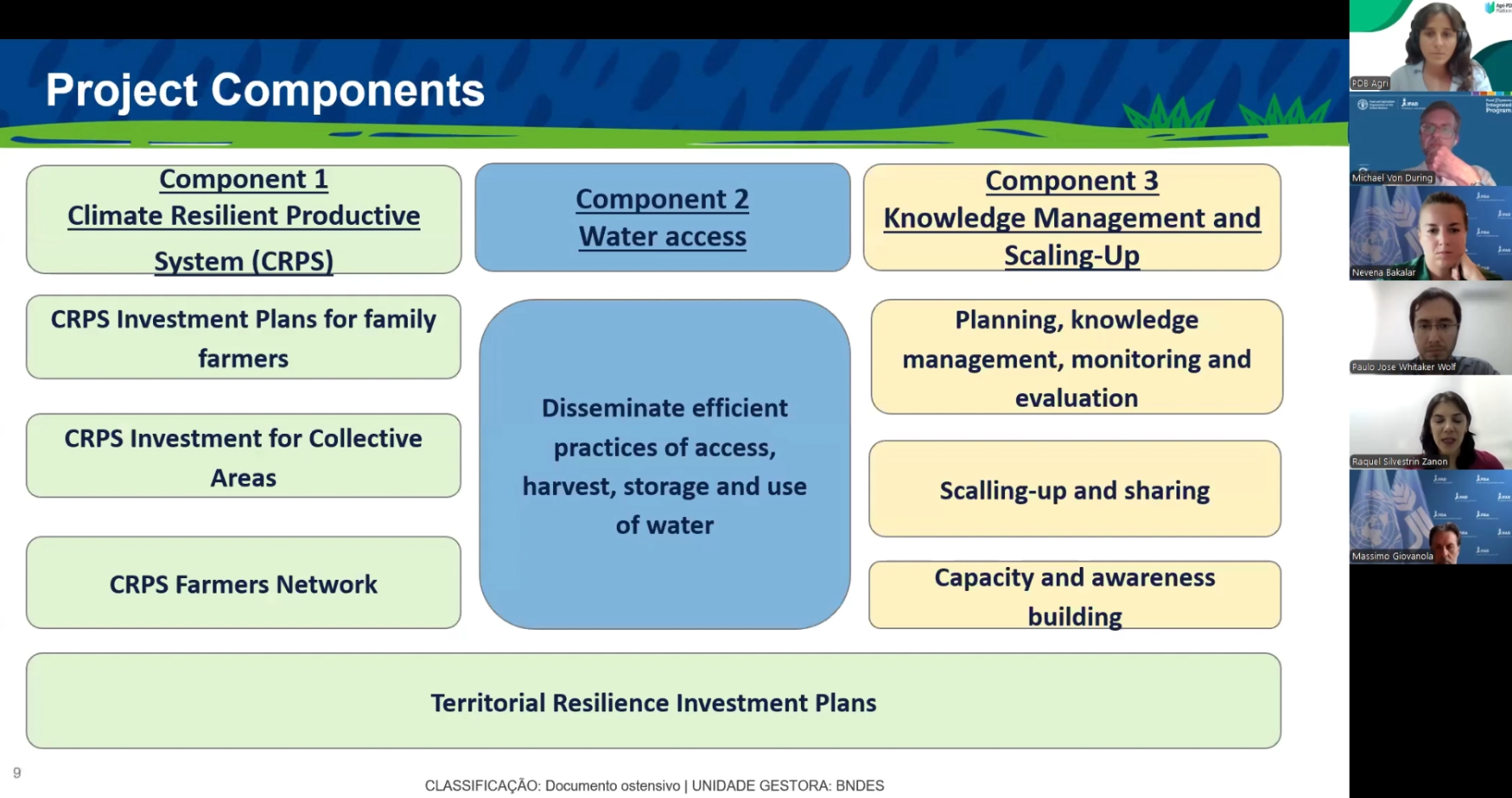
Components of the Sertão Vivo Programme.
Several features of the Sertão Vivo approach were identified as potentially replicable in other countries:
- Combining different sources and types of finance according to beneficiaries’ needs and vulnerability.
- Targeting resources based on indicators such as rural poverty, climate vulnerability, and food insecurity.
- Using existing government and institutional structures to achieve greater scale and efficiency.
- Supporting farmers collectively through cooperatives and associations rather than relying only on individual lending.
- Prioritizing particularly vulnerable groups and regions, including women, youth, traditional communities, and climate-vulnerable areas.
Main Challenges to Investment
The discussion identified several barriers that can limit conventional investment in sustainable food systems:
1) Public benefits don’t always generate financial returns. Projects may improve biodiversity, soil health, water security, climate resilience, and food security, but these benefits don’t necessarily create direct cash flows for investors.
2) Projects are often too small and fragmented. Smallholder farmers and rural businesses require relatively small amounts of capital, but due-diligence and transaction costs can be almost as high as for much larger projects.
3) High perceived risk and limited data. Investors often lack historical performance data and therefore perceive unfamiliar projects as risky. Building an evidence base can help attract future private investment.
4) Insufficient project preparation. Many promising projects aren’t yet investment-ready. They may lack strong financial models, offtake agreements, implementation plans, or clear risk allocation.
5) Short commercial lending horizons. Agricultural and nature-related projects often need patient, long-term capital, which commercial banks are less equipped to provide.
6) Limited collateral and credit history. Smallholder farmers, youth-led businesses, and emerging agricultural enterprises may not have the assets or track record required by traditional lenders. Guarantees can help overcome this.
7) Currency mismatch. Projects may earn revenue in local currency while financing is denominated in USD. Long-term currency hedging—especially for 15–20-year projects—can be extremely difficult or expensive.
Role of PDBs
The experiences presented by DBSA and BNDES illustrated the broader role that PDBs can play in overcoming these investment barriers.
DBSA emphasized the central role of PDBs in such programs as their mandate enable them to “understand government development priorities as well as the requirements of commercial finances” Mookho Mathaba stated. As an example, she provided insights into DBSA’s support to the country platform Renewable Energy Independent Power Producer Procurement Program, which aimed at facilitating private sector investment into grid-connected renewable energy generation. DBSA closely worked with government, commercial banks and with the private sector. It incubated the program, supported the development and design of the concept, getting the right resources in place. DBSA made available concessional funding instruments in order to help support the independent power producers in the country that are willing to actually support the generation of renewable energy. This collaborative work has proven successful, and DBSA is looking to replicate it in another sector, by structuring the facility, then attract private sector and also ensure that government puts policies in place to make investments.
BNDES completed describing PDBs as enablers and conveners. Because they can access concessional and other funding sources and lend at more affordable terms than commercial banks, they can help close financing gaps for small farmers. They can also bring together governments, private banks, international organizations, and other actors, while helping governments develop supportive legislation and public policies.
The discussion also highlighted the importance of partnerships with the private sector and other institutions, particularly as traditional grant funding and official development assistance become more constrained. BNDES has experimented with co-financing and matching-fund approaches, including partnerships with Petrobras and other foundations, to expand the scale and reach of support for family farming.
Connecting FSIP Countries with PDBs
Finally, the AgriPDB–IFAD platform is intended to help connect PDBs with countries implementing relevant programmes. Its role is to assess country needs, identify gaps in implementation, map these against programme priorities, and facilitate connections between PDBs and government focal points. Importantly, the platform is not creating a new pool of funds: country funding has already been allocated to approved activities. The objective is instead to identify who can best deliver those activities and where PDBs can contribute expertise, financing mechanisms, or implementation capacity.
Conclusion
The webinar demonstrated that PDBs can play a catalytic role in food systems transformation by combining their development mandate, local knowledge, financial expertise, and ability to mobilise public and private resources. The experiences of DBSA and BNDES showed that concessional finance, guarantees, blended-finance structures, technical assistance, and strong public–private partnerships can help overcome barriers that prevent commercially viable investment from reaching vulnerable farmers and sustainable food systems initiatives.
At the same time, the examples highlighted that successful PDB engagement requires strong coordination among governments, development banks, international financial institutions, and private-sector actors. The FSIP and Agri-PDB Platform provide an opportunity to strengthen these connections and translate country-level priorities into concrete, scalable investment opportunities.
Watch the recording: Morning session | Afternoon session
Access the event slides and materials: Morning session | Afternoon session


