

Financing the Agroecological Transition: Practical Pathways for Agricultural PDBs
How can public development banks finance the agroecological transition? Drawing on experiences from MAIIC in Malawi and BAAC in Thailand, this learning event explored how tailored lending, assessment tools, farmer incentives and partnerships can support sustainable farming while strengthening rural livelihoods and financial resilience.
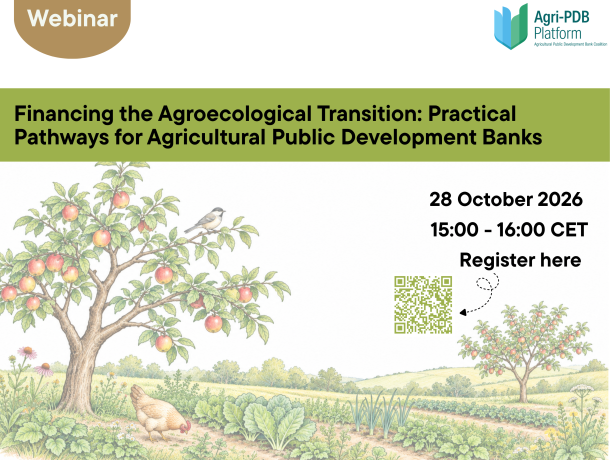
Financing the agroecological transition: Practical pathways for agricultural public development banks
28 October 2026 | Online
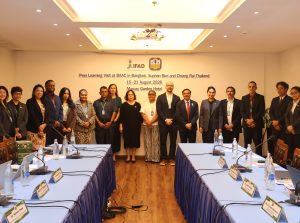
On 28 October 2026, the Agri-PDB Platform, hosted by the International Fund for Agricultural Development (IFAD), held a webinar on Financing the Agroecological Transition: Practical Pathways for Agricultural PDBs. The session brought together Oliver Oliveros of the Agroecology Coalition; climate finance expert Olivier Piérard; Peter Chipeta of the Malawi Agricultural and Industrial Investment Corporation (MAIIC); and Charuwan Satthakun, Director of the Office of Foreign Affairs at Thailand’s Bank for Agriculture and Agricultural Cooperatives (BAAC). The discussion examined how banks can assess agroecological investments, structure suitable financial products and connect borrowers with the knowledge and markets needed to make changes viable. Contributions from MAIIC and BAAC illustrated different stages of this work, from preparing a focused pilot to learning from an existing low-carbon rice project.
Matching finance to the realities of transition
In his opening remarks, Oliver Oliveros highlighted the growing recognition of agroecology in policy discussions and national strategies. Financing, however, often remains poorly suited to diversified, locally adapted production systems, particularly where benefits take time to emerge and extend beyond the individual farm. Oliveros illustrated the financing gap with estimates of around USD 430 billion in annual transition needs, compared with about USD 44 billion in funding. The Global Alliance for the Future of Food’s Cultivating Change analysis estimates annual costs of USD 250–430 billion for agroecological and regenerative transitions. At the upper end, this implies an almost tenfold increase in funding. He emphasised that financing arrangements should reflect when an activity can generate income, who bears the risks and whether implementing actors can manage and repay finance. Soil restoration, biodiversity and food security also generate public benefits, making it necessary to consider how public, private and philanthropic resources can support different parts of the transition.
Agroecology as a portfolio resilience strategy
Olivier Piérard connected agroecology with the risks agricultural lenders already face. Climate shocks, volatile input prices, soil degradation and crop concentration can affect borrowers’ cash flows and repayment capacity. Assessing these exposures helps banks understand the resilience of the production systems they finance.
He stressed that agroecological transition must respond to local conditions. Soil restoration may require carefully managed nutrient inputs, while appropriate mechanisation can remain important where labour costs and narrow margins constrain farmers. Financing decisions therefore need to consider the farm, its landscape, labour requirements, markets and local knowledge. For banks, this means adapting loan terms to cash flow and transition needs, linking finance with advisory services, strengthening staff skills and working with producer organisations, research institutions, public agencies and buyers. Financial sustainability and normal credit assessment remain essential.
Piérard distinguished three assessment approaches that can inform this work:
- The Tool for Agroecology Performance Evaluation (TAPE), developed by the Food and Agriculture Organization of the United Nations (FAO), can establish a baseline at farm or territorial level and help track changes over time.
- Biovision’s Business Agroecology Criteria Tool (B-ACT) assesses enterprises and value-chain actors against the 13 principles of agroecology, complementing financial analysis.
- Participatory Guarantee Systems (PGS) use locally governed peer review to assess practices and support market access. Their criteria and governance need to be understood, and participation does not provide a credit guarantee.
He recommended proportionate assessment: a quick screen for many clients, deeper analysis where exposure warrants it, and a small set of locally meaningful indicators agreed before a pilot begins.
MAIIC builds on peer learning and existing investments
Peter Chipeta described MAIIC’s aim to become more deliberate in identifying, supporting and measuring investments relevant to agroecology. For resource-constrained farmers, a change in practice is an investment decision shaped by upfront costs and the consequences of a poor season.
MAIIC’s exchange with India’s National Bank for Agriculture and Rural Development (NABARD) reinforced the importance of farmer organisations, field demonstrations and advice throughout the growing season. Learning about NABARD’s JIVA programme also highlighted the need to follow how new practices affect adoption, cash flow and results.
Chipeta presented two examples from MAIIC’s existing financing. EcoGen provides biogas solutions that can supply cooking fuel and produce nutrient-rich material for use on farms; he reported that the enterprise reaches more than 2,000 households and around 500 smallholder farmers. Kwithu Kitchen processes food sourced from smallholders and, according to the presentation, has more than 1,000 smallholder linkages. These examples illustrate how enterprise finance can connect farmers with services and markets. Chipeta noted that outcomes such as changes in soil health and farmer income still need to be measured.
Looking ahead, MAIIC intends to develop a focused agroecology pilot, potentially through an existing enterprise relationship or a participating financial institution. Preparatory work would identify suitable practices, investment costs, repayment capacity and the partners responsible for technical support. The institution is also interested in exploring TAPE and B-ACT alongside its existing credit analysis, and in reviewing adoption, incomes, loan performance, inclusion and delivery costs before expanding.
BAAC links low-carbon rice with farmer incentives
Charuwan Satthakun presented BAAC’s low-carbon rice project as an example of combining finance, practical training, market incentives and monitoring. The project supports alternate wetting and drying (AWD), a water-management practice that replaces continuous flooding with managed wetting and drying periods to help reduce methane emissions and water use. BAAC allocated approximately THB 1.5 million to support the pilot. Assistance combines low-interest loans, support for costs such as soil testing, technical advice and a purchase premium for participating farmers’ rice. The project also offers a guaranteed carbon-credit purchase price of THB 500 per tonne of CO₂ equivalent, connecting potential climate revenues with incentives for farmers to adopt new practices. Satthakun reported that the pilot involved 141 farmers across approximately 1,100 rai, equivalent to around 176 hectares. Reported results included an approximately 10 per cent improvement in rice yields, a 9 per cent reduction in production costs and methane-emission reductions equivalent to approximately 1,016 tonnes of CO₂. These figures describe the specific pilot presented during the webinar. She also noted that the initiative had expanded from one province to four in 2026.
Reliable measurement and verification remain central to the model. In the Q&A, Satthakun clarified that BAAC relies on an external validation and verification body for monitoring, reporting and verification. The project follows Thailand’s voluntary carbon-credit framework. BAAC identified continuing challenges around transition costs, uncertain returns, the expense of monitoring small projects and the need to aggregate activities to reach a viable scale. Partnerships among banks, government agencies, technical experts, buyers and farmers are essential to addressing these constraints.
Discussion on scale and evidence
Participants asked how banks can account for diverse territories, value chains and farmers without making every assessment excessively complex. Piérard recommended broadening appraisal to understand the production system while retaining economic analysis. Proportionate screening and learning from other institutions can help banks incorporate additional considerations into their credit processes.
Emile Frison of the Agroecology Coalition emphasised the importance of investing in social capital and farmers’ capacity for continued innovation. Agroecological transition involves farmers actively developing and adapting solutions over time, which requires attention to the full set of agroecological principles.
A further question concerned the economic evidence needed to convince farmers and lenders to invest. Frison and Oliveros pointed to research on Andhra Pradesh Community Managed Natural Farming (APCNF), India. The 2023 study Natural Farming Through a Wide-Angle Lens, led by GIST Impact and supported by the Global Alliance for the Future of Food, reported average yields of primary crops 11 per cent higher, net incomes 49 per cent higher and input costs 44 per cent lower than the farming systems used for comparison. These findings relate to the study’s Andhra Pradesh context. Oliveros also offered to share examples from Bangladesh. The discussion reinforced the value of examining results in context and measuring performance against a baseline.
Key takeaways for agricultural public development banks
- Start with farmers’ transition needs. Assess costs, income timing, local conditions and the practical support required before selecting financial instruments.
- Connect lending with knowledge and markets. Agree who provides advice, training and market access, and how these services will be funded.
- Use assessment tools proportionately. Match farm-level and enterprise-level tools to the purpose of the assessment, alongside normal credit analysis.
- Learn before scaling. Establish a baseline and track farmer outcomes, environmental changes, loan performance and delivery costs.
The webinar continued the Platform’s agroecology work, which has developed through working-group discussions, training and peer-to-peer exchanges since 2023. An agroecology MOOC is also under preparation. MAIIC plans to continue its engagement with NABARD, while BAAC expressed interest in exchanging practical solutions and exploring further collaboration with fellow PDBs.
Recording and presentations
Similar articles