

Highlights from the 4th Agri-PDB Platform Webinar on Agroecology
The Agri-PDB Platform successfully hosted the 4th webinar on Agroecology, bringing together institutional representatives and Moroccan farmers to discuss financial mechanisms to accelerate the agroecological transition.
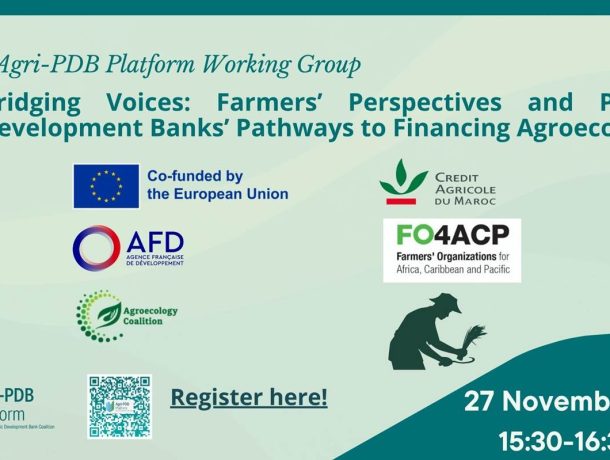
4th Agri-PDB Platform Webinar on Agroecology
Financing the Agroecological Transition: Farmers’ Voices and Perspectives of Public Development Banks
27 November 2025 | Rome, Italy
Introduction
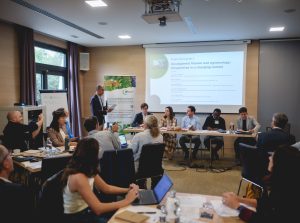
Held online on 27 November 2025 and organised by the Agri-PDB platform, the 4th webinar on Agroecology brought together institutional representatives and Moroccan farmers to discuss financial mechanisms to accelerate the agroecological transition.
Setting the Scene
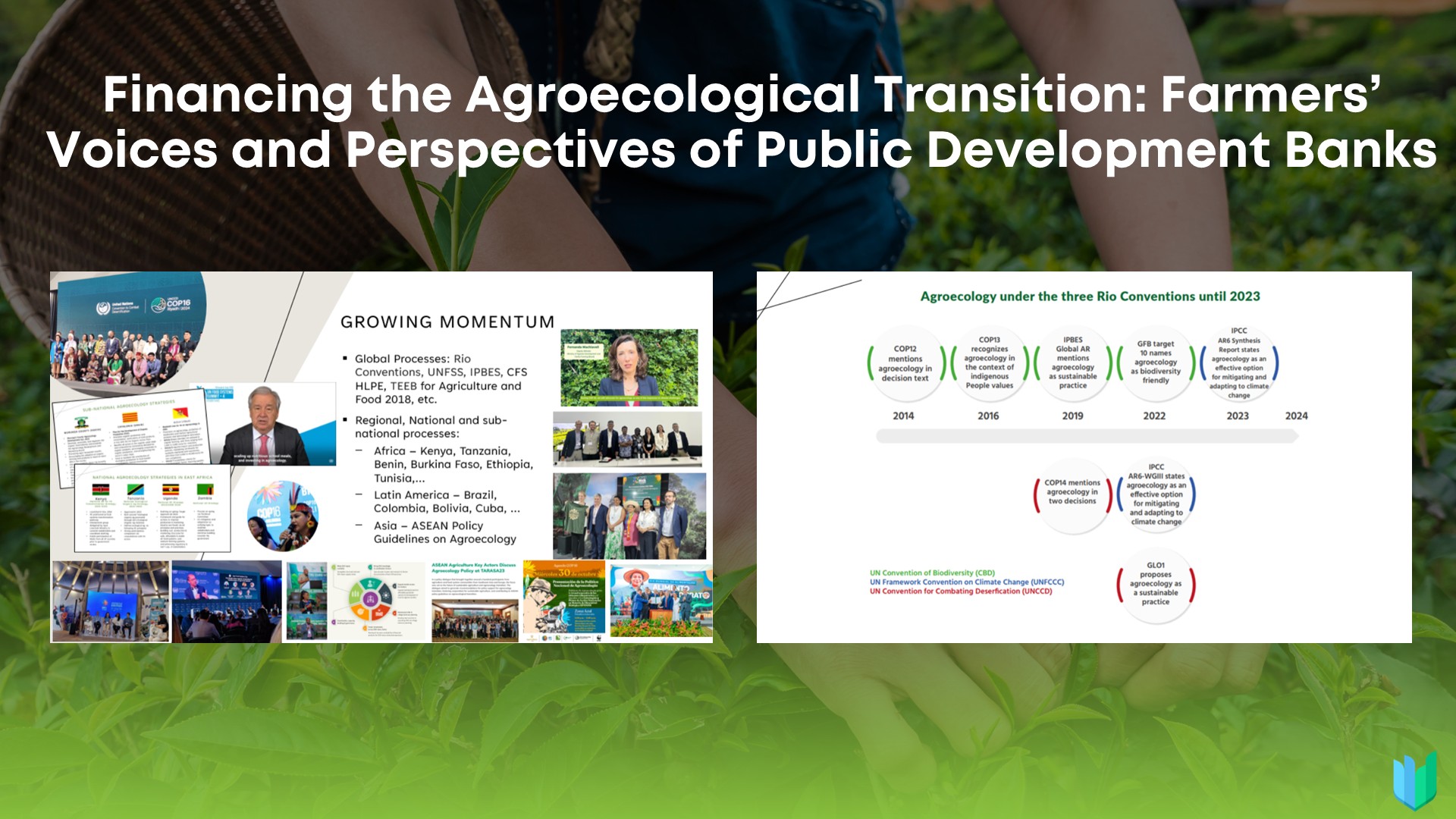
The session opened with representatives from the European Commission (DG INTPA), the Agroecology Coalition and IFAD. Marion Michaud (European Commission) recalled that agroecology, based on the principles defined by the FAO, is today a credible, effective and scientifically supported response to major global challenges such as climate change, soil degradation and biodiversity loss. Olivier Oliveros (Agroecology Coalition) highlighted the growing recognition of agroecology in national and international policy strategies, particularly within the framework of the Rio Conventions. Marco Camagni (IFAD) emphasised the central role of farmers’ organisations, a true driver of innovation, resilience and transmission of local knowledge, and underlined the importance of their inclusion in the design of appropriate financial mechanisms.
Despite increasing interest from policymakers and development partners, public investments in favour of agroecology remain largely insufficient. The ecological transition requires financing not only at higher levels but also designed over the long term, taking into account the transition period (often between five and ten years) during which agronomic results may be uncertain. In this context, the webinar follows on from previous work carried out by the Agri-PDB platform to bridge the gap between institutional vision and field realities, this time allowing farmers to speak directly.
Lessons from the Field – Farmers’ Voices
The testimonies all converged on one key finding: the agroecological transition requires courageous choices but is hindered by limited access to appropriate financing.
- Mimoun Alhouz (Taza) explained how diversification into almond trees, beekeeping and aromatic plants—supported by Fert Maroc—represents a resilient strategy against drought. However, he pointed out that this model cannot be scaled up without sustained technical support and institutional proximity.
- Fatiha Hassouni (Rabat region) presented a farm fully managed under integrated agroecological principles (zero external inputs, mixed livestock, solar energy, water management), financed exclusively through personal resources. She stressed the absence of financial products adapted to innovative small-scale producers and the need for flexible mechanisms that take into account transition risks and delayed profitability.
- Ramdan Imdabr (Taza) shared his positive experience with adopting agroecological practices but emphasised the challenges met during his loan request to Crédit Agricole du Maroc: administrative burdens, land-title guarantee requirements and inflexible repayment schedules.
- Mustapha Belharcha highlighted the need for training, support for farm establishment, structuring local markets and developing complementary sectors such as rural tourism. He advocated financing models that combine productive investment with climate-related subsidies—particularly through environmental value mechanisms (carbon, water)—in collaboration with specialised stakeholders.
Institutional Dialogue – Perspective of an Agricultural Public Development Bank
Speaking on behalf of Crédit Agricole du Maroc, Ihssane El Baijouni presented a structured programme to support the green transition of agricultural and agri-food operations. It is based on several complementary financial instruments, including:
- Biofilaha, allowing financing of up to 100% of investment for organic farming projects, with a repayment grace period of up to six years;
- Ecotaqa (Ecotaqa Agri / Ecotaqa Agro), focused on energy efficiency and covering the acquisition of adapted equipment, including no-till seeders, within the framework of a partnership with OCP;
- AgroNifaya, dedicated to financing the treatment and valorisation of agricultural and agro-industrial waste.
These instruments are combined with measures to reduce farmers’ risk exposure. She emphasised that the agroecological transition is above all a gradual process requiring close technical support. CAM is therefore strengthening its cooperation with the Agri-PDB platform and European partners (ILSA programme) to structure technical assistance and training mechanisms targeting financial institutions and producers.
AFD Summary
Claude Torre (AFD) closed the session, stating that the agroecological transition delivers long-term performance (5-10 years), but entails significant risks during the transition phase, which must be covered to enable financing. He underlined:
- the need for incentives and risk-management tools (e.g. insurance, subsidies) to remove banking barriers;
- the importance of ongoing technical support, beyond one-off projects, to secure implementation;
- the creation of local added value through diversification and quality-based value chains, notably via territorialised markets.
He recalled that agroecological systems are more resilient to climate change and may become less risky for banks if support mechanisms are strengthened. He finally called for continued dialogue between farmers, banks and partners to transform this vision into operational financial solutions.
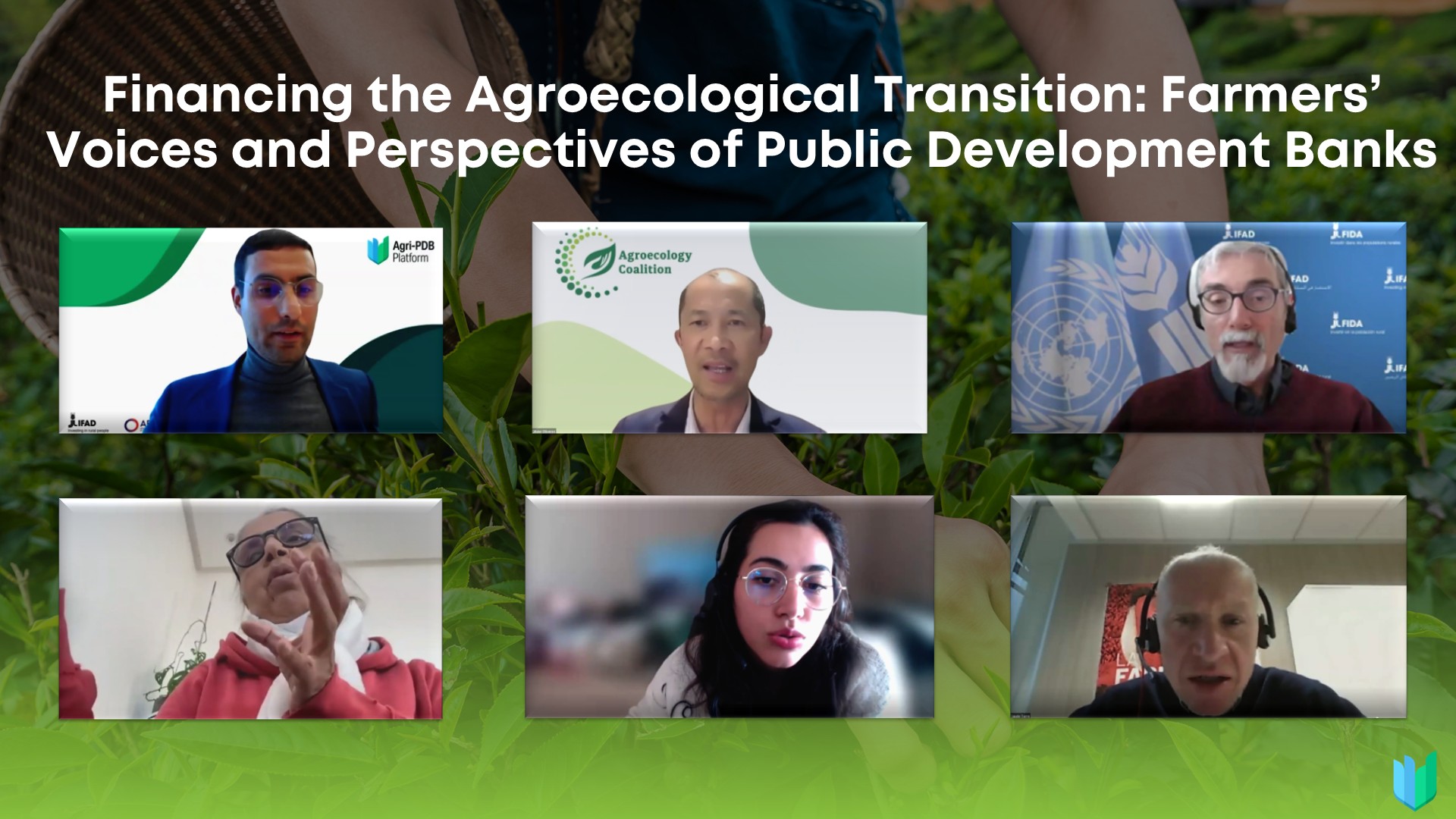
Key Lessons for Public Development Banks
The discussions highlighted three major priorities:
- Systematically combine financing with technical assistance, essential to secure the transition and reduce credit risk.
- Adapt financial products to the profiles of small-scale farmers, notably by simplifying procedures, easing guarantee requirements and accounting for the agroecological transition timeline.
- Strengthen collaboration between farmers, financial institutions and public partners to co-develop financial mechanisms tailored to field realities and reflecting the environmental and social value of agroecological practices.
Conclusion
In conclusion, the webinar reaffirmed that agroecology should not be seen as an obligation but as a progressive evolution requiring flexible financing, robust technical support and strengthened cooperation between producers, banks and public partners. A new dialogue between farmers and financial institutions will be organised in the first half of 2026 to further explore these collaboration opportunities.
Similar articles