

Financing Nature-Positive Agriculture: Lessons Learned from the Asia and the Pacific region
Building on the successful session held in December, which provided perspectives from the Development Bank of Southern Africa (DBSA) and the Brazilian Development Bank (BNDES), the Agri-PDB Platform and IFAD’s Biodiversity team organised another session engaging KfW and the Bangladesh’ Apex Development Institution Palli Karma-Sahayak Foundation (PKSF), to draw on the experience and approaches of institutions operating across Asia and the Pacific. Through concrete examples, such as KfW support to large-scale government-led programmes like zero budget natural farming and organic agriculture in Meghalaya, or the nature-positive farming approach “Ecological Farming System” implemented by PKSF in the northern part of Bangladesh, participants explored practical ways to scale nature-positive solutions. The discussion also highlighted synergies with climate finance and how existing tools, models, and approaches can be expanded through better coordination across finance, policy, technology, and partnerships.
Financing Nature-Positive Agriculture: Lessons Learned from the Asia and the Pacific region
16 April | Online
Introduction
In December 2025, representatives from another session was organised with KfW Development Bank and the Bangladesh’ Apex Development Institution Palli Karma-Sahayak Foundation (PKSF), to draw on the experience and approaches of institutions operating across Asia and the Pacific. This follow-up received great interest from PDBs and partners from Myanmar, the Philippines, Vietnam or Thailand, offering perspectives from the region.
Background
Marie-Aude Even, Senior Biodiversity Specialist at IFAD, started off by emphasizing on the place of biodiversity in the foundation of agriculture itself, as it encompasses the diversity of species, genetic variation, and ecosystems that regulate water, air, and climate. These natural and diverse systems provide essential services and help stabilize the climate while enabling farms to adapt to changing conditions. Yet this foundation is under growing pressure. Today, with roughly half of the world’s agricultural land degraded, and farming accounting for about 70% of global freshwater use, these pressures, more than just being environmental, translate directly into financial risks. As ecosystems weaken, crop yields become less reliable, supply chains more volatile, and investments more exposed. Financial institutions increasingly face credit risks from declining productivity, market risks from unstable supply, and reputational risks tied to unsustainable practices. At the same time, investing in biodiversity presents economic opportunities. For example, pollination services are valued at USD 235–577 billion annually, while restoration and bio-input markets are rapidly expanding.
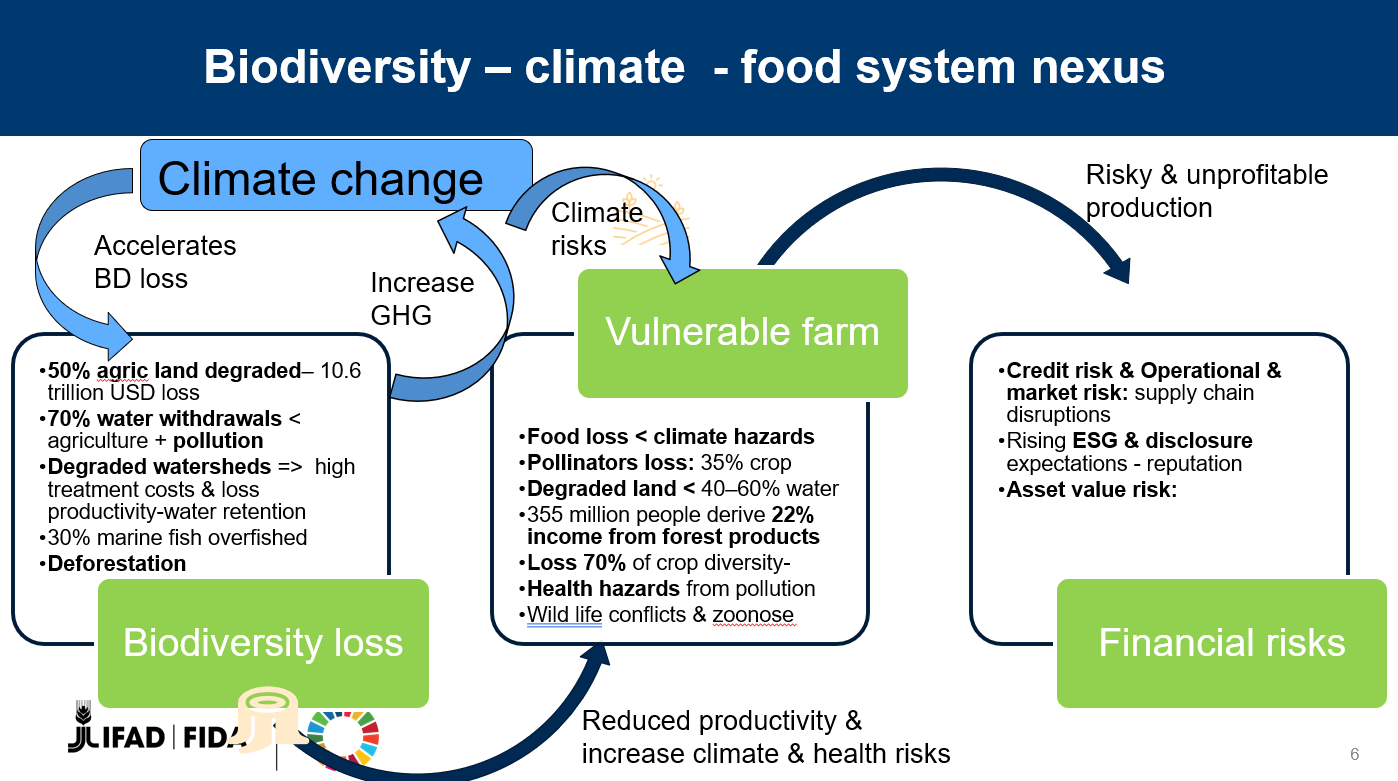
Highlighting the intertwined connection between biodiversity and climate change Marie-Aude Even explained that:
- Climate change drives biodiversity loss
- Ecosystem degradation increases greenhouse gas emissions
- Healthy ecosystems enhance climate resilience
For PDBs, this means that addressing biodiversity is not optional—it is central to managing climate risk and ensuring long-term portfolio performance.
How Public Development Banks Can Act?
Completing the presentation, Matthew Mather, Climate and Biodiversity Specialist at IFAD, Public Development Banks are uniquely positioned to influence this transition, and their role can evolve in stages: (i) greening finance, which reduces harm by integrating safeguards, exclusion lists, and better environmental risk monitoring into existing portfolios; and (ii) financing green, which involves actively investing in nature-positive activities such as agroecology, sustainable value chains, and ecosystem restoration. More information about these two stages were developed during the first webinar and can be found in this article.
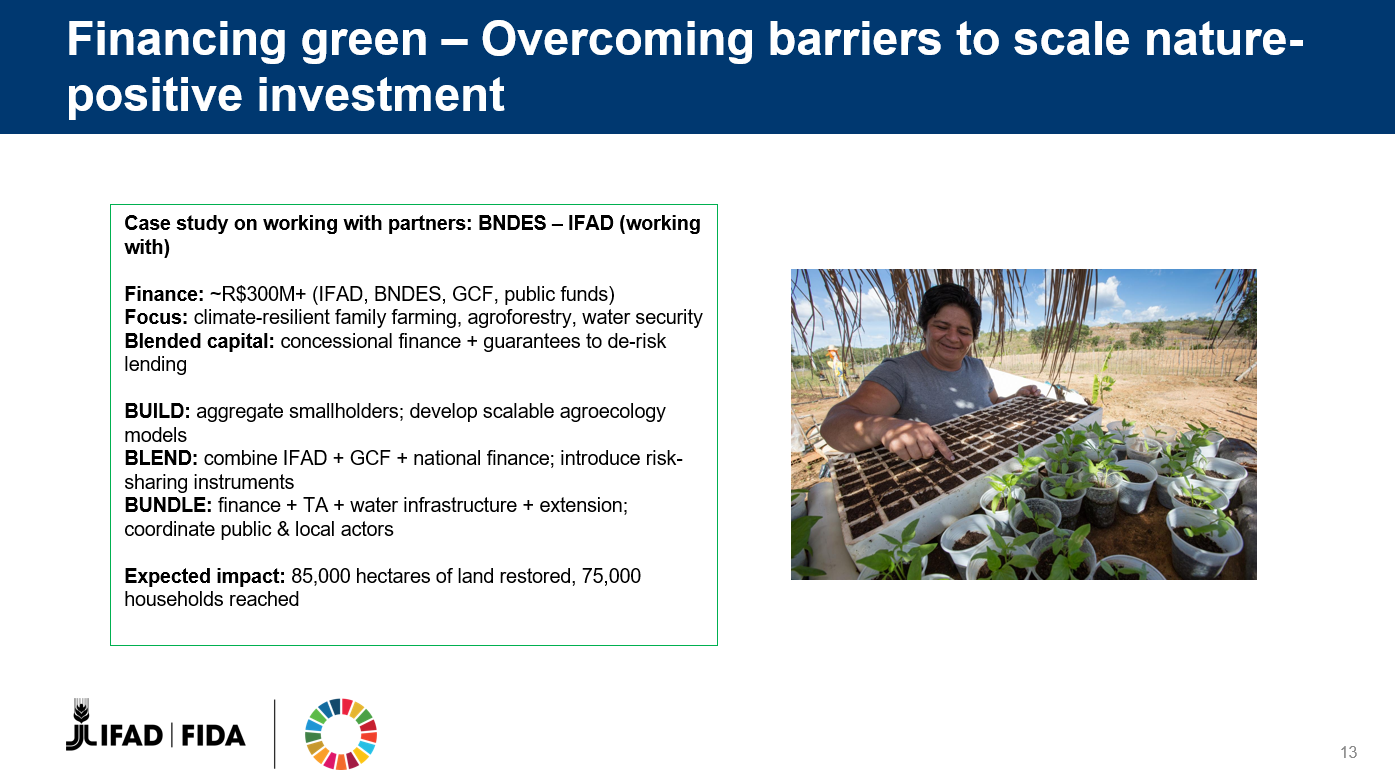
In practice, he explained that this transition moves from avoiding environmental damage to supporting sustainable production and, ultimately, to financing more complex restoration efforts that often require landscape-level coordination and supportive policies. However, challenges persist. Farmers face high upfront costs, delayed returns, and limited access to finance, while banks see these investments as risky, small-scale, and difficult to standardize. He also highlighted that PDBs can act as “system integrators” by helping to overcome these barriers. This can be done through a Build–Blend–Bundle approach: building pipelines by aggregating smallholders and cooperatives; blending concessional, public, and commercial finance to reduce risk; and bundling finance with technical assistance, extension services, market access, and infrastructure. A case from Brazil illustrates this approach, combining public and climate finance with technical support to scale agroforestry and improve resilience.
Experiences from Development Banks – KfW and PKSF
Christiane Ehringhaus, Senior sector Economist, Agricultural Rural Development at KfW, shared details on how the German development bank supports nature-positive agriculture through a mix of government programmes and financial sector initiatives. In practice, nature-positive efforts are most visible in agroecology, landscape restoration, and biodiversity-friendly value chains, alongside growing efforts to “green” irrigation and financial systems. In India, KfW supports large-scale government-led programs like zero budget natural farming and organic agriculture in Meghalaya, showing how political commitment can drive widespread adoption. In Latin America, blended finance funds and credit lines—combined with strong technical assistance—help scale biodiversity-friendly farming through local financial institutions.
She concluded that two main pathways are emerging: scaling public programmes and expanding agri-finance. Both require strong technical support, enabling policies, and market development. While biodiversity finance is gaining traction, challenges remain—especially high perceived risks and the need for better incentives and impact measurement systems.
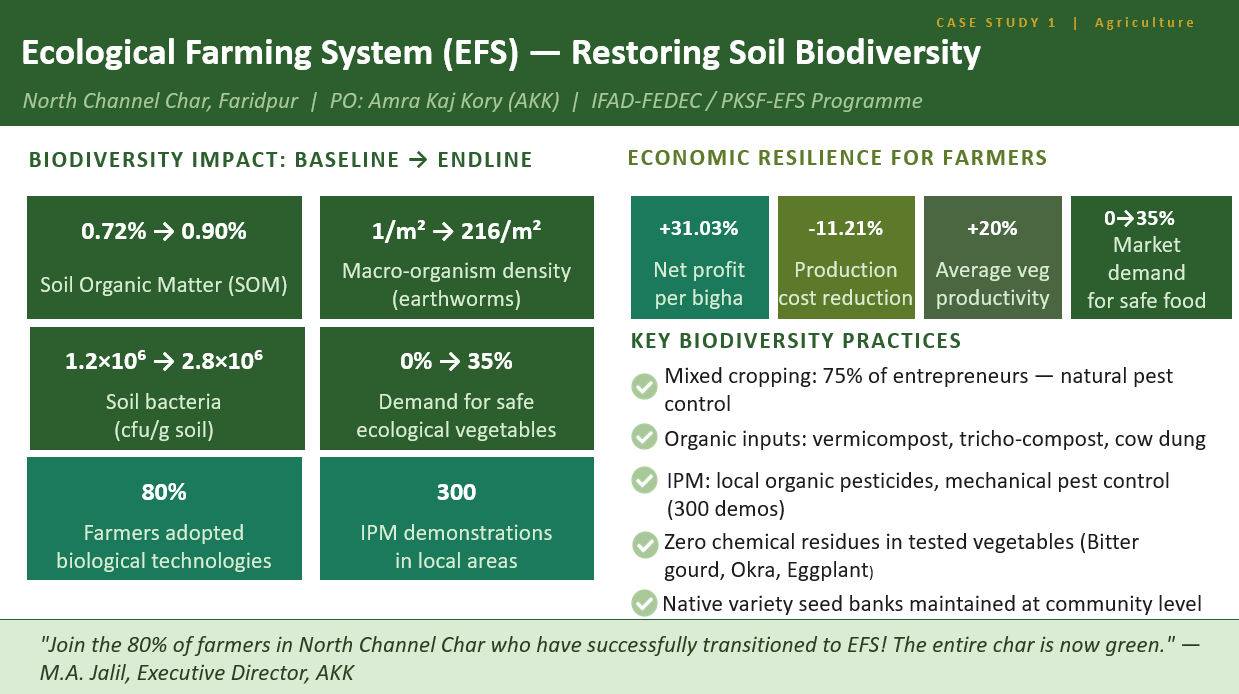
The discussion shifted to PKSF’s team from Bangladesh, Tanvir Sultana, Deputy General Manager, and Jesmin Ara, Manager, presented how they integrate biodiversity and climate resilience into rural finance. Through real examples, they showed how farmers benefit from agroecological methods, smart aquaculture, waste recycling, and climate-adapted crops—improving both environmental outcomes and incomes. Among the examples presented, they provided details on the Ecological Farming System implemented in the northern part of Bangladesh, a nature-positive farming approach built on five key practices: (i) mixed cropping; (ii) organic inputs such as vermicompost or tricho-compost; (iii) integrated pest management; (iv) zero chemical pesticides; (v) and community managed native variety seed banks. This system was adopted by 80% of the farmer from the area and generated great results for biodiversity, as shown in the slide:
Through another example they introduced one of PKSF’s most innovative nature-positive technologies, the black soldier fly larva production. This eco-friendly alternative protein source for aquaculture feed converts kitchen and market waste into insect larva, which uses as highly quality fish feed and organic fertilizer generated:
- An average of 70 tons of monthly production
- An average of USD 30,000 of monthly market value
- 540 jobs
- Reduction of feed cost by 30-40%
Flexible financing and technical support help farmers adopt these innovations.
They concluded sharing five ways PKSF plan to strengthen its nature-positive finance contribution: (i) break chemical dependency and restore soil health; (ii) close knowledge gaps and build farmer confidence; (iii) blended finance and distress-sale prevention; (iv) fix market barriers and certification gaps; and (v) policy reform, labour and land fragmentation.
Q&A Discussion
The discussion started on risk sharing mechanisms. IFAD representative explained that the Fund provides guarantees for loans and investments, grants from climate and environment funds, like the GCF, and insurance. At the field level, PKSF mitigate risk through practical services (e.g. veterinary care, vaccinations), flexible loan repayment aligned with harvest cycles, and emergency lending after disasters. Completing, KfW presented some of its risk mitigation measures including technical assistance, irrigation investment, insurance schemes.
Exchange pursued on recommendations for improving the learning effect and ensuring graduation. KfW admitted that for apex structures it is difficult to keep track of adoption rates making crucial technical assistance across different levels and mainstreaming it across financial intermediate institutions. IFAD stressed the importance of promoting practices that are actually sustainable and viable on the ground, providing support for farmers to monitor what work for them considering the long-term. Eventually, PKSF highlighted the importance of demonstration projects to encourage uptake by farmers. They also emphasized capacity building, nutrition, and livelihood improvements, with successful adoption helping reduce vulnerability and create local employment opportunities.
Key Lessons Learned
Across these experiences, several lessons stand out:
- For PDBs, integrating biodiversity is essential to protect portfolio value, reduce credit risk, and align with global sustainability goals.
- Finance alone is not enough—technical assistance is essential to make new practices viable.
- Supportive policies, including secure land tenure and market incentives, play a decisive role in adoption of sustainable practices.
- Blended finance has proven critical in unlocking larger-scale investment by reducing risk.
- The use of technology enables greater measurement and tracking of biodiversity outcomes, addressing one of the long-standing barriers in this space.
Conclusion
Once again, this learning event emphasized that nature-positive agriculture is more than an environmental ambition, it is a pathway to stronger, more resilient food systems and economies. PDBs have a pivotal role to play in this transition, with the ability to align financial flows with ecological sustainability.
The path forward is to leverage the tools, models, and examples that already exist, through coordinated action—bringing together finance, policy, technology, and partnerships to scale these approaches.
Click here to access the webinar recording and slides.