

Agroecology Monthly Talks: Explore the role of Public Development Banks in supporting agroecological transitions
This article takes you through the key insights shared during ILSA’s Monthly Talk dedicated to agroecological transition and how Public Development Banks, through coordinated action and practical tools, can play a decisive role in making this transition financially viable and operational at scale. From a practitioner’s perspective, PDBs representatives from Crédit Agricole du Maroc (CAM) and NABARD, shared concrete examples of how their institutions are advancing sustainable agricultural finance through integrated approaches. CAM presented the bank’s Foundation for Sustainable Development, which promotes climate-resilient and income-generating agriculture, while NABARD highlighted the farmer-centered agroecology JIVA programme which focused on five objectives: food and nutrition security, climate resilience, environmental conservation, economic growth, and food safety. Read our full article below to know more about the initiatives developed by PDBs in Morocco and India, the key challenges identified, including high transition risk and climate-related shocks, and the opportunities, like the use of scoring and monitoring tools, ahead.
Agroecology Monthly Talks:
Explore the role of Public Development Banks in supporting agroecological transitions
5 February 2026 | Rome, Italy
Introduction
On 5 February, the webinar featured representatives from the European Commission, the Agri-PDB Platform, CAM Morocco, and NABARD India, and explored how Public Development Banks (PDBs) can accelerate the transition to sustainable and inclusive food systems. Opening remarks by Marion Michaud, Policy Analyst at DG INTPA, underscored the strategic importance of PDBs as government-backed institutions aligned with public policy goals, particularly in a context where progress toward agroecological transformation remains too slow relative to the urgency of climate and biodiversity challenges.
Strengthening PDB Capacity for Agroecology
Since 2023, and in the context of its collaboration with European Commission, the Agri-PDB Platform has created an Agroecology Working Group which continuously expanded engagement, showcased good practices from Africa, Asia, and Latin America, and introduced practical tools in partnership with Food and Agriculture Organization of the United Nations (FAO), Biovision Foundation, and the Agroecology Coalition.
Tools such as TAPE, B-ACT, and the Agroecology Financing Tracking Tool are helping banks integrate agroecological criteria into operations, monitoring systems, and reporting frameworks. Trainings have already been delivered to PDBs across Senegal, Colombia, Lesotho, Benin, Morocco, Mali, South Africa, and China.
PDB Experiences – CAM and NABARD
Crédit Agricole du Maroc
Nihal Bounaim, Project Manager at Crédit Agricole du Maroc presented the PDB integrated approach to sustainable agricultural finance. With over 1.85 million clients, the bank combines universal banking services with agricultural expertise and operates within Morocco’s Sustainable Finance roadmap.
Through its Foundation for Sustainable Development, the bank promotes climate-resilient and income-generating agriculture across four pillars:
- Irrigation water conservation
- Energy efficiency and renewable energy
- Agroecology and organic farming with short supply chains
- Agricultural waste valorization
Notably, the Foundation introduced Morocco’s first Participatory Guarantee System (PGS) for agroecology, developed the BIOFILAHA financing product, and supported more than 30 farms in obtaining SPG Agroecology Morocco labelling. Pilot farms helped adapt the IDEA sustainability methodology to the Moroccan context and produced an 18-indicator grid enabling farmers to assess agro-environmental, socio-territorial, and economic performance.
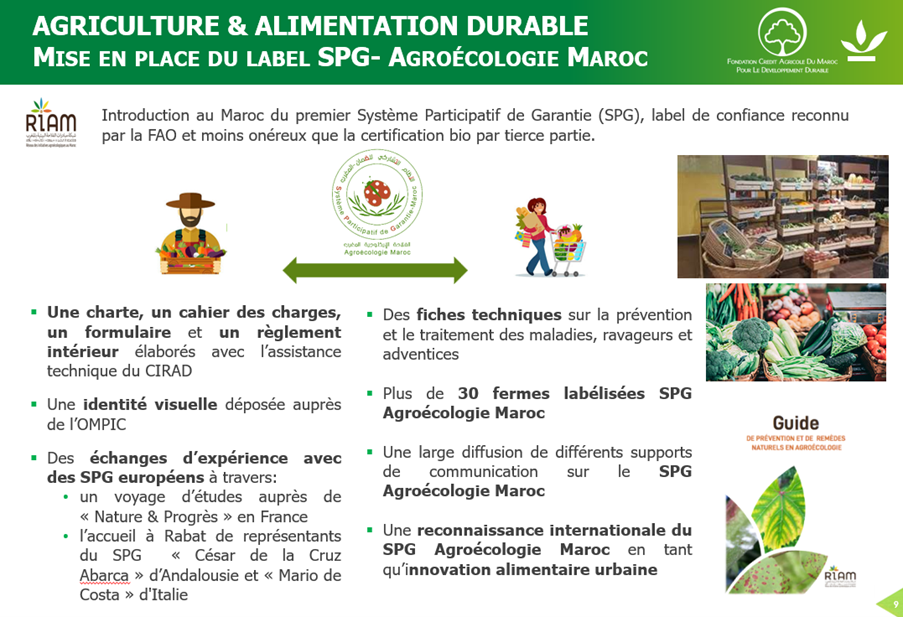
The bank has also developed an inclusive ecosystem, including microfinance, mesofinance, leasing, factoring, and participatory banking arms, to ensure access for small and non-landholding farmers.
National Bank for Agriculture and Rural Development (NABARD)
Dr. A. V. Bhavani Shankar, Chief General Manager at NABARD provided details on the farmer-centered agroecology JIVA programme. Established in 1982, NABARD is India’s largest development finance institution supporting rural development.
JIVA focuses on five objectives: food and nutrition security, climate resilience, environmental conservation, economic growth, and food safety. Key features include:
- Farmer-led extension models;
- Crop diversification and soil regeneration;
- Integrated livestock systems;
- Bio-input production centers;
- Market access and collective marketing structures.
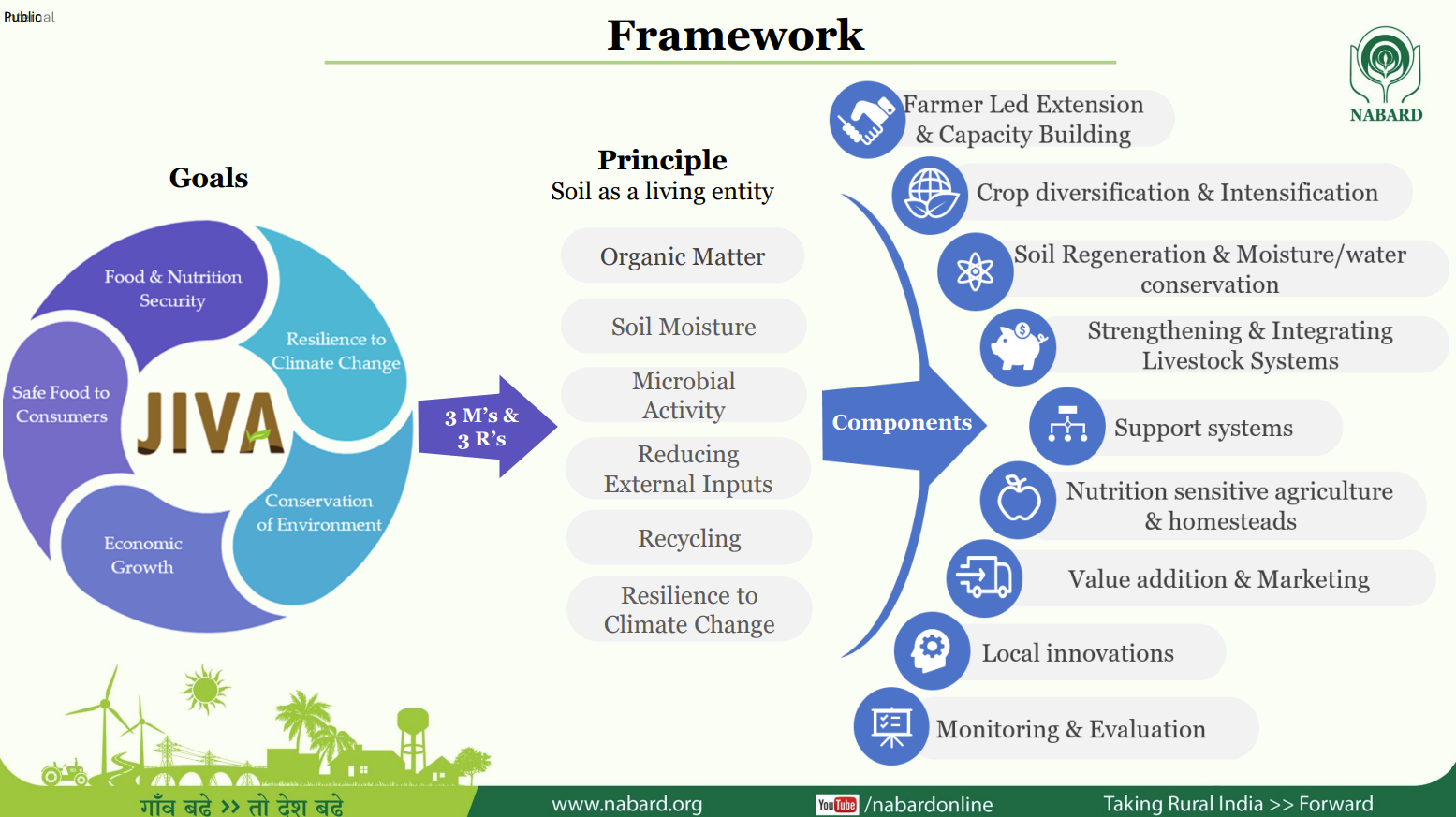
Currently covering 40 projects across 25,000–30,000 hectares, JIVA plans to scale to 200–300 projects nationwide. Monitoring is supported through a dedicated web portal and mobile application, facilitating data tracking and peer learning. International exchanges, such as the peer-to-peer visits from Malawi organised by the Agri-PDB Platform, have strengthened South–South collaboration.
Key Challenges Identified
Across discussions, several structural barriers to agroecological financing emerged:
- Insufficient public investment during the 5–10-year transition period
- High transition risk and climate-related shocks
- Administrative burdens and collateral requirements
- Inflexible repayment schedules
- Weak agricultural guarantee systems
- Limited market linkages for agroecological produce
Speakers emphasized that PDBs are expected to assume greater risk than private lenders and can use blended finance, insurance schemes, flexible loan structuring, and collective financing models to mitigate risks. In India, for example, short-term loans are structured over one year to provide repayment flexibility, while long-term loans incorporate grace periods to support transition.
Financing farmer collectives rather than individuals also emerged as an effective risk-sharing mechanism.
Q&A Highlights
Participants raised important questions about climate risk, guarantees, and tool application:
- De-risking under extreme climate events: Insurance schemes, collective financing models, and flexible repayment schedules were identified as key mechanisms.
- Use of scoring and monitoring tools: Current platforms primarily serve as information systems; integration with core banking systems would require API development for transactional functionality.
- Target audience for training: Capacity building focuses mainly on project managers and operational staff rather than senior executives.
- Guarantee requirements: Inclusive models aim to reach non-traditionally bankable farmers; however, agricultural guarantee systems remain underdeveloped in many countries.
- Knowledge sharing: NABARD plans to make its JIVA knowledge repository publicly accessible in the coming months.
The session also referenced a scoping report examining PDBs’ engagement with agroecology, emphasizing the need to reassess risk frameworks to account for the long-term environmental and socio-economic externalities of conventional agriculture, while recognizing the sustainability benefits of agroecological systems.
Looking Ahead
After three years of groundwork, the Agri-PDB Platform is shifting from dialogue and pilot initiatives toward systematic integration of agroecology into PDB portfolios, pipelines, and monitoring systems. The roadmap for 2026 prioritizes scaling structured training, embedding performance assessment tools, strengthening peer exchange, and supporting national implementation.
The discussion concluded with a shared recognition: agroecology is no longer a niche concept but a science-based and finance-relevant pathway for addressing climate, biodiversity, and food system challenges. Public Development Banks, through coordinated action and practical tools, can play a decisive role in making this transition financially viable and operational at scale.
To access the slides, please click here
Similar articles