

Toward Coordinated Climate–Agrifood Financing: AgriPDB Platform-FAST Partnership–G7 PDBs/DFIs Collaborative Dialogue
Toward Coordinated Climate–Agrifood Financing: AgriPDB Platform-FAST Partnership–G7 PDBs/DFIs Collaborative Dialogue
23 March 2026 | Rome, Italy
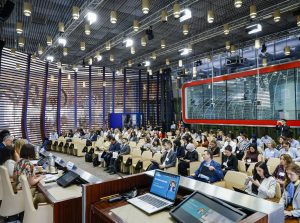
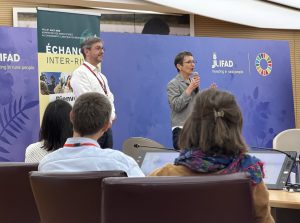
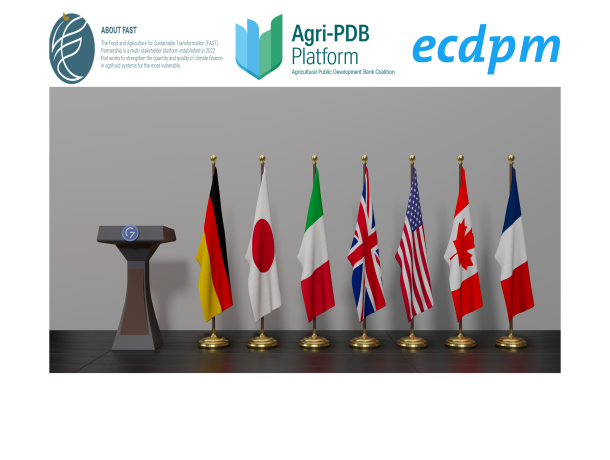
On 23 March 2026, the AgriPDB Platform, the FAST Partnership, and the G7 PDB/DFI Collaborative on Sustainable Food Systems came together at FAO Headquarters in Rome for an informal dialogue on how to scale climate-smart agrifood investments. Moderated by ECDPM, the meeting brought together around 25 participants — in person and online — from UN agencies, multilateral and bilateral DFIs, national public development banks (PDBs), commercial banks, agribusinesses, farmers’ organisations, and Savings and Credit Cooperative Organisations (SACCOs). The conversation was anchored in a simple but pressing reality: agrifood systems still receive only a small share of global climate finance, even though they are central to mitigation, adaptation, biodiversity, and food security.
Structured around three threads — strategic complementarities between the initiatives, concrete pilot concepts in priority geographies, and operational next steps — the dialogue surfaced a clear structural challenge. Macro-level climate finance commitments are not yet reaching micro-level realities on the ground. Closing that gap requires bringing instruments such as guarantees, blended finance, and concessional capital much closer to the point of implementation. Private sector participants pointed to a “missing middle” in which agribusinesses are effectively acting as financiers for smallholder farmers, and called on commercial banks and PDBs to engage with the alternative, locally developed credit-scoring tools already being used in the field.
Participants were aligned on a key principle: farmers, cooperatives, SACCOs, and national PDBs should be treated not just as beneficiaries, but as co-designers of financial instruments and as active intermediaries capable of deploying investment at the last mile. This is essential to overcoming collateral constraints, lowering the cost of credit for smallholders, and ensuring that financial products are genuinely bankable and locally owned.
A set of shared priorities emerged from the discussion. These include exploring alignment of investment priorities in two to three geographies where the three initiatives are already active; deepening coordination between international financial institutions, national PDBs, vertical climate funds, and private investors; structuring exchanges on financial tools such as credit lines, guarantees, blended finance, and technical assistance; and ensuring that farmer organisations and local actors are meaningfully engaged so that investment concepts remain demand-driven and implementation-ready. The collaboration is expected to begin with foundational steps — information sharing, knowledge exchange, and light coordination — while leaving room to evolve into more ambitious joint work over time, with each initiative continuing to focus on its core mandate.
To keep the momentum going, participants identified several upcoming milestones as natural entry points for continued engagement. CDP flagged the D20-LTIC Strategic Corridors Dialogue, launched in April during the 2026 World Bank–IMF Spring Meetings with the Lobito Corridor as its first focus, as a concrete platform for collaboration on agrifood value chains. The FAST Partnership Annual Meeting (16–18 September 2026) will host a dedicated working session to further develop joint proposals, with the aim of presenting them shortly afterwards at the World Food Forum in October. Equity Bank also offered to host a co-creation workshop to pilot a full value chain programme — from wheat production through milling and processing — combining grants, catalytic capital, and first-loss guarantees to enable lending to first-time, uncollateralised borrowers.
Taken together, the dialogue marked a meaningful step toward a more joined-up architecture for climate-agrifood finance. By building on the complementary strengths of the three initiatives — the AgriPDB Platform’s upstream capacity-building work with national PDBs, the FAST Partnership’s multistakeholder convening role, and the G7 Collaborative’s coordination of major DFIs — there is real scope to strengthen PDBs working as a system and to channel more, and better, finance into the food systems and farmers that the climate transition depends on.
Similar articles