

1st Working Group on Governance and Strategic Integration of Impact
The webinar series dedicated to impact indicators officially kicked off by focusing on governance and their strategic integration within agricultural Public Development Banks (PDBs). Through an overview of current challenges, identification of best practices, and concrete testimonials from the Agricultural Bank of Senegal and the Agricultural Finance Corporation of Kenya, these first two webinars outlined a roadmap to better understand how to leverage this governance tool in support of more inclusive and sustainable agricultural finance.
1st Working Group on Governance and Strategic Integration of Impact
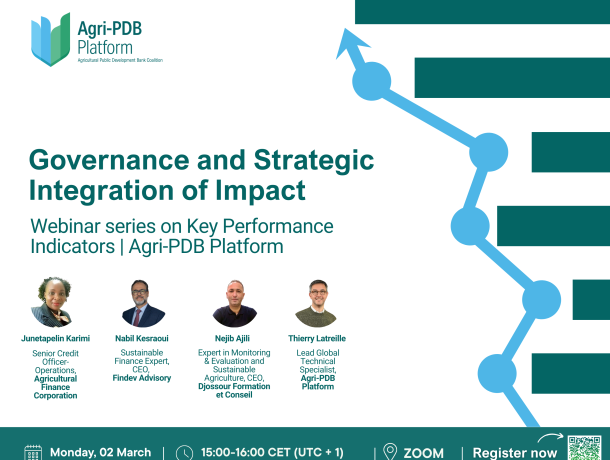
26 February – 2 March 2026 | Rome, Italy
Introduction
The Agri-PDB Platform, in collaboration with the German development bank KfW, Findev Advisory, and DJOSSOUR Formation & Conseil, organized two webinars, held in French and English, dedicated to governance and the strategic integration of impact indicators (KPIs) within agricultural Public Development Banks (PDBs).
Opening the session, Thierry Latreille, Coordinator of the Agri-PDB Platform, emphasized that donor requirements are intensifying, access to green financing depends on the ability to demonstrate measurable results, and public mandates are evolving toward greater inclusion, climate resilience, and food security. This makes the integration of impact into PDB governance an institutional priority.
The webinar therefore addressed a central question: how can impact move beyond being a simple reporting exercise to become a genuine strategic management tool that influences financing decisions and capital allocation?
Governance and Strategic Steering of Impact
Nejib Ajili, Monitoring & Evaluation and Sustainable Agriculture Expert and CEO of DJOSSOUR Training & Consulting, presented current challenges, notably the transition from reporting-oriented KPIs to steering KPIs—meaning a limited number of truly decision-oriented indicators that shift from a peripheral function to a structuring lever within the credit cycle.
To achieve this, four fundamental questions structuring impact governance were identified:
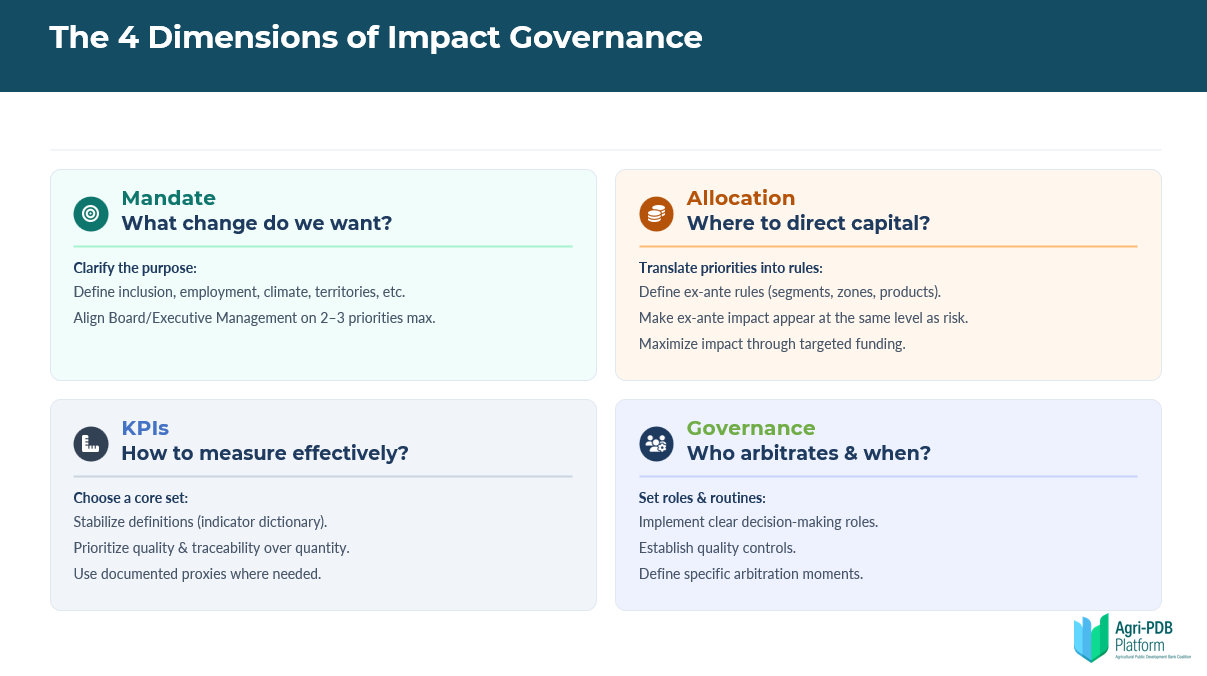
Thus, without clear governance, impact remains confined to a declarative function. With structured governance, it becomes a strategic arbitration tool.
Integrating Impact into the Financing Cycle
A key recommendation is to integrate impact from the origination stage of a file, rather than retrospectively. The proposed integration cycle includes:
- Pre-screening: Eligibility criteria aligned with the strategic mandate.
- Appraisal: Detailed impact analysis including baseline and proxies.
- Approval: Arbitration between impact, risk, and profitability.
- Contracting: Inclusion of covenants linked to impact commitments.
- Monitoring: Data aggregation and corrective adjustments when necessary.
This approach introduces a paradigm shift: financing decisions are no longer based solely on the risk/profitability pair, but on a triptych integrating impact. In this way, banks can mobilize concessional resources, reduce their refinancing costs, or access instruments such as green and sustainable bonds—provided they have reliable and traceable indicators.
International Frameworks and Standards
Nabil Kesraoui, Sustainable Finance Expert and CEO of Findev Advisory, presented available international frameworks for structuring impact measurement, such as: Global Impact Investing Network (IRIS+), International Finance Corporation (Performance Standards, AIMM), Sustainable Development Goals (SDGs), Organisation for Economic Co-operation and Development (DAC) or the Harmonized Indicators for Private Sector Operations (HIPSO).
He emphasized that the objective is not to adopt all frameworks simultaneously, but to build a coherent system aligned with each institution’s mandate and internal capacities.
Experience of the Agricultural Bank of Senegal (LBA) and the Agricultural Finance Corporation (AFC) of Kenya
Alioune Seydi, Head of Monitoring and Evaluation at LBA, presented the bank’s reporting priorities, which focus on: Gender, Job creation, Income improvement, Natural resource management (water, biodiversity), or Climate adaptation and mitigation.
Going further, he shared several key lessons:
- Start with simple indicators and proxies;
- Strike a balance between data robustness and collection costs;
- Use grants or partnerships to test systems;
- Support internal change management and culture.
On the AFC side, Junetapelin Karimi, Senior Credit Manager – Operations, explained that the bank aligns its activities with national development priorities by defining KPIs at the strategic level under Board supervision.
KPIs are defined before product launch, validated by the credit committee, and continuously monitored through a digital infrastructure enabling real-time reporting and early identification of underperforming segments. Quarterly Board reviews allow adjustments to resource allocation or product design when necessary.
In terms of challenges, LBA highlighted the need to simplify tools, automate processes through information systems, and align internal incentives (commercial targets incorporating impact objectives). A continuous trade-off must also be made between data precision and cost, to avoid both excessive complexity and the risk of greenwashing.
AFC mentioned the absence of a standardized agricultural taxonomy to facilitate cross-institution comparison, difficulties in measuring carbon emissions, and the evolving nature of agricultural value chains.
However, both testimonies demonstrated that impact measurement is a genuine governance tool serving more inclusive and sustainable agricultural finance.
The session concluded by leaving participants with a roadmap based on a progressive approach:
- Clarify the mandate and strategic priorities.
- Define a limited core of reliable indicators.
- Establish governance routines.
- Integrate impact into the credit cycle.
- Gradually industrialize tools and systems.
To access the slides and recordings, please click here for English and here for French.
Similar articles