

High Integrity Carbon Markets & Agriculture Finance: Building Capacity, Connection, and Action
Integrity Carbon Markets & Agriculture Finance: Building Capacity, Connection, and Action
January 28, 2025 | Rome, Italy
This webinar marked the launch of a new learning series dedicated to carbon markets and their relevance for agricultural finance and public development banks (PDBs). Co-organized by the Agri-PDB Platform and the FAST Partnership (Food and Agriculture for Sustainable Transformation), a multi-stakeholder climate finance initiative hosted and facilitated by the Food and Agriculture Organization of the United Nations (FAO), the session aimed to build a shared understanding of how carbon markets function, why integrity and quality matter, and where PDBs can meaningfully engage.
The speakers opened by setting the global context. Climate finance remains far below what is needed to meet the goals of the Paris Agreement, while agri-food systems account for roughly one-third of global greenhouse gas emissions and continue to be significantly underfinanced. Against this backdrop, carbon markets were presented as a potential complementary tool to mobilize additional resources for climate mitigation and resilience in agriculture.
The session then walked participants through the fundamentals of carbon markets, including core concepts and the current market landscape. Carbon markets were explained as systems in which verified greenhouse gas emission reductions or removals are issued as tradable credits, with one carbon credit representing one tonne of CO₂ equivalent (tCO₂e). These credits are used to finance climate-friendly activities. Two main market types were distinguished: voluntary carbon markets (VCMs) and compliance markets. Particular attention was given to agriculture’s role, highlighting both its significant mitigation potential and the fact that agricultural projects still represent only a small share of current carbon market activity.
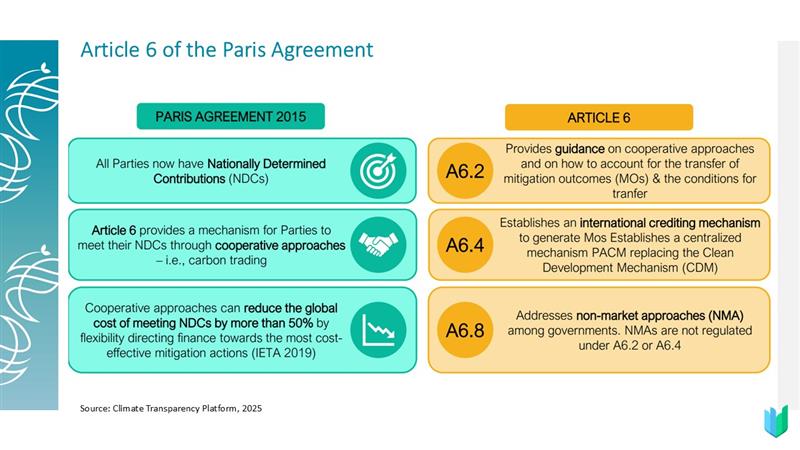
A dedicated segment focused on the international regulatory framework, with a clear explanation of Article 6 of the Paris Agreement. The speakers outlined how Article 6.2 enables cooperative approaches and bilateral trading of mitigation outcomes, while Article 6.4 establishes a UN-supervised crediting mechanism. Article 6.8 focuses on non-market approaches for international cooperation. The close link between these mechanisms and countries’ nationally determined contributions (NDCs) was emphasized, the need for strong institutional frameworks, enabling policies, and robust monitoring, reporting, and verification (MRV) systems.
Supply–demand dynamics were also discussed. The supply side includes international crediting mechanisms, government-led crediting schemes, and independent standards, while demand is driven by domestic compliance requirements, international compliance mechanisms, NDC achievement, and voluntary corporate demand.
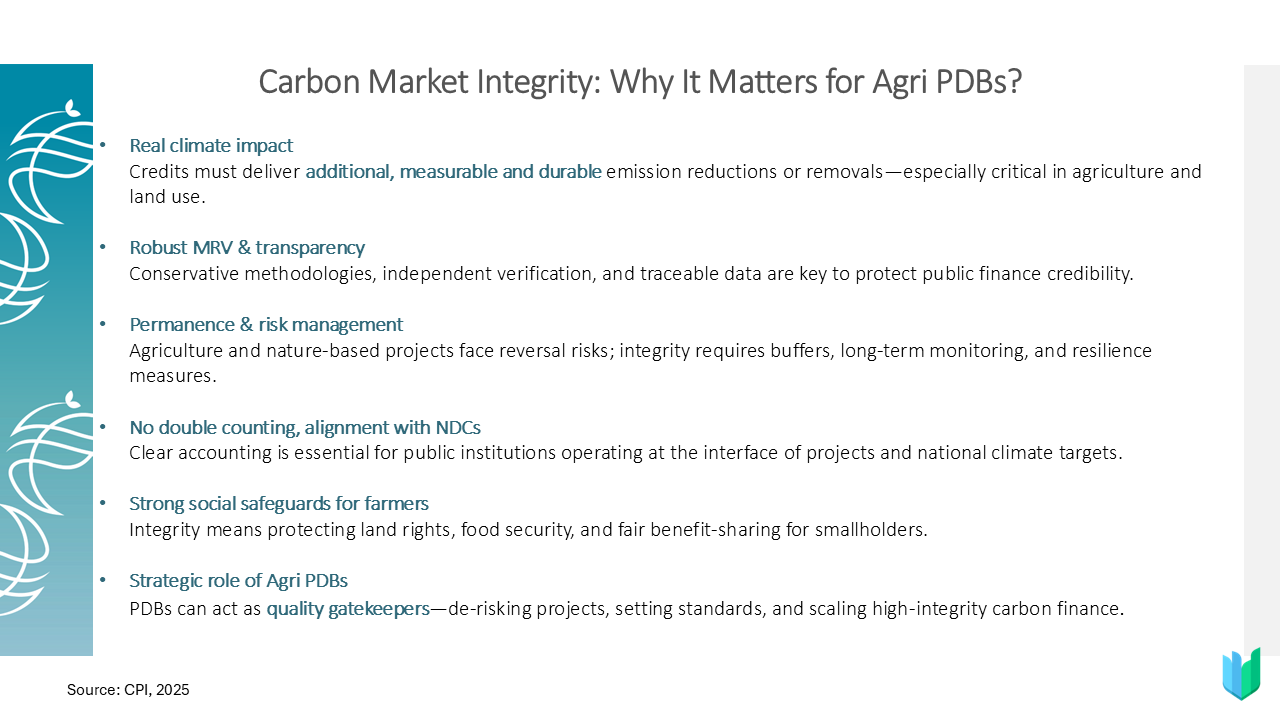
Integrity and quality emerged as central themes throughout the discussion. Key integrity elements highlighted included real climate impact, robust MRV and transparency, permanence and reversal risks, avoidance of double counting, and social safeguards and benefit-sharing mechanisms. Recent initiatives aimed at strengthening market integrity were discussed, including the ICVCM Core Carbon Principles and VCMI codes of practice, designed to reinforce confidence on both the supply and demand sides. Market trends were also examined, noting recent volatility in voluntary carbon markets and a growing emphasis on high-quality, high-integrity credits.
The role of public development banks was discussed in depth. PDBs were positioned as “system enablers” that can help make agricultural carbon projects more bankable, scalable, and credible, particularly by reducing risks on both the project development side and the buyer or investor side.
Live polling showed that participants see de-risking carbon projects and mobilizing finance as the most immediate opportunities for PDB engagement. At the same time, participants identified key constraints, including limited technical capacity, regulatory uncertainty, and a lack of bankable financing structures.
The speakers highlighted several relevant roles for PDBs in carbon markets. These include providing strategic guidance aligned with national climate strategies and NDCs; offering technical assistance and readiness support, such as MRV capacity-building and project preparation; supporting market design and integrity through clear methodologies, safeguards, and risk management; de-risking projects and mobilizing private finance through familiar financial instruments; and facilitating knowledge sharing to strengthen internal capacity and support client decision-making.
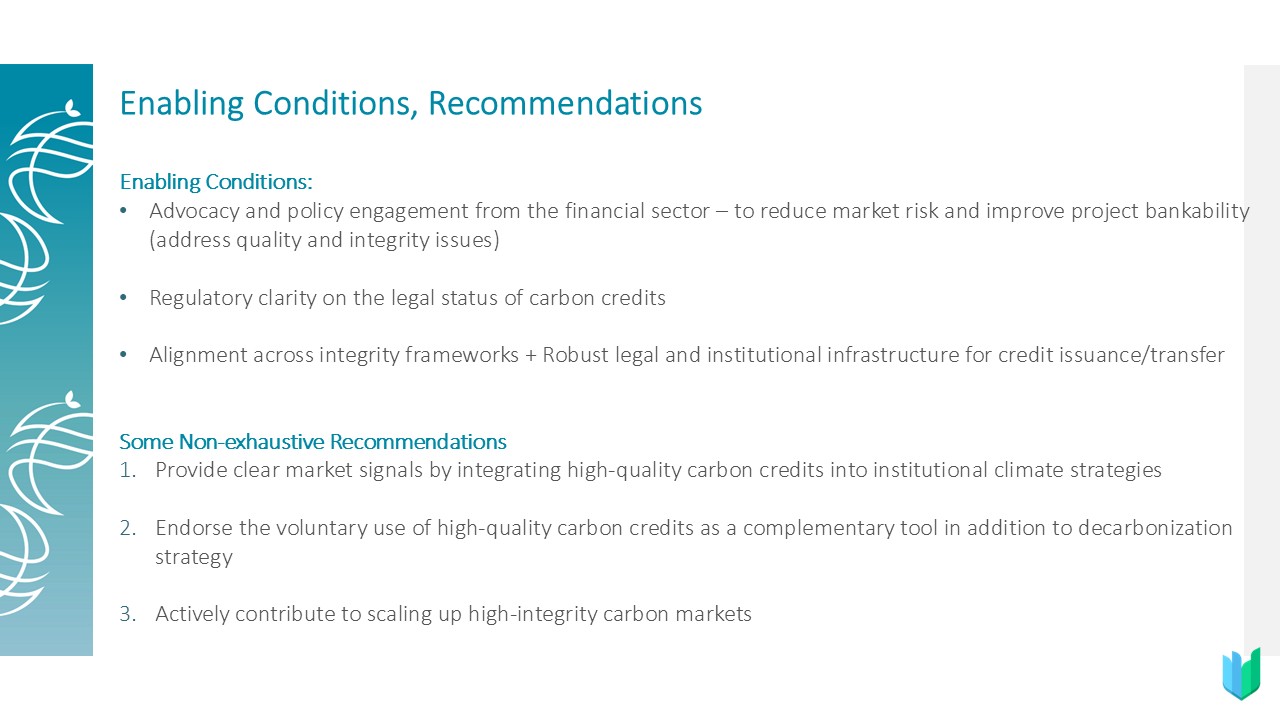
Key takeaways and recommendations
Toward the end of the session, the panel emphasized enabling conditions for PDB engagement in carbon markets and shared three key recommendations.
Q&A
The Q&A session was lively and highly practical, helping to shape priorities for future webinars and reflecting strong interest from participants across regions and institutions.
- La Banque Agricole (Senegal) asked whether concrete examples of agricultural carbon credit projects, particularly in Africa, could be shared. The speakers confirmed that such projects exist and noted that region-specific examples will be explored in more detail in the next session.
- Inter-American Institute for Cooperation on Agriculture (Costa Rica) raised questions about financial returns, including the potential return on investment for PDBs and how value is distributed along the carbon value chain, especially for farmers and ranchers. The speakers noted that outcomes vary widely depending on project design, but emphasized that integrity, quality, and benefit-sharing mechanisms are critical to ensuring real economic and climate benefits.
- Fund for the Financing of the Agricultural Sector (Colombia) asked whether carbon markets can support projects with long-term mitigation outcomes, such as silvopastoral systems where sequestration becomes visible only after several years. The speakers explained that instruments such as pre-purchase and offtake agreements already exist, and that contractual design, safeguards, and risk management are essential. This was highlighted as an area where PDBs can play an important de-risking role.
- Agricultural Finance Corporation (Kenya) asked where intermediary PDBs should start when engaging in carbon markets. The response emphasized the importance of clarifying whether engagement is through voluntary markets or Article 6 mechanisms, conducting initial assessments, and positioning PDBs early in project origination, design, and stakeholder coordination.
- Productive Development Bank (Bolivia) raised questions on how carbon mechanisms address financial, social, and implementation risks, particularly for Indigenous Peoples, and how benefit-sharing mechanisms ensure transparency and equity. The speakers noted that new methodologies and safeguards are emerging and that this topic will be explored further with concrete project examples.
Next steps
The session concluded by confirming a follow-up webinar planned for April. This next session will move from global frameworks toward more operational, project-level discussions, including concrete project examples, financing structures, and practical entry points for PDBs in agricultural carbon markets.
To access the slides and recording, please click here:
More resources:
- Climate Transparency Platform, 2025. Introduction to Article 6
- CPI, 2025.Role of Public Development Banks in Supporting Domestic Carbon Markets
- FAO, 2025. Agrifood systems in the voluntary carbon market: Status and prospects
- VCMI, 2025. Catalyzing Carbon Markets: The Role and Opportunity for Financial Institutions
- WB, 2025. States and Trends of Carbon Pricing
- New Carbon Market Rules Recognize Community Rights – Namati
- Comparative study of carbon rights in the context of jurisdictional REDD+
- Verra Launches Version 5 of the VCS Program – Verra
Contacts:
- Ivano Assenza (Ivano.assenza@fao.org)
- Elena Marchetti (Elena.marchetti@fao.org)
- FAST-PARTNERSHIP@FAO.ORG
Similar articles