

Financing Nature-Positive Agriculture: What Public Development Banks Can Do. IFAD and Agri-PDB Platform Learning Event.
IFAD and the Agri-PDB Platform explore how Public Development Banks can finance nature-positive agriculture through practical tools, partnerships and case studies.
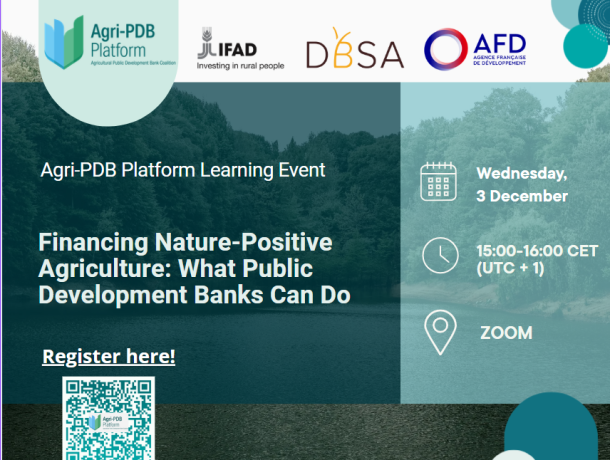
IFAD and Agri-PDB Platform Learning Event: Financing Nature-Positive Agriculture: What Public Development Banks Can Do
3 December 2025 | Rome, Italy
Introduction
Building on our last session on agroecology, in this session we look at how public development banks can finance nature-positive agriculture. Agroecology is one of the key pathways within nature-positive agriculture, and this presentation shows how PDBs can translate these and other wider nature-positive practices into concrete lending strategies as well as steps to reduce risks to biodiversity as part of agricultural investments. Held online on 3 December 2025 and organised by the Agri-PDB Platform and the Biodiversity team in IFAD, this first webinar of the new biodiversity series explored how Public Development Banks (PDBs) can accelerate the shift towards nature-positive agriculture. The session gathered representatives from IFAD, the French Development Agency (French: Agence française de développement, AFD), Development Bank of Southern Africa (DBSA), and the Brazilian Development Bank (BNDES) to share practical approaches, tools and financial mechanisms for integrating biodiversity into agricultural lending.
Background
Opening the session, Agri-PDB Platform stressed that nature-positive agriculture is now one of its core priorities, given its importance to food security, soil health, water quality and climate resilience, building on earlier discussions on agroecology.
Matthieu Le Grix (AFD) highlighted the AFD’s commitment to mobilising at least €1 billion annually for biodiversity and presented its OECD Development Assistance Committee criteria (DAC) aligned biodiversity rating and quantitative accounting systems. AFD supports agroecological and biodiversity-positive practices through a pragmatic and progressive approach, recognising that transitions require context-appropriate pathways. Its approach is guided by a structured framework—available in English, French and Spanish—that categorises projects according to their level of contribution to agroecological transition and biodiversity objectives. (See documents below). AFD also underscored the need for practical monitoring tools, showcasing the ABC Map developed with FAO, and noted ongoing work to align operations with the Global Biodiversity Framework (GBF). In practice, AFD works closely with national public development banks to translate these principles into operational tools. One example is the long-term partnership with FIRA (Mexico), aimed at transforming agricultural practices, fostering green and sustainable investment projects, and strengthening the institution’s capacity to serve rural areas vulnerable to climate and socio-economic pressures. This partnership combines credit lines (over USD 140 million in the last decade), technical assistance grants, and investment grants to create financing conditions that encourage agroecological adoption. Another example is the collaboration with Crédit Agricole du Maroc (CAM), which focuses on investments that improve water management, energy efficiency and organic farming—key levers for both agroecology and biodiversity protection.
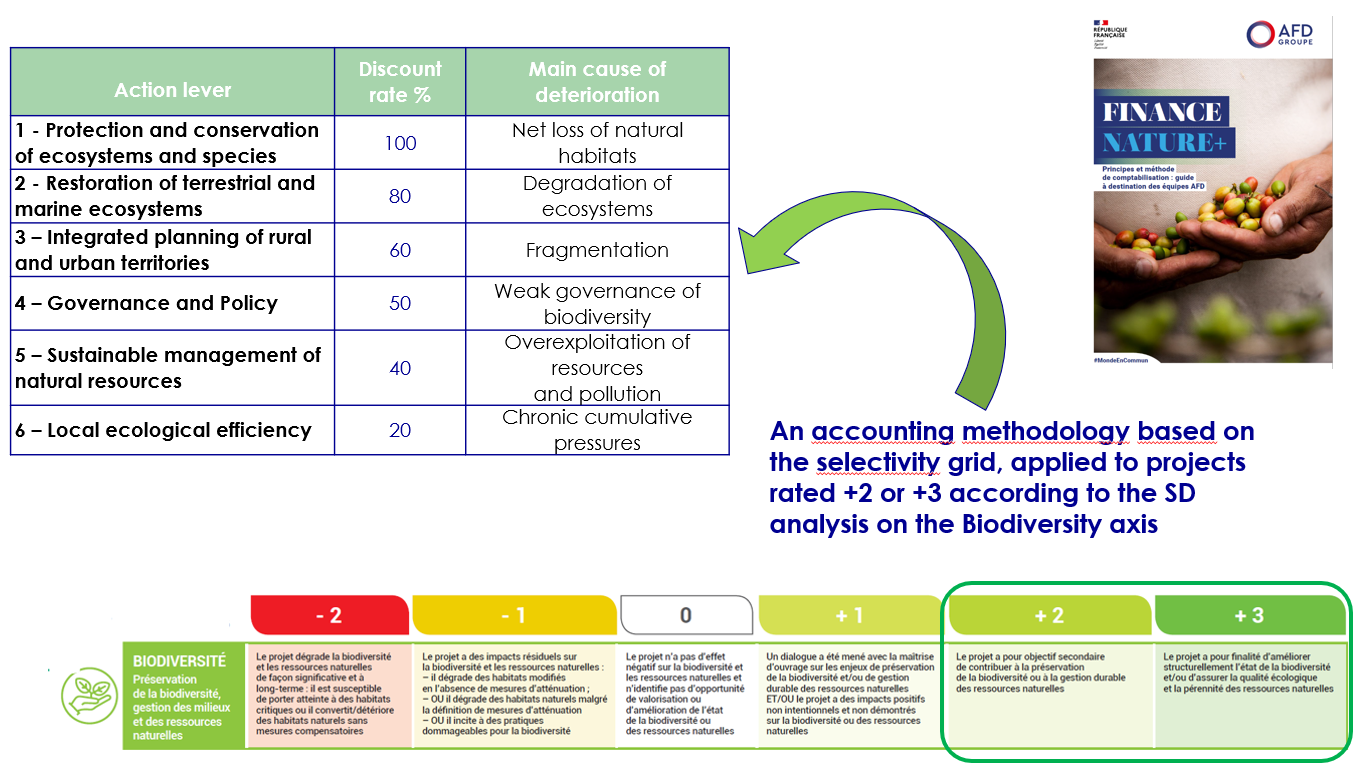
Source: AFD – Nature + Finance methodology
To read more about AFD’s approach to Nature+ Finance, see Nature+ Finance: Principles for Tracking Biodiversity and Nature-Positive Finance.
To read more about AFD’s approach to integrating the agroecological transition into AFD-funded projects, please click here.
Why Biodiversity Matters for Public Development Banks?
Marie-Aude Even (IFAD) highlighted that biodiversity underpins essential agricultural functions—from soil health and water regulation to climate resilience—and that its degradation creates direct financial risks for farmers and lenders. For PDBs, she noted, investing in biodiversity can lower credit risk, diversify portfolios, align with policies and open access to blended climate and partnership–nature finance and international partnerships. Beyond risk management, nature also offers, investing in nature presents tangible and compelling economic returns across levels. At farm level, agrobiodiversity contributes around USD 150 billion annually to productivity and innovation. Along the value chain, the bio-inputs market is projected to triple to USD 22 billion by 2033, helping unlock premium markets and partnerships. At the ecosystem scale, the returns are equally striking: every dollar invested in restoration can generate USD 7–30, with mangrove restoration delivering over USD 65 billion, while nature-based solutions could create around 50 million jobs by 2030. From a climate perspective, investments in nature can boost adaptive capacity by 40–60% and provide a direct entry point into growing climate finance markets.
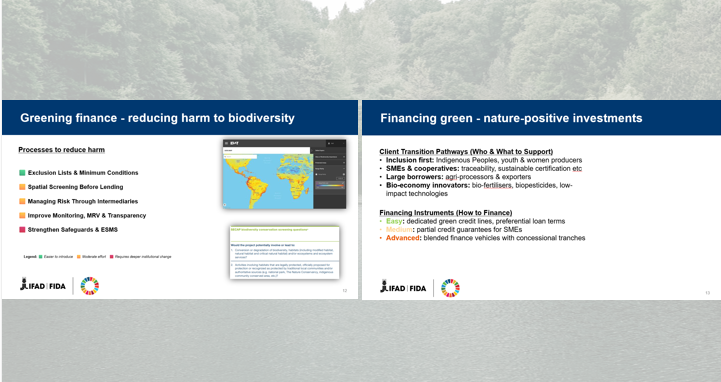
Matthew Mather (IFAD) then outlined practical pathways for integrating biodiversity into PDB operations. Using irrigation as an example, he showed how banks can build on traditional agriculture and climate-smart investments, which banks will likely be investing in, to deliver i) on-farm biodiversity benefits (quick wins such as hedgerows along irrigation canals; and ii) ecosystem benefits (protecting wetlands and natural recharge areas, requiring landscape-wide coordination).He emphasised the two complementary ways PDBs can integrate biodiversity into their operations by financing green (reducing harm to biodiversity in their portfolios) and greening finance (scaling nature-positive investment). On greening finance, this includes measures such as including biodiversity in exclusion lists, using spatial tools like ABC Map, strengthening monitoring through remote sensing, and embedding the mitigation hierarchy within ESMS.
For financing green, Matthew highlighted a spectrum of financial instruments, ranging from easy to advanced, to support smallholders, SMEs and bioeconomy actors: At the simplest end, PDBs can introduce green credit lines and preferential loan terms. At an intermediate level, they can deploy partial credit guarantees to de-risk investments for SMEs. At the most complex level, they can structure blended-finance vehicles with concessional tranches. He concluded by describing PDBs as system integrators, responsible for:
- Building pipelines of bankable nature-positive projects;
- Blending public and private capital to reduce risks;
- Bundling finance with technical assistance and market access.
PDB Experiences – DBSA and BNDES
Development Bank of Southern Africa (DBSA)
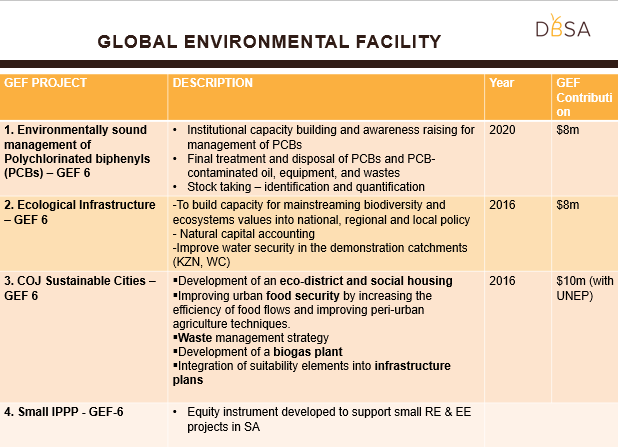
Mookho Mathaba (DBSA) underlined its innovative efforts in developing nature-based solutions through projects that combine biodiversity and infrastructure. DBSA highlighted initiatives such as integrating natural resources—including water—into pricing and tariff systems through nature capital accounting, and programmes to remove alien invasive species to preserve water bodies. Two examples were presented: the construction of a dam designed in parallel with wetland conservation measures to ensure long-term ecological sustainability, and a stormwater drainage project that leverages natural water-absorption capacities to reduce the need for costly grey infrastructure. Additional models showcased how timber production can be blended with conservation to generate stable revenues, alongside infrastructure designs that systematically incorporate wetland protection and nature-based stormwater management. Collectively, these initiatives illustrate DBSA’s commitment to advancing biodiversity-positive investments while balancing financial returns with emerging biodiversity credit opportunities.
BNDES (Brazil)
Nabil Moura Kadri presented BNDES’s long-standing biodiversity agenda, which has evolved from the creation of the Amazon Fund in 2009 to the Atlantic Forest Initiative and the new Ecological Restoration Programme launched in 2025. He explained that BNDES supports two main types of forest restoration—ecological restoration focused on conservation outcomes, and agroforestry models aimed at productivity and livelihood generation. Each year, the bank allocates part of its profits (around USD 100 million) to a social-environmental fund used to finance projects through non-refundable grants and blended finance structures. BNDES also partners with private-sector actors to mobilise resources, select field projects and ensure effective implementation, complemented by access to low-cost national climate funds with interest rates as low as 1% per year.
The Sertão Vivo programme, developed jointly with IFAD, GCF and BNDES, was highlighted as an example of incentivised green lending. Kadri stressed lessons learned, notably the importance of understanding the business models of enterprises that depend entirely on nature, ensuring they are economically—not only ecologically—viable, and integrating supply chains to secure long-term sustainability. The bank is also working on new guarantee instruments and better coordination of loans and grants to make financial instruments more complementary. Across Brazil’s biomes, BNDES continues to support forest conservation and restoration, socio-biodiversity value chains and sustainable production systems, in alignment with the 2 goals of the Kunming-Montreal Global Biodiversity Framework.
To access all BNDES’s initiatives on forest-related programmes, please click here.
To learn how BNDES is aligning with the 22 goals of Kunming-Montreal Global Biodiversity Framework (BNDES’s Commitment to Nature), please click here.
Key Lessons for Public Development Banks
- Embed biodiversity into financial decision-making.
PDBs can start with simple, low-cost actions—such as basic biodiversity screening, exclusion lists and climate-aligned agronomic practices—while progressively moving towards more advanced tools, including enhanced monitoring, TNFD-aligned reporting and blended finance instruments.
- Scale nature-positive investments through integrated support.
Financing alone is often insufficient; combining credit with technical assistance, guarantees and concessional or blended facilities is critical to reduce risk and support transition.
- Strengthen cooperation across the ecosystem.
Effective nature-positive finance requires closer collaboration between PDBs, MDBs, governments, the private sector and farmers to co-develop viable and context-specific business models.
- Build the business case for nature-positive agriculture.
Speakers stressed the importance of demonstrating economic viability, particularly for enterprises and value chains that depend entirely on natural capital, to ensure long-term sustainability and bankability.
- Address nature and climate together.
Nature and climate must be addressed together. Speakers highlighted that nature-positive agriculture improves climate resilience, water security and long-term loan performance, making biodiversity integration a core risk-management tool rather than an added burden.
Challenges and Limitations
The polls conducted during the webinar indicate that most participating PDBs are still at an early stage of integrating biodiversity into their operations. Respondents included FIRA (Mexico), Banrural (Guatemala), FINAGRO (Colombia), BDP (Bolivia), DFC (Belize), UDB (Uganda), BAGRI (Niger), CDCB (Benin), BAAC (Thailand), ADBC (China), as well as European partners such as AFD and CDP (Italy). The main challenges identified were limited technical capacity, data and analytical gaps, and the absence of clear mandates, with capacity constraints most pronounced among African PDBs and instrument-related gaps more common in Latin America. Overall, the results point to a clear need for practical tools, targeted capacity-building and continued peer exchange to help PDBs move from interest to implementation.
In addition to the banks that responded to the webinar polls, the session brought together a broad group of Public Development Banks from across regions, including CAM (Morocco), BFA (El Salvador), ADBZ (Zimbabwe), LBP (Philippines), MAIIC (Malawi), BNDES (Brazil), NDB (Botswana), Land Bank (South Africa), BDMG (Brazil), BNDA (Mali), CEDA (Botswana), BDC (Botswana), DBS (Seychelles), LNDC (Lesotho), BFP (Nicaragua) and BAC (Colombia).
Conclusion
The webinar reaffirmed that nature-positive agriculture is both a necessity and an opportunity for PDBs. Achieving it requires a progressive approach, practical tools, flexible financial products and strong partnerships. The Agri-PDB Platform will continue this biodiversity series in 2026, deepening the technical and operational dialogue with its members. AFD also emphasised that linking biodiversity-positive investment with reduced portfolio risk is essential to making these approaches viable for PDBs.
Click here to access the webinar recording and slides.